Friday, September 20, 2013
Digital Humanities Roundup
IN THE print edition this week we look at “Kindred Britain”, an amazing digital humanities website that traces relations between 30,000 British people. Is it possible to resist frittering away hours in front of the computer screen while examining the remote relatives of George Washington (originally British, of course) or the literary friendships of Mary Shelley?
The project harnesses data about the ties among people in an innovative way. Historical individuals are presented as dots connected to each other on a network map. Colour-coding suggests how figures are linked, say, by marriage or profession. Rolling over the dots brings up a wealth of information about the people. A scrolling timeline across the bottom of the site lets users skim through the ages. A map of the world lets people scan by geography.>>>
"Rutgers to Host Lecture on Emerging Field of Digital Humanities," Rutgers Today, September 12, 2013
As the humanities continue to integrate computer technology and traditional methodologies, the evolving field of digital humanities signals a future of unlimited research implications. With this evolution, scholars invariably face the challenges of understanding, utilizing and incorporating these latest technological advances into their respective disciplines. Thanks to an informative lecture at Rutgers–Camden, these issues will begin to get a little clearer – byte by byte. [7 p.m. to 9 p.m. on Monday, Sept. 30.]>>>
Monday, May 20, 2013
Size Matters?
![]() |
| "Length of the average dissertation," from FlowData. |
When I made a snide remark about length on Facebook, my historian friends jumped to the defense of 325 page dissertations as the necessary length for a monograph. Other fields publish articles rather than books. Thus, the argument went, they can get away with less. This perplexed me. A doctoral dissertation no matter the field should demonstrate an original contribution to knowledge, right?
Wednesday, March 20, 2013
The Sequester Hits History
![]() |
| Harry S. Truman's farm home in Grandview, Missouri |
But as of March 24, Truman’s old white-board home in Independence (which he far preferred to the other White House he lived in, dubbing the latter, “the great white jail”) will be closed on national holidays, Sundays and Mondays. The Noland house across the street, which once belonged to Truman’s cousins, is being shuttered for good. And though visitors can still mosey around the grounds of the family farm in Grandview, Missouri, they’ll no longer be able to tour the house.
Wednesday, March 6, 2013
The Society for US Intellectual History: An Interview
Friday, March 1, 2013
Mapping the Past Roundup
![]() |
| The route of Lincoln's funeral train |
A group of graduate students at Emory University specializing in digital research in the humanities have created a new website that uses digital tools to analyze and compare the text of sermons delivered after Abraham Lincoln's assassination.
Their project uses various digital text tools to map geographic and thematic patterns in the collection of 57 sermons, which reside in the Manuscript, Archives and Rare Book Library of Emory's Robert W. Woodruff Library. The scholars are calling their project "Lincoln Logarithms: Finding Meaning in Sermons" and they hope it will become a model for the next wave of research in the humanities.>>>
Max Fisher, "A surprising map of the world’s national holidays (only two countries have no national day)," Washington Post, February 26, 2013
This map, inspired by a Reddit thread with a similar map, shows the national days of the world’s countries. As you can see, the world is mostly divided between countries that celebrate a national independence day and countries that celebrate a national unification or revolution day. The outliers are a tiny minority, and only two countries have no formal national day at all.>>>
Thursday, November 8, 2012
Humanities and Social Sciences under Fire in Florida
In the coming days Florida Governor Rick Scott’s Blue Ribbon Task Force on State Higher Education Reform will submit its final report. At its center are recommendations that state-determined “accountability” metrics shall determine university funding and that Florida adopt a new funding model of differential tuition rates that favor “strategic programs” (mostly science, technology, engineering, and math, STEM disciplines) also to be determined by the state legislature. Students will potentially pay much higher tuition rates for "non-strategic programs" (mostly humanities and social sciences).
A group of concerned faculty from the Department of History at the University of Florida has drafted a letter to Governor Rick Scott opposing the task force’s recommendations and calling on him to incorporate faculty input into reforms to the state university system. (See the petition here.)
For more, see:
Jordan Weissmann, "Should Science Majors Pay Less for College Than Art Majors?" Atlantic, November 5, 2012
Elizabeth Popp Berman, "More STEM Majors Won’t Solve Higher Education’s Problems," Chronicle, November 1, 2012
William A. Link, Richard J. Milbauer Professor, History Department, University of Florida
Monday, March 19, 2012
Superabundance
.
NPR recently aired a story on the tower of 7,000 Abraham Lincoln-centered books (they’re actually replicas and amount to roughly half of the 15,000 total Lincoln volumes in existence) that now extends 34 feet above the floor of Ford's Theatre in Washington, D.C. It’s an arresting sight, a soaring tribute to our most important
president and the historians who have written about him.
What this immense stack portends to a graduate student considering a career in Lincoln studies, I can only dimly fathom. It’s worth noting that there was no foundation of journal articles here; just books. Most of us won’t have reason to find the Lincoln book tower so daunting. We spend our professional lives erecting theses upon much less imposing and much more manageable stacks of historiography.
Still, the Lincoln Tower heralds an increasingly universal condition among historians that we might term superabundance. The problem derives from the formidable supply of primary sources—thanks to Google Books and other online repositories of historical texts—as well as our output of monographs, journal articles, and dissertations. As a result, what often makes historical research challenging today has less to do with the scarcity of primary sources or their geographic dispersal than the mini-towers of primary and secondary sources that we need to sort through on our way to an original argument. Superabundance is a first-world-type problem in that it mainly afflicts the comfortable and its direct consequences, which may include regular bouts of ennui, are far from catastrophic. Still, it’s an “issue,” as Americans like to describe their non-fatal maladies.
Historians aren’t alone in confronting the scholarly challenges posed by superabundance. Nearly every other academic field is afflicted by its own prodigious production. In a 2009 issue of Chronicle of Higher Education, Mark Bauerlein reported that “[f]rom 1986 to 2008, Wordsworth collected 2,257 books, chapters, dissertations, etc. Faulkner came in at 2,781, Milton at 3,294, Whitman at 1,509, Woolf at 3,217, and Shakespeare at 18,799.”
No doubt many thousands of illuminating volumes on Lincoln and Shakespeare are yet to be written. But how many more—and at what rate? This is the weightier question posed by our own scholarly superabundance. The good embodied in that indomitable stack of Lincoln volumes is not the profit that some ideal reader might reap from digesting every single one of them, because no sane person would—and certainly not a person who hoped to ever write anything themselves. Moreover, and this warrants more than passing mention, only a handful of libraries can now afford to own more than a fraction of the total.
Recognizing that humanities research contributes a great deal to the public good and that every teaching historian should have extensive and regular experience with it, would higher education be any worse if only 2000 works on Lincoln were produced over the next decade, as opposed to 2500? Would our public culture suffer? Over the last three years or so, Mark Bauerlein has been unsettling Chronicle readers with questions of just this sort. In particular, he asks: Might there be diminishing marginal returns in humanities scholarship? And might the sheer volume of this production bury high quality work under a heap of scholarly mediocrity?
Last May, Stephen J. Mexal countered Bauerlein with a stout defense of research quantity, arguing from the twin premises that 1) “we cannot know in advance which projects will matter, or in what way. The easiest way to account for this uncertainty is to produce as much work as possible and let the future worry about quality or utility” and 2) the peer review process is indefinitely scalable and “a larger community of active scholars means a stronger, more democratic community of ‘peers’ to perform the valuable work of peer review.” (For another astute consideration along these lines—comparing scholarly projects to the risks inherent in new business enterprises—see Johann Neem’s post, “The Value of Useless Research.”)
Mexal and Neem make a convincing case for generous funding of a wide-range of humanities research, which I’m pretty sure Bauerlein also favors. But Bauerlein’s argument is really about priorities. It assumes a resource-neutral environment in which the superabundance represented by the tower of Lincoln books is not a reason to halt, or even significantly curtail research, but simply to reevaluate our priorities as scholars and teachers. Perhaps wary of too close an association with market economics, Bauerlein calls it “redistribution.” What he’s really pointing to is the need for a realignment of incentives. It boils down to this: If we’re going to improve the quality of higher education and expand its impact, we may need to reward interaction with students more generously and reward individual research quantity less so.Monday, December 26, 2011
The Classics in Crisis
Over at the NYRB Mary Beard worries that when it comes to the future of the classics "the basic message is a gloomy one." ("Do the Classics Have a Future?" January 12, 2012.) With some horror she writes that "Literally hundreds of books,
Beard turns turns questions about decline back on themselves. "What drives us so insistently to examine the 'state' of the classics," she wonders, "and to buy books that lament their decline?" In Beard's view, notes about decline tell us as much about what people think about the classics and what they think about their own era. Reports "on the decline of the classics are not commentaries upon it, they are debates within it: they are in part the expressions of the loss and longing and the nostalgia that have always tinged classical studies." We see our own predicament and the direction of history in the study of the ancients.
In the end, she offers a good defense for the humanities by way of the classics. (Her argument is not unlike those made by Anthony Grafton and others in the NYRB.) "The important cultural point is that some people should have read Virgil and Dante," concludes Beard. "To put it another way, the overall strength of the classics is not to be measured by exactly how many young people know Latin and Greek from high school or university. It is better measured by asking how many believe that there should be people in the world who do know Latin and Greek, how many people think that there is an expertise in that worth taking seriously—and ultimately paying for."
Monday, June 6, 2011
What's the Point of College?
If you haven't already checked it out, have a look at Louis Menand's New Yorker essay, "Live and Learn: Why We Have College," June 6, 2011. The Pulitzer Prize-winning intellectual historian and Harvard professor considers the changing nature of college in recent years and the various ideals that have shaped higher ed. He also discusses several books that take stock of the situation.
Are we in the midst of a major change in higher education? Says Menand:The system appears to be drawing in large numbers of people who have no firm career goals but failing to help them acquire focus. This is what Arum and Roksa believe, anyway. Students at very selective colleges are still super-motivated—their motivation is one of the reasons they are selected—and most professors, since we are the sort of people who want a little gold star for everything we do, still want to make a difference to their students. But when motivation is missing, when people come into the system without believing that what goes on in it really matters, it’s hard to transform minds.
If there is a decline in motivation, it may mean that an exceptional phase in the history of American higher education is coming to an end. That phase began after the Second World War and lasted for fifty years. Large new populations kept entering the system. First, there were the veterans who attended on the G.I. Bill—2.2 million of them between 1944 and 1956. Then came the great expansion of the nineteen-sixties, when the baby boomers entered and enrollments doubled. Then came co-education, when virtually every all-male college, apart from the military academies, began accepting women. Finally, in the nineteen-eighties and nineties, there was a period of remarkable racial and ethnic diversification.>>>
Tuesday, May 31, 2011
Notes from Grad School: The Last Professors
In a 2010 review of Frank Donoghue’s book The Last Professors, D.R. Koukal mentioned that while reading it he had several pangs of survivor’s guilt, as a member of the “dwindling community” of tenured humanities professors. This is an
interesting sentiment, which could open a lively discussion on the role of tenured faculty in the change facing the educational system, but that’s a topic of a future post. Donoghue resists the idea that this is a new crisis. He calls attention to the historical griping of business magnates like Carnegie, Birdseye, and Crane against the academy, and to F.W. Taylor’s claim that progress happens only when people use “originality and ingenuity to make real additions to the world’s knowledge instead of reinventing things which are old.”Donoghue also questions assumptions regarding the traditional bundle of activities that go with being a professor. Among these are the beliefs that, “professors are authors,” that “our scholarship determines our relative prestige,” and that “scholarship is integrally related to teaching.” Donoghue suggests that “the typical academic monograph sells 250 copies and goes largely unread, except in institutional venues of evaluation.” He suggests this element of academic work is a product of the quest for tenure, and that once this goal is acquired many professors lose interest in research. It might be fruitful for grad students like myself to try to "unbundle" the various aspects of our chosen profession, ask ourselves which of them we really want to focus on, and then pursue opportunities that match. We might even find that the traditional system is not the ideal solution, which might alter our perspective on the prospect of change.
“Any meaningful debate about tenure,” Donoghue says, “has to start with the fact that it is slowly but surely disappearing, and the current workforce in higher education is unwittingly hastening its extinction.” But when he says the current workforce, Donoghue does not mean just tenured professors. “Tenured and tenure-track professors currently constitute only 35% of college teaching personnel” in America, he says, and “this number is steadily falling.” Non tenure-track instructors are part of this workforce, and “In no other workforce is there such a wide disparity, both in income and in day-to-day life, between groups of people whose jobs are, in part at least, so similar,” he says. Donoghue notes that the use of adjunct faculty varies widely: “at Stanford, 6.4% full-time faculty members are off the tenure track, while at Harvard the figure is 45.4%. One pattern, though, is indisputable: those sectors of higher education that are currently expanding at the fastest pace–community colleges and for-profit institutions–are most resistant to the idea of a tenured faculty. Nationwide, 65% of the faculty at two-year institutions are part timers, and 80% are not on the tenure track.” These are scary numbers, viewed from Donoghue's perspective. But what is it like to teach in a place without tenure if your dream was to teach? What is it like to work in a place without such a rigid, caste-like disparity between roles?
Donoghue describes what he terms for-profit universities as, at best, vocational and professional training institutes, and at worst, mere degree-mills capitalizing on the wage disparity between holders of high school and college diplomas. He quotes a memo from a manager at a for-profit university, assessing the team of instructors based on student evaluations: “most of you do an excellent job . . . if you score below 4.0–I will be talking with you directly. We cannot retain instructors with scores in the 3.0 range. Have a good day!” Although this message is a bit brutal, as Donoghue says, it also seems to underscore an issue of accountability he is less enthusiastic about addressing. He chides the University of Phoenix for granting an MBA to Shaquille O’Neal, but does not seem equally concerned with the weekend “executive MBAs” granted by prestigious academic institutions. Donoghue criticizes the financial performance of these for-profit universities as well as their mission, as if there is no thought of profit (financial or otherwise) at traditional institutions. “They focus on the tight relationship between curriculum and job preparation and the appeal primarily to the older, working adults who are steadily becoming the typical American college student,” he says. But do we really want to be opposing working people who give up their leisure time, in order to try to make a better life for themselves and their families?
Donoghue seems to view the question of why undergraduates go to college as a battleground where the humanities must overturn students’ (and administrations’) market calculations. In the future, he suggests “the BA and BS will largely be replaced by a kind of educational passport that will document each student’s various educational certifications from one or several
schools, the credentials directly relevant to his or her future occupation.” But “this will not be the whole picture. Like American society as a whole, with its widening gap between haves and have-nots, America’s universities will grow increasingly stratified. The elite, privileged universities and colleges will continue to function much as they do today, championing the liberal arts and the humanities and educating the children of the elite and privileged for positions of leadership . . . the gulf between these elite universities and institutions that educate everyone else will widen in new ways that will complicate our efforts to define both the idea of higher education and the concept of access to higher education.” While the "educational passport" at first seems like a utilitarian instrument for meeting job requirements, the idea it contains of a lifelong process of education, belonging to the student and portable between schools, has a certain appeal. In addition to a BS and an MA, for example, I hold several certifications, including an NASD principal's license and a UNIX System Administrator's certification from a Tier-1 University's technical night-school. If access to elite institutions does become more limited, flexible and effective educational options for the rest of us will become more important than ever.The Last Professors presents a series of facts that are interesting and surprising. For example, “nearly 80% of the total PhD’s in the country are awarded by just 133 universities. This is a staggering imbalance, as those…universities make up a tiny fraction–less than 2%–of the 3,500 traditional institutions of higher learning in the country and only one fifth of all institutions that grant PhD’s.” Donoghue also notes that there were “a record 17.3 million students enrolled in college in 2004, up 28% since 1991. Enrollment is expected to increase another 11% by 2013. The image of an 18 to 20-year-old, full-time student in residence at a traditional college, however, is now a figment of the past; only 16% of all undergraduates now fit that profile. Today, the majority of students are over the age of 25, as compared to just 22% in 1970.” Clearly the game is changing, and grad students should begin to think about and act on these changes. Donoghue suggests there are two main things that tenured professors can do to improve their situation. First, they must challenge the main corporatist tenet, “the assumption that a practical, occupation oriented college education leads to a secure job and thus it is crucial to improving one’s quality of life.” The second action that humanists need to take, he says, is to “balance their commitment to the content of higher education with a thorough familiarity with how the university works.” Donoghue suggests tenured professors (and those who want to be tenured professors) “need to resist the tendency to romanticize our work,” and need to better understand the real distribution of work at a university, and the causes and likely effects of this distribution. While I think this is a good suggestion, the pool of tenure-track opportunities is drying up without a corresponding decrease in the number of new PhDs (see graph from 2010).
Some of us may need to think about finding new ways to do what we love, rather than just elbowing our way to the front of the queue. And the prospect of drawing a line in the sand and trying to argue against the vocational goals that bring so many students to higher education seems misguided. The claim that undergraduates have to choose between academic purity and a degree that will help them get ahead in the world sets up a confrontation the humanities cannot win. And it flies in the face of experience, since in many places, the humanities have found at least a relatively safe haven in their role as a vital complement to job-preparation and a key to general education.
Saturday, April 30, 2011
"Will this be on the test?" Rough Seas Ahead
A couple weeks ago, William Pannapacker (going by the pen name Thomas H. Benton), offered up his thoughts on "A Perfect Storm in Undergraduate Education" in the Chronicle. He is one of the many Cassandras at the Chronicle, lamenting the state of teaching and the desperate situation in the
humanities. Though, it seems, many academics do believe such prophecies of doom.I just came across Pannapacker's essay. For my money, the most depressing bit has to do with "Declining academic engagement."
Pannapacker writes:
Yikes. . . . I'm not so sure about the extent of this phenomenon. I think the degree of this decline would be very different depending on the institution. Small colleges with limited resources, directional schools (Southwest Central _______ State University), community colleges, and the like certainly suffer from steep grade inflation and lowered expectations. But I can't imagine that the same could be said of America's premier colleges and universities. So, maybe in the future, as a colleague from another school suggested to me, elite schools will stand as islands of excellence and privilege in a increasingly troubled sea of mediocrity.
Monday, March 14, 2011
An Interview with Robert Darnton on the Digital Public Library of America
"Google demonstrated the possibility of transforming the intellectual riches of our libraries, books lying inert and underused on shelves, into an electronic database that could be tapped by anyone anywhere at any time," wrote Robert Darton several months back in the New York Review of Books. "Why not adapt its formula for success to the public good," he asked, "a digital library composed of virtually all the books in our greatest research libraries available free of charge to the entire citizenry, in fact, to everyone in the world?"
Creating a Digital Public Library of America would be no easy task. Certainly there are major obstacles to overcome. The legal matters of copyright and what to do about so-called orphan books would be daunting. Cost, as well, would pose a problem. Yet, says Darnton:
A little over a week ago I sat down with Darnton—award-winning historian, Carl H. Pforzheimer University Professor at Harvard, and director of the Harvard University Library—to discuss plans underway for a Digital Public Library of America (DPLA). Sitting in Darnton's office right next to Harvard Square we discussed the nettlesome issues surrounding the DPLA, what the massive on-line collection might offer, and how such a virtual repository could serve the public. In the two videos embedded here Darnton also considers what this proposed library would mean for scholars in the humanities and history in particular.
The project has deep intellectual roots in American soil. In another essay that Darnton wrote for the New York Review, he reflected on the long history of the idea. "The ambition behind this project goes back to the founding of this country," he remarks. "Thomas Jefferson formulated it succinctly: 'Knowledge is the common property of mankind.' He was right—in principle. But in practice, most of humanity has been cut off from the accumulated wisdom of the ages. In Jefferson’s day, only a tiny elite had access to the world of learning. Today, thanks to the Internet, we can open up that world to all of our fellow citizens. We have the technical means to make Jefferson’s dream come true, but do we have the will?" In the video interview Darnton ponders what is possible now that has never been possible before. The dreams of the Founders, spun out of Enlightenment optimism, could, at least in some ways, be realized today.
Few early Americans spelled out a plan for a "publick" Library as did Benjamin Franklin. His ideals of thrift, self-improvement, volunteerism, access, and the public good are apparent in passages like the following from his Autobiography:
etc., almanacs, ballads, and a few common school-books. Those who lov'd reading were oblig'd to send for their books from England; the members of the Junto had each a few. We had left the alehouse, where we first met, and hired a room to hold our club in. I propos'd that we should all of us bring our books to that room, where they would not only be ready to consult in our conferences, but become a common benefit, each of us being at liberty to borrow such as he wish'd to read at home. This was accordingly done, and for some time contented us.Finding the advantage of this little collection, I propos'd to render the benefit from books more common, by commencing a public subscription library. I drew a sketch of the plan and rules that would be necessary, and got a skilful conveyancer, Mr Charles Brockden, to put the whole in form of articles of agreement to be subscribed, by which each subscriber engag'd to pay a certain sum down for the first purchase of books, and an annual contribution for increasing them. So few were the readers at that time in Philadelphia, and the majority of us so poor, that I was not able, with great industry, to find more than fifty persons, mostly young tradesmen, willing to pay down for this purpose forty shillings each, and ten shillings per annum. On this little fund we began. The books were imported; the library was opened one day in the week for lending to the subscribers, on their promissory notes to pay double the value if not duly returned. The institution soon manifested its utility, was imitated by other towns, and in other provinces. The libraries were augmented by donations; reading became fashionable; and our people, having no publick amusements to divert their attention from study, became better acquainted with books, and in a few years were observ'd by strangers to be better instructed and more intelligent than people of the same rank generally are in other countries.
There were critics in Franklin's day and there are critics of the DPLA now. But, it's encouraging that conversations/debates and planning have begun in earnest!
Friday, March 4, 2011
Digital Humanities Roundup
David H. Rothman, "It's Time for a National Digital-Library System:
But it can't serve only elites," Chronicle of Higher Education, February 24, 2011
President Obama did not use the word "library" in his State of the Union Address, but wittingly or not, he helped the cause by citing digital textbooks as one
justification for American business to expand high-speed broadband coverage. The topic is finally gaining attention in the national news media as well. Peter Svensson, an Associated Press writer, recently delved into the problems of e-books in public libraries today and complained that they are divided among thousands of libraries. "Some branch out there might have a spare copy of The Black Swan," he wrote, "yet I'm stuck in the long line of the local library. One national e-book library would be better." The New York Times ran a feature in January headlined "Playing Catch-Up in a Digital Library Race," describing how other countries have already begun: The National Library of Norway is digitizing its entire collection. The National Library of the Netherlands has started an ambitious digitizing project.>>>Richard J. Alley, "Digital history: New online archive displays vast collections of library's Memphis Room," Commercial Appeal (Memphis), March 3, 2011
If you are interested in a sepia-toned photo of the 1932 graduating class of Central High School or an 1836 letter from William Andusentte of New Orleans to Britton Duke of Germantown regarding cotton prices, you can put on your shoes and button up your coat before heading to the fourth floor of the Benjamin L. Hooks Central Library to see them.>>>
"National Digital Newspaper Program: A partnership between the Library & the National Endowment for the Humanities," Library of Congress
The National Digital Newspaper Program (NDNP), a partnership between the National Endowment for the Humanities (NEH) and the Library of Congress (LC), is a long-term effort to develop an Internet-based, searchable database of U.S. newspapers with descriptive information and select digitization of historic pages. Supported by NEH, this rich digital resource will be developed and permanently maintained at the Library of Congress. An NEH award program will fund the contribution of content from, eventually, all U.S. states and territories.>>>
Josh Hadro, "TRLN Digitization Strategy Advocates Flexible Approach to Intellectual Property Rights of Large Collections," Library Journal, February 24, 2011
Go forth and digitize: so says a recent report from the Triangle Research Libraries Network (TRLN), which urges libraries to make large-scale special collections available online, even if some question about the copyright status of certain elements remains. The TRLN group—which includes Duke University, North Carolina Central University (NCCU), North Carolina State University (NCSU), and the University of North Carolina at Chapel Hill (UNC)—described this strategy in a recently released document, "The Triangle Research Libraries Network's Intellectual Property Rights Strategy for Digitization of Modern Manuscript Collections and Archival Records Groups" [PDF]. The title may be unwieldy, but the underlying idea is simple and appealing: don't let potentially legitimate but vague copyright concerns overwhelm digitization projects of significant scholarly value.>>>
Olivia Parker, "Print books hold their own over digital media," Telegraph, March 3, 2011
. . . . Print books still look unlikely to go out of fashion in the immediate future however, with both adults and teenagers ranking them ahead of news, comics, e-books and magazines as their preferred media.>>>
Tuesday, January 25, 2011
Rarely is the Question Asked: Is Our Professors Teaching? Part III
Guess what? Many college students do not learn analytical and writing skills during the four years they spend in college. Students don't study. Courses are not demanding. Collaborative learning does not work like professors think
or hope it does. . .Or, so argues a new book, Academically Adrift: Limited Learning on College Campuses (University of Chicago Press), by Richard Arum and Josipa Roksa. More and more students--more likely parents--are throwing down the cash for college. But the authors ask: "are undergraduates really learning anything once they get there?"
Last week the Chronicle highlighted Academically Adrift and the authors' controversial findings. (David Glenn, "New Book Lays Failure to Learn on Colleges' Doorsteps," Chronicle, January 18, 2011.) Arum and Roksa tracked 2,000 students at 24 four-year colleges. Thirty-six percent of these students who took the Collegiate Learning Assessment essay test showed no significant improvement from their freshman to senior year.
Arum and Roksa certainly have their critics. The study asked too few questions about collaborative learning, say some. Others say that the study, limited in scope, should not challenge the whole undergraduate enterprise.
But, overall, the findings should give us pause. "Mr. Arum and Ms. Roksa don't see any simple remedies for the problems they have identified," writes David Glenn in the Chronicle. "They discovered more variation in CLA-score gains within institutions than across institutions, and they say there are no simple lessons to draw about effective and ineffective colleges." Still, Glenn points out that business and education programs in Texas colleges require that students "take only a small number of writing-intensive courses." The path of least resistance.
Are students today less likely to major in history when the workload is high and the perceived payoff is so low? ("So I'm going to spend all this time reading primary and secondary works just so I can be unemployed after four years of reading, writing, and reading some more?") Five years ago Robert Townsend noted in Perspectives that: "Information from the latest Department of Education (DoE) report (pertaining to the years 1997–98 to 2001–02) suggests that in the competition for students, history lost ground while the total number of undergraduate students at colleges and universities grew quite quickly." I haven't see more recent data, but I can't help but think that there are fewer majors today then there were 20 years ago.
Perhaps history departments could do a better job of emphasizing the portable skills students learn in the major. Why not stress in clear terms that history trains students to think critically and to write clearly? I have my students read Peter Stearns excellent essay, "Why Study History," for this very reason. They learn that history students gain: "The Ability to Assess Evidence. . . . The Ability to Assess Conflicting Interpretations. . . . Experience in Assessing Past Examples of Change." Stearns ably shows that "Work in history also improves basic writing and speaking skills and is directly relevant to many of the analytical requirements in the public and private sectors, where the capacity to identify, assess, and explain trends is essential." I've also had students read Heather's excellent post on this subject from our blog. She noted: "History is the study of how and why things happen. What creates change in human society? What stops it? Why do people act in certain ways? Are there patterns in human behavior? What makes a society successful? . . . . When you study history, you’re not just studying the history of, for example, colonial America. You’ll learn a great deal about the specifics of colonial America in such a class, of course, but you’ll also learn about the role of economics in the establishment of human societies and about how class and racial divisions can either weaken the stability of a government or be used to shore it up."
Sounds like a cure for the "I-learned-little-in-four-years-of-college" blues.
Monday, January 3, 2011
History Job Market Looks Bleak . . . Again
There is nothing like ringing in the near year with bad news . . . But, here goes.
The history job market is still bleak. (Not really news to anyone, I suppose. We're used to this. It's like watching the film Groundhog Day.) As it stands right now, the number of jobs listed through the American Historical
Association is at a 25-year low.Scott Jaschik reports at Inside Higher Ed: "The reality of radically differing job markets may be especially clear as 2011 begins with disciplinary associations gathering for job interviews at annual meetings and releasing data on the number of available positions." There will be many sad faces at this year's AHA meeting in Boston. (If you are on the market, and would like to improve your odds, see John Fea's interview advice at the Way of Improvement Leads Home and Claire B. Potter's suggestions at Tenured Radical.)
The number of new history PhDs rose to a 9-year high in 2009. You don't need any training in economic theory to know that there's something wrong with that picture. (Speaking of economics . . . the American Economic Association announced that its job listings have recovered from a 21% dip in 2008.)
Could it get worse? Maybe. The Inside Higher Ed piece draws from Robert Townsend's AHA report on the job market. (You may need to sign in to your AHA account to read this.) Townsend, assistant director of research and publications at the AHA, writes about long-term concerns in the new issue of Perspectives on History:
Townsend wraps up his article with a note of caution. "Most history doctoral students are being trained for an academic job market that is now beset by crises," he observes. "Departments should begin to carefully reflect on the type of training they are providing their students and the number of students they are admitting to their programs."
See these related articles for more:
Eric Kelderman, "Colleges to Confront Deep Cutbacks. In states where new governors pledge no new taxes, higher-education budgets will suffer," Chronicle, January 2, 2011
Christopher Phelps, "A Move Abroad: Travels and Travails," Chronicle, January 2, 2011
Samuel Wren, "Rule Britannia. Being a job candidate in a British faculty search is a curiously different experience," Chronicle, April 10, 2010
Anthony Grafton, "History under Attack," Perspectives on History (January 2011)
Robert B. Townsend, "History under the Hammer: Department Chairs Report Effects of Economic Woes," Perspectives on History (January 2011)
Scott Jaschik, "No Entry," Inside Higher Ed, January 4, 2010
Hannah Fearn, "Shrinking job market sees nearly 70 applicants vie for every graduate job," THE, July 6 2010
Tuesday, October 26, 2010
So You Want to Go to Graduate School?
A big hat tip to Matt Sutton who passed along this hilariously bleak cartoon. It's a conversation between a college student and an English professor. "Humanities is under attack . . . You will begin to question the nature of your own existence."
Tuesday, September 21, 2010
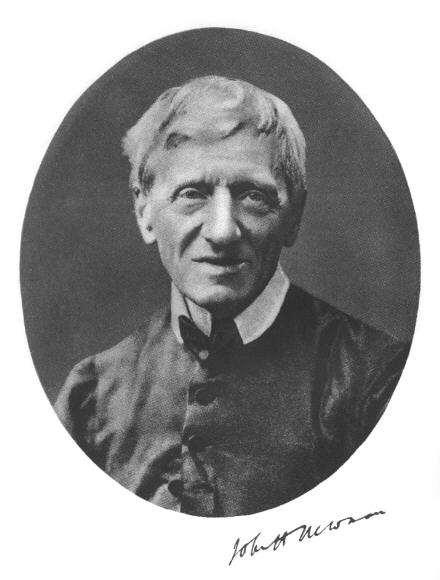
From John Henry Newman's Era to Our's
Today I spoke to students in my civ class about the historic significance of the Pope Benedict's visit to England. (It helped that we had gone over the reformations of the 16th century in previous weeks.) While in England--along with facing the largest protest of a papal visit in history--the Pope beatified John Henry
English philosopher and public intellectual Roger Scruton seizes on the moment to write about Newman's views on higher education. Oh how things have declined, laments Scruton in the American Spectator. "What is expected of the student in many courses in the humanities and social sciences is ideological conformity, rather than critical appraisal," he writes, "and censorship has become accepted as a legitimate part of the academic way of life." He ventures into choppy political waters and makes some sweeping indictments of the new American system. Seems overdone to me. Don't think hyper-political correctness is the problem.
Still, Newman's eloquent summary of the mission of the university and his ode to the life of the mind is well worth revisiting.
Excerpt: John Henry Newman, The Idea of a University (reprint: 1852, London, 1899), ix, 101-102.
THE view taken of a University in these Discourses is the following: — That it is a place of teaching universal knowledge. This implies that its object is, on the one hand, intellectual, not moral; and, on the other, that it is the diffusion and extension of knowledge rather than the advancement. If its object were scientific and philosophical discovery, I do not see why a University should have students; if religious training, I do not see how it can be the seat of literature and science.
Such is a University in its essence, and independently of its relation to the Church. But, practically speaking, it cannot fulfil its object duly, such as I have described it, without the Church's assistance; or, to use the theological term, the Church is necessary for its integrity. Not that its main characters are changed by this incorporation: it still has the office of intellectual education; but the Church steadies it in the performance of that office. . . .
It is a great point then to enlarge the range of studies, which a University professes, even for the sake of the students; and, though they cannot pursue every subject which is open to them, they will be the gainers by living among those and under those who represent the whole circle. This I conceive to be the advantage of a seat of universal learning, considered as a place of education. An assemblage of learned men, zealous for their own sciences, and rivals of each other, are brought, by familiar intercourse and for the sake of intellectual peace, to adjust together the claims and relations of their respective subjects of investigation. They learn to respect, to consult, to aid each other. Thus is created a pure and clear atmosphere of thought, which the student also breathes, though in his own case he only pursues a few sciences out of the multitude. He profits by an intellectual tradition, which is independent of particular teachers, which guides him in his choice of subjects, and duly interprets for him those which he chooses. He apprehends the great outlines of knowledge, the principles on which it rests, the scale of its parts, its lights and its shades, its great points and its little, as he otherwise cannot apprehend them. Hence it is that his education is called "Liberal." A habit of mind is formed which lasts through life, of which the attributes are, freedom, equitableness, calmness, moderation, and wisdom; or what in a former Discourse I have ventured to call a philosophical haunt. This then I would assign as the special fruit of the education furnished at a University as contrasted with other places of teaching or modes of teaching. This is the main purpose of a University in its treatment of its students.
Sunday, September 5, 2010
Higher Ed Jeremiads
Read Christopher Shea's review essay in the NYT: "The End of Tenure?" Quite a few American's outside the academy are mad as hell, and not going to take it anymore.
Should academics be accountable to the broader public for the writing and teaching that they do? Perhaps something like the UK's Research Assessment Exercise could be in American higher ed's future.
Anyhow, Shea considers several books that offer up nightmare scenarios of privilege or offer some suggestions for reform.
"The higher-ed jeremiads of the last generation came mainly from the right," says Shea. "But this time, it’s the tenured radicals — or at least the tenured liberals — who are leading the charge. [Andrew] Hacker is a longtime contributor to The New York Review of Books and the author of the acclaimed study 'Two Nations: Black and White, Separate, Hostile, Unequal,' while [Mark] Taylor, a religion scholar who recently moved to Columbia from Williams College, has taught courses that Allan Bloom would have gagged on ('Imagologies: Media Philosophy'). And these two books arrive at a time, unlike the early 1990s, when universities are, like many students, backed into a fiscal corner. Taylor writes of walking into a meeting one day and learning that Columbia’s endowment had dropped by 'at least' 30 percent. Simply brushing off calls for reform, however strident and scattershot, may no longer be an option.">>>
Friday, September 3, 2010
"I can't read this book . . . it's long and boring"
Are we awash in a rising sea of idiocracy? Or, are things just different today; no better, no worse than yesterday? Is short always sweet? Perhaps anything worth saying can be pared down to 140 characters (twitter) or 160 characters (SMS). I don't believe that. And I think that "pithy" and "tweet" probably shouldn't go in the same
Still I'm not above assigning portions of a longer book. Maybe students do get less from the whole. I know that some students are paralyzed with fear at the thought of reading a 250-page work of non fiction. It's like asking them to scale a mountain and then paraglide down into a briar patch.
So, I was intrigued by Carlin Romano's sign-of-the-times essay in the August 29th Chronicle: "Will the Book Survive Generation Text?" (It's part of a series of essays on what the future of the profession holds.) He summarizes the work of academic forecasters and doomsayers--Derek Bok, Jennifer Washburn, Frank Donoghue, Mary Burgan, Louis Menand. Romano proposes a funny sort of idea, "extreme academe," to sum up what might take place in our near future. "Extreme academe, as a vision, ups the ante of such concerns. It adds flash and cynicism to mere trepidation," says Romano. "According to it, college students in 2020 will use plastic cards to open the glass security doors installed at each entrance to campus. On special occasions, the sole tenured faculty member at every institution will be wheeled out, like the stuffed remains of Jeremy Bentham at University College London, for receptions."
Romano worries that, "Destructive cultural trends lurk behind the decline of readerly ambition and student stamina. One is the expanding cultural bias in all writerly media toward clipped, hit-friendly brevity—no longer the soul of wit, but metric-driven pith in lieu of wit. Everywhere they turn, but particularly in mainstream, sophisticated venues—where middle-aged fogies desperately seek to stay ahead of the tech curve—young people hear, through the apotheosis of tweets, blog posts, Facebook updates, and sound bites as the core of communication, that short is always smarter and better than long, even though most everyone knows it's usually dumber and worse."
He also takes aim at a kind of cult of "interactivity.": "Another cultural trend propelling the possible death of the whole book as assigned reading is the pressurized hawking of interactivity, brought to us by the same media panderers to limited attention spans. It's no longer acceptable for A to listen to B for more than a few minutes before A gets his or her right to respond."
Not so encouraging. Certainly worth considering as the job market continues to shrink and as the culture of the academy undergoes radical change.
Wednesday, June 23, 2010
London Calling Librarians
Dana Goblaskas
As a self-proclaimed history nerd and an Anglophile, it’s hard for me to be giddier than when I’m immersed in the tangible history of England. And if I can earn credits toward my degree for that immersion, well, let’s just say the happy dances abound.
Last month, I took part in the inaugural session of University College London’s Librarianship Summer School, co-sponsored by the University of North Carolina’s School of Information and Library Studies. The two-week seminar examined the past, present, and future of Britain’s libraries and the field of librarianship, and featured daily field trips to museums, libraries, and archives throughout the city and beyond. Lectures by librarians, historians, and UCL faculty provided background for what my classmates and I saw during tours, and behind-the-scenes peeks into the workings of such places as the British Library and Bodleian Library at Oxford set our future-librarians’ hearts a-racing.
For the history nerd in me, there was plenty of “past” to learn about and see firsthand. Lectures about medieval manuscripts and eccentric pioneers of cataloging were coupled with glimpses inside Wren’s Library at Trinity College Cambridge (built in 1695), the Natural History Museum, and viewings of treasures like the Domesday Book at the National Archives.
Perhaps even more exciting than getting to drink all that in was seeing how much effort these institutions are presently putting into making their historical collections available to the world. With help from foundations like JISC (Joint Information Systems Committee), many of the places I visited were in the midst of massive digitization, indexing, or retrospective cataloging projects. Inspired by the popularity of the BBC’s Who Do You Think You Are? TV program, several libraries and archives were focusing on increasing public accessibility to the parts of their collections that could be used for genealogical research.
As for the future of Britain’s libraries, I think they’re heading in the right direction. Facing questions about libraries’
And in addition to focusing on expanding digital content and accessibility, some institutions are appealing to the public to help develop their collections. Projects such as Transcribe Bentham at UCL and Oxford’s First World War Poetry Archive rely on crowd-sourcing to create and identify materials, as well as on social networking tools like Twitter and Flickr to get the word out to wider circles of volunteers.
Coming back down to reality after two weeks spent doing not much more than hanging around inside and gawking at cool old libraries—or cool new libraries—was a little difficult. But coming back with great experiences, thousands of pictures, and a head full of ideas lessened the blow of the transition. And I’m excited by the prospect of so much more incredible content being made widely available. Now I just have to finish my research paper to earn those credits, and I think the happy dances will abound once again.