Showing posts with label Elizabeth Lewis Pardoe's posts. Show all posts

Friday, February 28, 2014

Robin Hood and Remote Rule

Elizabeth Lewis Pardoe

British North America developed from a landscape of religions into a nation of races over the course of the eighteenth century.This process culminated in a hot, locked Philadelphia hall in 1787, but the lessons upon which the drafters drew reached back to the Reformation of the sixteenth century and earlier to Rome.

Americans had, after all, just rejected their inclusion in the British variant. If they failed to grasp the significance of their success, Edward Gibbon’s Decline and Fall of Rome, David Hume’s History of England, and the tales of Robin Hood1 served to remind them of the dangers of remote rule.


Early Modern Europe possessed two empires with established Protestant populations inhabiting borders under perpetual threat.The Holy Roman Empire’s borderland Protestants included the Southwestern Germans of Wuerttemberg and the Rhineland-Palatinate, for whom “cuius regio, eius religio” offered precious little protection from neighboring Catholic armies. The British Empire sent forth Scots to settle among and pacify the Catholics a few leagues away in Northeastern Ireland. These two groups moved away from their fraught locations on Europe’s bloodiest frontiers topopulate the so-called backcountry of eighteenth-century British North America from the Kennebec to the Altamaha.2

Wednesday, February 19, 2014

When Virtù Courts Virtue

Elizabeth Lewis Pardoe

I found my way to this topic via a peculiar trajectory that began along the Cam under the tutelage of Quentin Skinner, where the distinction between classical republican virtù and protestant Christian virtue first entered my consciousness.  The hybridized virtù(e) that filled the political treatises of the American Revolution/War for Independence fascinated me but were not the centerpiece of my doctoral research.  When I returned to Jane Austen as my entertainment while my second son nursed, I realized that the hybridization process took place on the pages of Miss Austen’s novels.

The historiography of the American Revolution nearly drowns in examinations of Republican motherhood and patricidal rage. Austen’s heroines need not kill their fathers. They are already dead (Sense & Sensibility) or emasculated by poverty (Pride & Prejudice, Northanger Abbey, Mansfield Park), frailty (Emma), and vanity (Persuasion).  It takes little imagination to envision Elinor Dashwood, Elizabeth Bennet, Catherine Moreland, Fanny Price, Emma Woodhouse, and Anne Elliot as the republican mothers of a future generation.  In attributes they share much with the ultimate Republican mother as proven in her dual role as the United States’ first wife and mother to (failed) Presidents, Abigail Adams.  They can hold their own in discussions of the lofty but are unafraid to engage in the lowly. Think of Abigail Adams mopping her floors with vinegar while her many children lay sick, and Anne Elliot caring for her injured nephew while his squeamish mother tends to her own nerves not his physical needs.  When the virtùous Captain and Mrs. Wentworth set sail, I suspect their destination is the new republic on the other side of the Atlantic.

Thomas Jefferson obsessed over virtù(e) and corruption in both the public and private spheres.  Jefferson is remembered for his assiduous adherence to the necessity of landholding independence as a prerequisite for political virtù. He never deigned to fight in the colonies-cum-new republic’s wars though famously wrote on the worth of blood spilled for a virtùous cause.   He is also remembered for his utter lapse in private virtue, bedding but never wedding a woman he considered his racial inferior.   Jefferson was a last gasp of  this double standard in the Americas.  The widow’s of New Jersey had already become the first in Atlantic world to cast their votes in a simultaneous demonstration of both their virtù(e)s. 

Finally, I beg leave to indulge in some Whiggish analysis and imagine that William Jefferson Clinton’s presidency would have been very different indeed  had Americans not come to accept Jane Austen’s definition of hybridized virtù(e) and applied it to men and women alike.

____________

Sources: Linda Kerber, Women of the Republic; Mary Beth Norton, Liberty’s Daughters; and Jay Fleigelman, Prodigals and Pilgrims.

Monday, January 6, 2014

Snow Day

Elizabeth Lewis Pardoe

I am as giddy as a child at the prospect of a snow day. Others fret about climate change when they see -40 windchills on the weather and can’t push the door open into a snowdrift. I think about Laura Ingalls
Laura Ingalls Wilder
Wilder’s memoirs and relish the prospect of stoking the fires of memory and imagination.

Wilder’s books sparked my early interest in the past. Some of Wilder’s tales seemed similar to my own grandmother’s recollections of learning and teaching in a one room school house. My grandmother had a comparatively stable life on a comparatively prosperous farm in Illinois.  Laura followed Pa Ingalls from Wisconsin West in a series of tentative land claims. My mother read the stories aloud at bedtime. My father would pass through and groan every time Pa uprooted his family and chased further west in pursuit of a half-baked dream. I didn’t need the New Yorker to tell me Pa Ingalls was not the saint his daughter imagined him to be.  Even as a child, I couldn’t stomach the television version of Wilder's tales. Michael Landon’s Pa was so angelic that the actor needed no adaptation to his performance when he moved on to play an angel in Highway to Heaven. I craved the bits of terrifying realism that remained in the prose and faded from the screen.

Monday, December 2, 2013

Listen More; Judge Less: Lessons from Jim Grossman

Elizabeth Lewis Pardoe

Thanks to a series of Teagle Teaching Workshops at Northwestern, the executive director of the American Historical Association, Jim Grossman, gave a lecture on “Historical Thinking and Public Culture.” Much of what he said hearkened to conversations I had at the Historical Society’s 2012 conference "Popularizing Historical Knowledge: Practice, Prospects, and Perils." As Jim said, we know people like history. The History Channel, thousands of reenactors, and millions of genealogists indicate a thirst for knowledge of the past. Derision of such historical fancy keeps doctoral candidates clothed in a veil of superiority while their bank balances dwindle. Grossman suggested a revolutionary shift in academic historical thought: dispense with the patronizing judgment and listen to what people want to learn.

The lesson holds for the undergraduate classroom. Faculty ask one another, “what are you teaching?” Grossman suggests we end the obsession with our own performances at the front of class and focus upon what the students at the back learned. While teaching and learning have a symbiotic relationship, the shift of emphasis from professor to listener signals a broader embrace of history’s public value. The nuances of Foucauldian analysis may help the professor frame his or her argument, but if every iPhone in the lecture hall sends out a frantic  “wtf?” we have lost the pedagogical point.

Thursday, October 17, 2013

When History Hits Home

Elizabeth Lewis Pardoe


In my job as a fellowships advisor I stress to applicants that a strong application demonstrates three things: depth of expertise in a given field; breadth of interests and experiences; and the applicant’s change over time, i.e. history. The third pillar of the triad constitutes the all-important biographical element. Americans' hunger for personal history makes Ancestry.com’s stockholders rich and guarantees the flood of genealogists to the shores of Salt Lake.

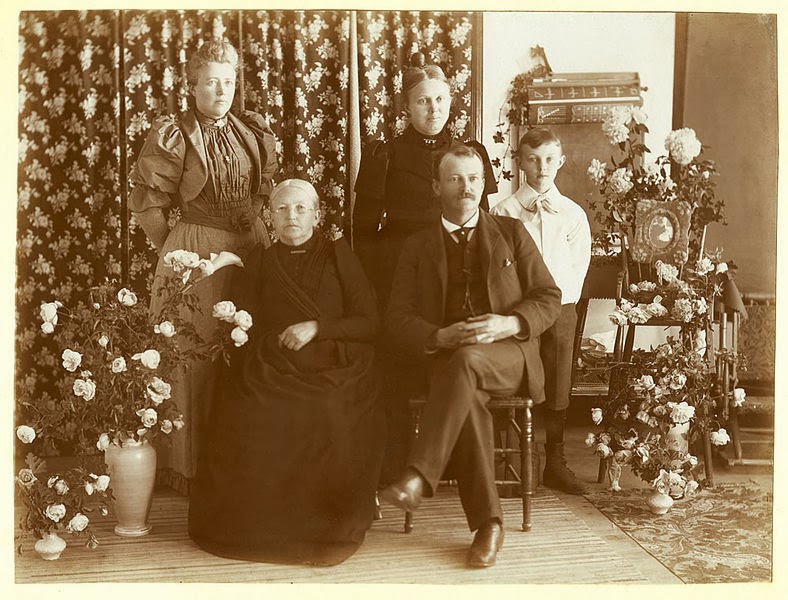
The Ball family of Lompoc, California, ca. 1894. 
My sons started high school and middle school at the end of August. As I delivered my nearly­ men to the doors of their new institutions, my desire to make history from memory overwhelmed me. The hundreds of digital images stored on the family computer cried out for a chronology with which to capture the evolution of my chubby-­cheeked chappies into the skinny tweens who seek escape from their mother’s needy embrace.

My compulsion has since produced three photo­books, and I am at work on two more. My mother used to assemble such tomes from the fragile prints of an earlier age. My photo­books exist in a cyber “cloud” as well as on my coffee table. My ability to shape the past into the form I like resembles the easier editing now accessible to authors of all history books. While David Hume wrote by hand and Oscar Handlin clattered at a keyboard, post­modern respondents to Clio’s call can, in a matter of seconds, place images on pages and produce flourishes that only the most able medieval monks could make over many days.

Monday, July 15, 2013

Summer Scholarship for the #altac

Elizabeth Lewis Pardoe

As I struggle to find the energy, focus, and drive to complete my summer writing deadlines, the opening lines of Thomas Paine’s The Crisis take on new meaning:

THESE are the times that try men's souls. The summer soldier and the sunshine patriot will, in this crisis, shrink from the service of their country; but he that stands by it now, deserves the love and thanks of man and woman.

For those of us “Alternative Academics,” marked by #altac hashtags on Twitter, the summer IS the season that tries our souls.  Our tenure-line colleagues disappear into the archives and post to Facebook from glamorous destinations around the globe. At the same time we work full time and wonder whether or not to attempt CPR on the scholarly commitments we left flailing for breath during the academic year. 

The difference appears less acute from September to June.  I may advise while others teach, but the strain on scholarship seems less stark then.  In the summer, when the professoriate retires from lectures, seminars, and office hours, I still Skype with fellowship applicants as registrars revise databases.  In some ways the summer pressure is less.  Undergraduates don’t line the halls.  Thus, the summer #altac scholar thinks a flurry of productivity just might be possible.


Monday, May 20, 2013

Size Matters?

Elizabeth Lewis Pardoe

"Length of the average dissertation," from FlowData.
This chart initiated a round of chest thumping by academic historians. Apparently we historians write the longest dissertations. Now, according to this chart, philosophers and classicists do not write dissertations, when in fact they do. However, for the sake of argument, let’s assume the chart is correct. What does it tell us about historians? Either we do more research than scholars in any other field (unlikely from my interdisciplinary vantage point), or we are less able to articulate our findings in a pithy manner than our colleagues in other departments on campus.

When I made a snide remark about length on Facebook, my historian friends jumped to the defense of 325 page dissertations as the necessary length for a monograph. Other fields publish articles rather than books. Thus, the argument went, they can get away with less. This perplexed me. A doctoral dissertation no matter the field should demonstrate an original contribution to knowledge, right?

Wednesday, April 3, 2013

Visual Learners and Historical Myopia

Elizabeth Lewis Pardoe

On my first day as a brand new assistant professor a student came up to me, introduced himself, and announced, “I am a visual learner.” The class was a reading and writing intensive freshman seminar with a predetermined syllabus. I knew we had a problem, but I had limited agency to remedy the situation. 

This year I decided to see if I could match my long-since graduated student’s need for visual stimulus with my own desire to make students delve deep into the documents that reveal the mental landscape of the past. I integrated video presentations into the middle portion of each three-hour seminar.

The visual interlude fixed one pedagogical problem and revealed another. Although academic historians of colonial America know that all the world was not New England, word has yet to reach the filmmakers. Three Sovereigns for Sarah captures Salem’s witchcraft crisis and Mary Silliman’s War strips the romantic Revolutionary myths away from a tense civil war in Connecticut. When I wished to illuminate my own area of expertise, the colonial mid-Atlantic, I came up short. No film of which I am aware follows Conrad Weiser through Penn’s Woods or brings to life the ascetic world of the Ephrata Cloister. In the realm of video pedagogy,  the years between witches and independence and the geography between Puritans and plantations cease to exist. 

Friday, February 15, 2013

A Reprieve from Oligarchy

Elizabeth Lewis Pardoe 

Thank heaven George Washington and Thomas Jefferson failed to produce legitimate male heirs and John Quincy Adams was a presidential dud. Our nation periodically flirts with oligarchy, but with the 2012 presidential results, we spared ourselves for four more years. 

The 2012 election was historically significant in many ways, but the absence of a single WASP (white Anglo-Saxon Protestant) candidate merits more than just a mention. Barack Obama was the only black man on the ticket; but he was also the only Protestant on the ticket. (Some may quibble with me about Mormonism’s not belonging under the Protestant umbrella, but Mormons have a prophet of their own distinct from the 16th-century European Reformation that birthed Protestantism in its many forms.)

Wednesday, December 19, 2012

Mankind's Hubris

Elizabeth Lewis Pardoe

Any show that claims to speak for the entirety of mankind sets itself up for a fall worthy of Adam. 

First let me make clear that I am not a History Channel hater.  I spent a year happily writing and editing entries for “This Day in the American Revolution” on their website.  I have complete confidence that more people have read my prose in that forum than all my appearances in peer-reviewed journals combined.

My son’s teacher let the kids forgo their nightly reading if they watched the History Channel’s Mankind series’ treatment of the “Age of Empire.”  He warned it might be gory and asked that a parent watch with each child.  Thus I found myself forced to suffer through some of the worst history and worst television I have ever endured.

Thanks to clunky editing, I learned that the Pilgrims fled the Tulip bubble in the Netherlands.  Salem drew the “era of fear and superstition” to a welcome close so the “wilderness” could be “tamed” from Siberia to North America by rugged, male, entrepreneurial pioneers desirous of fur.  As “superstition is giving way to science,” Captain James Cook, “mankind’s greatest explorer . . . opened up a new continent,” inhabited by “animals and plants unknown to science.”  Benjamin Franklin, “innovator and entrepreneur,” brought the scientific revolution to “America.” And the march of progress goes on.