Showing posts with label Jacksonian America. Show all posts

Wednesday, February 6, 2013

Birth Control in the First Half of the 19th Century*

Dan Allosso
 
Charles Knowlton believed that his enemies’ big objection to The Fruits of Philosophy, which he published in 1831 and was imprisoned for in 1833, wasn’t so much that it gave people the power to reduce the sizes of their families, but that he had claimed in his “Philosophical Proem” that religion should have nothing to say about the matter.  He was jailed for three months at hard labor, Charles said, “ostensibly, for diffusing scientific knowledge of practical utility; but, really, for giving thee a small pill in connection with it, slyly wrapped up, which thou canst not swallow.”  Other freethinkers, such as Abner Kneeland and Robert Dale Owen, focused on the idea that by giving regular people the ability to limit family sizes, they were instigating a major social change.  By reducing the number of poor wage-workers, they said, families would become better able to demand higher wages and the money they earned would go farther toward giving all children the nourishment and educations they needed.  Most freethinkers agreed that it was important to give everybody the right to choose, and that the social reforms they supported would be advanced by effective family planning.

So was Knowlton’s method effective?  Should he be remembered as an early champion of the idea of choice, or as someone who actually helped people change the sizes of their families in ways that led to social change?  Either way, he was ahead of his time and helped move American society from its Calvinist roots toward the world we live in today, where for most people the choice to have children and how many to have is just assumed to be a private, family decision.

Wednesday, November 21, 2012

Gorgeous Hussies and Parlor Politics

Joseph Yannielli*

One of the advantages of digital history is that it allows its practitioners to comment on public events in real time and achieve a potentially broader and more immediate impact. And what event could be more gripping than a big old scandal? Scandals tap into a seemingly universal appetite for tawdry drama. In times of great crisis or division, they serve an important cultural function. Brimming with prurient details, amplified by politicians and the media, public scandals are manufactured distractions. Really good scandals also have the capacity to shake revered institutions to their core—to disturb and expose powerful elements that are normally obscure or hidden.

Of all the endless varieties of public embarrassment, the sex scandal holds a special place for its ability to shed light on subterranean social anxieties. The latest example offers up a juicy blend of the military, politicians, the CIA, and the FBI (and the East Tuscaloosa Junior Marching Band, and Kevin Bacon, and your mom, and who knows how many others by the time the investigation is concluded). But the story is as old as America . . . or at least as old as Old Hickory.

The Petticoat Affair that almost derailed Andrew Jackson's first term as President was perhaps the first major American sex scandal. And like the still-unraveling Petraeus Affair, it disgorged fascinating information about the inner workings of power in what would become the world's mightiest military machine.

Tuesday, June 14, 2011

American Political Partisanship in Historical Perspective

Heather Cox Richardson

Peter Orszag had an article last week at Bloomberg arguing that political partisanship in America has increased dramatically in recent years because Americans have self-segregated their housing according to political leanings. Once in like-minded groups, he suggests, they tend to reinforce each other and drift toward extremes as individuals try to outdo each other in enthusiasm for their political affiliations.

This is an interesting theory. It suggests our political inclinations are beyond our control and that society has spiraled into extremism for reasons we cannot stop.

It would certainly be quite interesting to Americans of the 1840s and 1850s, whose partisanship was so extreme congressmen took guns to the House of Representatives to protect themselves, settlers in Kansas and Missouri murdered each other in their beds, and millions of men killed off several hundred thousand of each other before deciding to call it quits. Who knew that when they moved West, setting up shelters wherever they found good land, that antebellum Americans were unconsciously segregating into political neighborhoods?

There is a much more obvious and more plausible explanation than political segregation for the increases in political partisanship that have occurred with pretty cyclical regularity in American history. It is an explanation that suggests that partisanship and compromise are both deeply imbedded in the American political tradition.

Rising politicians need to be able to attract attention. To that end, they need to distinguish themselves from the successful politicians who hold power. When those senior politicians have emphasized compromise, aspiring politicians have attacked them and advocated more extreme positions. Extremism begets extremism until the system becomes utterly dysfunctional. At that point, aspiring younger politicians can attract attention by advocating not extremism, but compromise.

This cycle of compromise to partisanship to extremism to compromise has turned over again and again in American history.

To see how this works, let’s look at the first generation of professional politicians in America: the Jacksonians of the 1830s. The men who wanted to put Andrew Jackson in the White House needed a way to garner support for a man who was widely regarded as volatile and a rather dim bulb. How could they elevate him when men like Henry Clay, the Great Compromiser, controlled the political scene? By viciously attacking Clay and men of his ilk with unfounded accusations, decrying compromise as weakness, and building a constituency that despised the very art of compromise Clay performed so well.

How then could the next generation of politicians opposed to Jackson’s Democratic Party build its own constituency? By attacking the Democrats, of course.

As political leaders squared off, the newspapers that supported them echoed their rhetoric. There, and not in unconsciously politically segregated communities, individual editors turned up the heat of extremism. Each tried to outdo the competition to draw readership and the advertising dollars readers attracted. Partisanship rose as voters learned to value conflict rather than compromise.

As members of each party more and more often characterized their opponents as corrupt, dangerous, and evil, compromise became increasingly unthinkable.

We know how that turned out.

But the need for politicians to distinguish themselves from their predecessors can serve compromise as well as conflict. When partisanship has become more important than actual governing the government ceases to function in any sort of a competent way. Astute younger politicians then can build careers by promising to compromise with opponents to create solutions that make the government work again. Theodore Roosevelt, for example, recognized voters were frustrated by the extremism of the late nineteenth century that had paralyzed government just when the nation was desperate for solutions to the crises of industrialism. Roosevelt created an image of himself as bipartisan, willing to side with Democrats even against members of his own party to do what was good for the country (a position that infuriated old-fashioned Republicans and Democrats both). Roosevelt was not alone, though. His construction of a politics of compromise was part of the reaction of his generation to the partisanship of the previous generation. That premium on compromise produced the bipartisan Progressive Era.

Which, in turn, was followed by the growing extremism of the 1920s . . . and so on.

These political swings have been part of American society since at least the 1830s. They are not about living quarters. While housing patterns may reflect the current political values of the national culture, Americans are not first self-segregating politically and then self-integrating politically every few generations. What they are doing, though, is listening to their political leaders, reading the news, watching TV, and now, using the internet. What they hear drives their attitudes toward politics.

Far from being a reflection of living patterns created without our conscious control, partisanship and compromise are both deliberate decisions made by political leaders.

Monday, April 25, 2011

Guess Who's Coming to Graduation

Randall Stephens

Last summer Nick Seaton asked in the Guardian: "Should the news that Sex in the City actress Kim Cattrall and Pirates of the Caribbean actor Orlando Bloom have donned funny hats and gowns to collect honorary degrees this week give pause for thought?" Sports heroes, too, had the opportunity to swoosh across stage in billowy regalia. "And yesterday we learned that three golfers – Padraig Harrington, Arnold Palmer and Tom Watson – received honorary degrees from, appropriately, the University of St Andrews."

Critics in the academy snap their pencils in disgust. And when politicians and political pundits receive honorary degrees, things can get even more interesting--as when Liberty University bestowed a doctorate on the sage of Fox News and college dropout, Glenn Beck (not really surprising).

Barack Obama gave the commencement speech at Notre Dame in 2009 and received an honorary doctorate in law. Salon's Alex Koppelman reported that the "announcement has turned into a PR nightmare, though, as conservative Catholics are up in arms over the choice and are organizing against it. One local bishop has said he'll boycott commencement in protest, as the president's decision on stem cells means the government is 'supporting direct destruction of innocent human life.' The Cardinal Newman Society claims to have 80,000 signatures on a petition asking the university to rescind the invitation."

History helps put things into perspective. At least former presidents did not raise a fiery complaint against Obama, as far as I know. But that was just what happened when Harvard decided to hand an honorary degree to Old Hickory in 1833. Eleven years earlier the college had given one to Jackson's arch-rival John Quincy Adams--the world traveler and bibliophile, who knew Latin and Greek and studied numerous modern languages. Now Adams could not believe that the same revered institution would tarnish its name and legacy by honoring Jackson, vulgarian in chief. Though Adams was a Harvard overseer, he refused to attend the ceremony for his long-time political foe. How could this beacon of learning "confer her highest literary honor," he fumed, "upon a barbarian who could not write a sentence of grammar and hardly could spell his own name"? (On the contrasts between these two towering figures, see David Reynolds's excellent Waking Giant: America in the Age of Jackson.) Adams, brooding in Quincy, was not alone in his contempt. There were plenty of Jackson despisers in Massachusetts.

The whole affair made Charles Francis Adams, JQ's son, burn with rage. Charles confided to his diary: Jackson "served his Country no more usefully than a thousand others, but he has the prestige of military glory which dazzles all mortal minds. The art of killing is prized higher than the art of vivifying. My father who was his competitor for the Presidency and a man of incomparably superior character, yet carries with him perpetually a load of unpopularity." Argghhh!!

A political doggerel of the day ran:

John Quincy Adams
Who can write,
Andrew Jackson
Who can fight

And the cycle continues. I'm waiting to hear who will be the lucky recipients of honorary degrees this year. (A famous mime? A skilled puppeteer? Macho Man Randy Savage?) We'll see what kinds of denunciations appear in the press and on the Sunday political chat shows.

Saturday, February 5, 2011

Reading Clothes, Hair Styles, Architecture, and More

Randall Stephens

I'm teaching a course this semester on American history from 1783-1865. I'd like to introduce the students more to everyday life than I have in previous years. So, I'm asking questions like: How did Americans behave, dress, eat, live, work, worship, and play? What can we learn from reading the material culture and the manners of, say, the Early Republic or the Age of Jackson?

A look at Jack Larkin's excellent The Reshaping of Everyday Life: 1790-1840 (Harper, 1989) seemed like a good place to start. The book is part of a series that examines the intimate and public lives of Americans in a given period. I read a couple of short passages to the class on Thursday. For example, Larkin says this of how Americans were greeting each other in the Jacksonian period:

Shaking hands became the accustomed American greeting between men, a gesture whose symmetry and mutuality signified equality. The Englishman Frederick Marryat found in 1835 that it was 'invariably the custom to shake hands' when he was introduced to Americans, and that he could not carefully grade the acknowledgment he would give to new acquaintances according to their signs of wealth and breeding. He found instead he had to 'go on shaking hands here, there and everywhere, and with everybody.'

All this will overlap nicely with a book that the class is reading--Leo Damrosch's wonderfully entertaining and insightful Tocqueville's Discovery of America (FSG, 2010). In Damrosch's telling Tocqueville was quite sensitive to the styles, cultural peculiarities, and attitudes of the Americans he encountered in his trek across the country in 1831 and 1832.

I have been doing some searches on-line for websites and resources for the teaching of material culture. I wonder if their is a one-stop site that would include bibliographies and short summaries of what material culture and style can tell us about a given era? What can we know about American men over the decades by looking at changes in facial hair? (That topic would certainly lend itself to an interactive graphic.) Or, as one student asked me several years ago: Why did men have outrageous mustaches and lambchops--like cats and walruses--in the 1850s-1870s and why did so few have the same in the 1920s and 1930s? I don't really know. For those later decades, maybe faces were supposed to look like the fronts of streamlined trains. What can we learn about men and women, children and adults, in the Jacksonian period by looking at the clothes they wore? How might we compare those styles with ones from today? Can we speak about the democratization of architecture, speech, or, as Larkin writes, physical greetings?

Students seem to have fun with these kinds of topics. I do as well, though, I know little about them. So . . . if anyone out there knows of some on-line resources to get at these kinds of material culture and cultural history questions, please let us know.

Saturday, August 7, 2010

History through the Eyes of . . . Harriet Martineau: Washington, D.C., 1835, #1

Randall Stephens

In a post a few weeks ago, I asked what an American city might have looked like in 1848. An amazingly detailed daguerreotype of a booming Cincinnati gives us a good idea. It's a tremendous resource.

That got me thinking about a new series for the blog. The idea is to post a portion of a primary source from that offers an insightful, evocative portrait of a place, a time, a people. Some questions that sources might answer: What was it like to live in Paris as the Black Death decimated the city? What might it have been like to walk down Cheapside in Dickensian London? How did it feel to live in Pompeii on the eve of the city's destruction? What was it like to be a 16th-century Jesuit missionary in Japan? (Please pass along your favorite primary sources.)

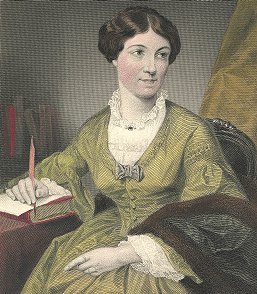
For the first installment I've chosen Harriet Martineau's (1802-1876) interesting portrait of Washington, DC, (1835) populated as it was by oddballs from the sticks, society ladies, gabbing politicians, and some giants of the day. (A came across this in Allan Nevins, ed., American Through British Eyes [Oxford University Press, 1948].) Martineau was an English journalist, novelist, and essayist from Norwich. Her family's falling fortunes in her youth are worthy of a Jane Austen novel. Luckily, she made a tidy living off her writing.

Martineau circulated among the leading movers and shakers of her era. She developed keen observational abilities and could make even complex subjects accessible to a wide audience. She wrote about the development of religions and penned essays on new economic theories. Her abolitionism and unorthodox take on religion stirred controversy in the United States and made her an infamous character for many. (See her comments below about Northerners and Southerners.)

Martineau's American travel writings--though not as well know as those by De Tocqueville, Dickens, and the Trollopes--shed light on customs, sectional differences, and the boisterous Waking Giant of America in the Age of Jackson. (Her unflinching portrait of cast-iron Calhoun, as someone who has come unhinged, or unbolted, is, pardon the pun, riveting.)

Harriet Martineau, Retrospect of Western Travel, Volume 1 (London, 1838).

In Philadelphia, I had found perpetual difficulty in remembering that I was in a foreign country. The pronunciation of a few words by our host and hostess, the dinner table, and the inquiries of visiters were almost all that occurred to remind me that I was not in a brother's house. At Washington, it was very different. The city itself is unlike any other that ever was seen,—straggling out hither and thither,—with a small house or two, a quarter of a mile from any other; so that in making calls "in the city," we had to cross ditches and stiles, and walk alternately on grass and pave menu, and strike across a field to reach a street.—Then the weather was so strange; sometimes so cold that the only way I could get any comfort was by stretching on the sofa drawn before the fire, up to the very fender; (on which days, every person who went in and out of the house was sure to leave the front door wide open:) then the next morning, perhaps, if we went out muffled in furs, we had to turn back, and exchange our wraps for a light shawl. Then, we were waited upon by a slave, appointed for the exclusive service of our party during our stay. Then, there were canvas-back ducks, and all manner of other ducks on the table, in greater profusion than any single article of food, except turkeys, that I ever saw. Then, there was the society, singularly compounded from the largest variety of elements— foreign ambassadors, the American government, members of Congress, from Clay and Webster down to Davy Crockett, Benton from Missouri, and Cuthbert, with the freshest Irish brogue, from Georgia; flippant young belles, "pious" wives, dutifully attending their husbands, and groaning over the frivolities of the place; grave judges, saucy travellers, pert newspaper reporters, melancholy Indian chiefs, and timid New England ladies, trembling on the verge of the vortex,—all this was wholly unlike any thing that is to be seen in any other city in the world; for all these are mixed up together in daily intercourse, like the higher circle of a little village, and there is nothing else. You have this or nothing; you pass your days among these people, or you spend them alone. It is in Washington that varieties of manners are conspicuous. There the Southerners appear to the most advantage, and the New Englanders to the least: the ease and frank courtesy of the gentry of the south, (with an occasional touch of arrogance, however,) contrasting favourably with the cautious, somewhat gauche, and too deferential air of the members from the north. One fancies one can tell a New England member in the open air by his deprecatory walk. He seems to bear in mind perpetually that he cannot fight a duel, while other people can. The odd mortals that wander in from the western border cannot be described as a class ; for no one is like anybody else. One has a neck like a crane, making an interval of inches between stock and chin. Another wears no cravat, apparently because there is no room for one. A third has his lank black hair parted accurately down the middle, and disposed in bands in front, so that he is taken for a woman when only the head is seen in a crowd. A fourth puts an arm round the neck of a neighbour on either side as he stands, seeming afraid of his tall wire-hung frame dropping to pieces if he tries to stand alone: a fifth makes something between a bow and a curtsey to every body who comes near, and proses with a knowing air:—all having shrewd faces, and being probably very fit for the business they come upon. . . . (237-239)

Our pleasantest evenings were some spent at home in a society of the highest order. Ladies, literary, fashionable, or domestic, would spend an hour with us on their way from a dinner, or to a ball. Members of Congress would repose themselves by our fire side. Mr. Clay, sitting upright on the sofa, with his snuff-box ever in his hand, would discourse for many an hour, in his even, soft, deliberate tone, on any one of the great subjects of American policy which we might happen to start, always amazing us with the moderation of estimate and speech
which so impetuous a nature has been able to attain. Mr. Webster, leaning back at his ease, telling stories, cracking jokes, shaking the sofa with burst after burst of laughter, or smoothly discoursing to the perfect felicity of the logical part of one's constitution, would illuminate an evening now and then. Mr. Calhoun, the cast-iron man, who looks as if he had never been born, and never could be extinguished, would come in sometimes to keep our understandings upon a painful stretch for a short while, and leave us to take to pieces his close, rapid, theoretical, illustrated talk, and see what we could make of it. We found it usually more worth retaining as a curiosity than as either very just or useful. His speech abounds in figures, truly illustrative, if that which they illustrate were but true also. But his theories of government, (almost the only subject on which his thoughts are employed,) the squarest and compactest theories that ever were made, are composed out of limited elements, and are not therefore likely to stand service very well. It is at first extremely interesting to hear Mr. Calhoun talk; and there is a never-failing evidence of power in all he says and does, which commands intellectual reverence: but the admiration is too soon turned into regret,—into absolute melancholy. It is impossible to resist the conviction that all this force can be at best but useless, and is but too likely to be very mischievous. His mind has long lost all power of communicating with any other. I know no man who lives in such utter intellectual solitude. He meets men and harangues them, by the fire-side, as in the Senate: he is wrought, like a piece of machinery, set a-going vehemently by a weight, and stops while you answer: he either passes by what you say, or twists it into a suitability with what is in his head, and begins to lecture again. Of course, a mind like this can have little influence in the Senate, except by virtue, perpetually wearing out, of what it did in its less eccentric days: but its influence at home is to be dreaded. There is no hope that an intellect so cast in narrow theories will accommodate itself to varying circumstances: and there is every danger that it will break up all that it can, in order to remould the materials in its own way. (242-244)

For more:

"Miss Martineau's Retrospect of American Travel," Tait's Edinburgh Magazine (April 1838).

Harriet Martineau, Maria Weston Chapman, Harriet Martineau's Autobiography, Volume 1 (London, 1877).

Harriet Martineau, The Martyr Age of the United States: An Appeal on Behalf of the Oberlin Institute in Aid of the Abolition of Slavery (Newcastle Upon Tyne, 1840).