Showing posts with label Evolutionary Biology. Show all posts

Tuesday, January 4, 2011

Science as History and Big History

Dan Allosso

The past finds its way into all types of disciplines. Historical speculation is done by everyone, including scientists and popular science writers. I recently read a really interesting little book by British science writer Colin Tudge. Called Neanderthals, Bandits & Farmers: How Agriculture Really Began, this 50-page essay speculates wildly about the fate of the Neanderthals, ascribes the origin of global Great Flood myths to dim memories of rising sea levels after the last ice age, and suggests that agriculture spread with the original human migrations, rather than being simultaneously discovered in many places afterward. It’s short on “facts” and long on speculation, but it’s really fascinating speculation. (I wish I had this guy’s agent!)

The sciences all deal with change over time. Evolution is history. So it’s no surprise to people who read science that they are reading history. But recently science has leaped onto the history shelves in the form of Big History. I wonder if history-readers excited about Big History are aware that in many cases they’re just reading science. We may be impressed by the novelty of a view that goes back to the big bang, but this is nothing new to the science-readers. Even Bill Bryson had a bestseller out (A Short History of Nearly Everything, 2003, which is a really good read) when David Christian’s Maps of Time was making waves among historians. Other good examples of science-histories include Brian Greene’s The Elegant Universe and Michio Kaku’s Hyperspace, both of which are stories of both the history of the universe and of our expanding knowledge of it: or, histories and historiographies.

Actually, the heritage of that science-reader type of big history goes back to some very interesting documents like Robert Chambers’ 1844 Vestiges of the Natural History of Creation, which presents a case for evolution and has been credited with causing Darwin to keep his ideas secret for decades. But unlike these science texts, what big history does, is try to contextualize “small history.” This is something the scientists aren’t concerned with. Big History doesn’t do what Fernand Braudel did, and add scope—it actually undercuts regular history (at least momentarily) by its sheer geological and cosmic scale. Maybe it sometimes goes too far, and passes a point where the comparison becomes meaningless. But at least it reminds us that the world didn’t begin when people started keeping records.

The context that history like Braudel's brings is environmental, which is also not what the scientists are doing. Except perhaps in the sense of the Anthropic Principle, which argues (circularly) that things “had” to be this way because these are the basic cosmic conditions that enable life. The scientific perspective is usually materialist, but not determinist in the human sense. While some scientists argue that given complete information about the initial conditions of the universe, a sufficiently powerful computer could predict the future, others point to quantum uncertainty as the way out of this trap. Still others, following the hints of scientifically-inclined humorist Douglas Adams, might suggest that there’s only one computer big enough to solve this equation, and it already exists: the universe itself.

There are evolutionary biologists, and evolutionary psychologists. Are there actually any evolutionary historians, who have deliberately applied the ideas of modern evolutionary theory to history?

Thursday, December 9, 2010

Dogs through Time

Randall Stephens

No other animal has been as shaped by humankind as Canis lupus, the gray wolf. There are now 400 different official breeds. They range in size from the itty-bitty Chihuahua, which can sit comfortably in a teacup, to the Mastiff, weighing in at well over 200 lbs.

And just how much has human history been shaped and altered by dogs, and domestic animals in general? Ancient grave sites are littered with animal bones. The domestication of animals more than 10,000 years ago brought with it significant changes. Groups could settle and channel energies into new cultural pursuits. And since we first figured out how to keep cats around, use yeast to make intoxicants, and herd cattle, our lives have been caught up with the lives of animals.

A recent article in Der Spiegel, "The Pharoahs' Pups: Egyptian Bones Could Help Solve Canine Conundrum," looks into the roots of human-dog interaction. The earliest archeological evidence suggests that we've been linked closely to them for 14,000 years. Even more surprising: "Scholars believe that wolves first started to have peaceful interactions with Stone Age humans about 30,000 years ago."

"How did all of these various [dog] breeds develop?" asks the author in Der Spiegel.

Reliefs, grave paintings and statues indicate that the ancient Egyptians played a major role in this development. The first known depictions of dogs come from rock carvings along the Nile River dating back almost 5,000 years ago. Not long thereafter, the pharaohs were already hunting with slender greyhounds. A leashed dog with black-and-white spots that vaguely resembles a dalmation is painted on a sarcophagus from the 6th dynasty, or roughly 4,000 years back.

Around 1500 B.C., small, bowlegged mutts and lapdogs were already scurrying around the palaces of the pharaohs. Brawny hunting dogs were bred for the battlefield, and mastiffs imported from Assyria were crossed with the domestic breed. A bronze figure from the grave of King Tut strongly resembles a dachshund.>>>

For more on the amazing transformation of dogkind over the ages, and for a look at how humans have interacted with dogs, watch Nova's Dogs Decoded (2010) and The Science of Dogs (National Geographic, 2007) on Netflix. (Each is a "watch instantly" title.)

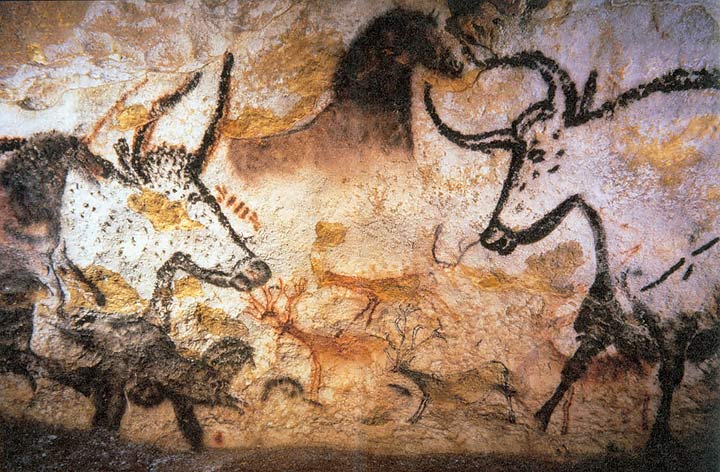
On a related note, check out this preview of Werner Herzog's new 3-D documentary, Caves of Forgotten Dreams, about a group of 32,000-year-old cave paintings of animals and humans in southern France.

Thursday, September 16, 2010

But is it History? II: Deep History

Randall Stephens

Harvard University professor of history Daniel Lord Smail has challenged the idea that history begins only with the advent of writing. In his 2008 book, On Deep History and the Brain (University of California Press), he lays out his arguments about how history and biology have worked together over the long arc of time. Smail asks "When does history begin?" and "What characterizes it?" He follows up on the work of evolutionary biologists and the macro history of Jared Diamond, with a new way of understanding the past.

"The ancient world is unimaginable without archeological evidence;" Smail observes, "the Middle Ages very nearly so; and the effort to reconstitute the lives of peoples without writing has been one of the signal achievements of the twentieth century." In light of that Smail asks: "So what does it matter that the evidence for the deep past comes not from written documents but from the other things that teach--from artifacts, fossils, vegetable remains, phonemes, and various forms of modern DNA?" (On Deep History, 6)

But, as Heather asked earlier on a different topic, is it history? How can we undertsand preliterate humans and societies in a historical sense? Can historians add to our understanding of pre-historic humans in ways that anthropologists and archeologists cannot? Historians inside and outside of the guild will have to figure those questions out for themselves.

What follows are some recent macro-historical, deep history, evolutionary history essays, and tidbits from the web:

Drake Bennett, "How Animals Made Us Human," Boston Globe, September 12, 2010.

. . . . What explains [our] yen to have animals in our lives? An anthropologist named Pat Shipman believes she’s found the answer: Animals make us human. She means this not in a metaphorical way — that animals teach us about loyalty or nurturing or the fragility of life or anything like that — but that the unique ability to observe and control the behavior of other animals is what allowed one particular set of Pleistocene era primates to evolve into modern man.>>>

Cynthia Haven, "Stanford historian tells why the West rules - for now," Stanford University News, September 14, 2010.

. . . . Stanford Classics and History Professor Ian Morris puts forth some bold answers in his ambitious new 750-page book, Why the West Rules – For Now (Farrar, Straus & Giroux). And that places Looty in a longer story going back to the last ice age.

Morris' book argues that history is a slow, complicated tango between geography and social development.>>>

How could a civilization that mastered the planet suddenly Collapse? Inspired by the New York Times best-selling book "Collapse: How Societies Choose to Fail or Succeed", NGC time travels 200 years into the future to see what the world would look like after civilization as we know it collapsed. Guided by author Jared Diamond, we'll piece together the remarkable story of what on earth triggered our decline.

Collapse: Based on the Book by Jared Diamond, National Geographic Channel.

How could a civilization that mastered the planet suddenly Collapse? Inspired by the New York Times best-selling book "Collapse: How Societies Choose to Fail or Succeed", NGC time travels 200 years into the future to see what the world would look like after civilization as we know it collapsed. Guided by author Jared Diamond, we'll piece together the remarkable story of what on earth triggered our decline.>>>

Mary Gray, "Are You Descended from Neanderthals?" New Zealand Herald, September 2, 2010.

. . . . With the expansion of human populations and climate change, Neanderthal populations are thought to have shrunk toward Europe and Spain. Europeans and Neanderthals had potentially longer to interbreed compared to other human populations, but there is no evidence for this - so far. Did waves of human migration from the Middle East replace ancient Neanderthal-human Europeans or did the first human inhabitants of Europe and Neanderthals keep to themselves? >>>