Randall Stephens
Coming to the 2011 AHA in Boston? Have a moment or two to spare? Check out the
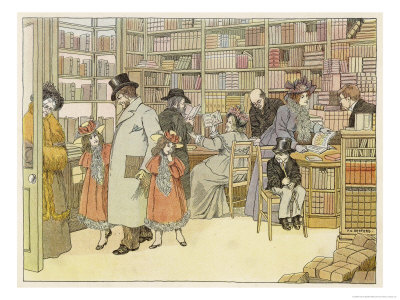
Brattle Book Shop, near the Downtown Crossing and Park Street T stops. The store is one of the oldest in the country and is brimming with books, old and new. Sections on 19th-century history, European studies, Asian

history, New England history, religious history, African-American studies, ethnicity, political science, and on and on line what seem like miles of shelf space.
I’m particularly fond of the outdoor area, which contains thousands of books for as little as $1 to $5 each. (See the video I shot, embedded below.) That space is open all year round, only closing when it rains or snows. (After a long Boston walk with my border collie Beatrice, I’ll peruse titles until Bea begins to whimper out of sheer boredom.)
As Beatrice waits impatiently, I’ve been surprised by how many great history titles I’ve found outside. I’ve picked up books there by Allan Nevins, Oscar Handlin, Gordon Wood, Pauline Maier, Patricia Bonomi, and many more. Also, I’ve been happy to track down unusual 19th-century travel accounts, memoirs, primary source collections, and all manner of biographies.
Brattle Book Shop is real must-see for history bibliophiles!
I asked Ken Gloss, proprietor, about his store and what a history professor, grad student, or history enthusiast might find there.
Randall Stephens: What makes the Brattle Book Shop unique? What would you say are some of its most distinctive features?Kenneth Gloss: The Brattle Book Shop can be traced back to the 1820s and it’s been in my family since 1949. It is a Dickensian-style store. The outside stands hold about 2,000+ books at $1, $3, and $5. We have two floors of general used books, and a third floor with rare books, 1st editions, leather-bound volumes, manuscripts, etc.
We go to estates throughout New England almost every day. It is like being Jim Hawkins on Treasure Island finding great books and libraries and then bringing them back to the shop.
You never know what is new to the shop on
any given day.
Stephens: What sort of clientele do you serve? Does the Brattle Book Shop have a typical customer?Gloss: We have every type of customer you can imagine. We’ve got street people who buy from our $1 tables, collectors who spend large sums on rare letters, manuscripts, rare editions, and the customer who just wants a hard-to-find volume. They are young, old, male, female, regular, one-time, compulsive, and interesting. We have one customer who comes in every day and calls in sick when he cannot get in.
Stephens: Many historians that I know keep an eye out for that gem of a book. What sorts of books at Brattle would catch the eye of a historian on the lookout for a bargain or a rarity?Gloss: We buy and put out books each day. Many of those are by amateur historians, professors, and writers. So you never know what will be on the shelves. That is what keeps people coming. There are also many, many bargains.

 for advice on what to expect. As a third-year Ph.D. candidate who is about to start writing a dissertation, I was regularly advised that many aspects of the AHA meeting did not yet apply to me, such as the Job Center, where interviews for academic positions are conducted, or the Book Exhibit where publishers meet with scholars and teachers to discuss manuscripts or books for use in the classroom.


 Posts
Posts


