Showing posts with label Cold War. Show all posts

Friday, October 18, 2013

A Tense October

Heather Cox Richardson

United States Department of Defense graphic in the John F. Kennedy Presidential Library and Museum, Boston.

The Cuban Missile Crisis lasted for thirteen tense days in October 1962. During those days, the USSR faced off against the U.S. over the placement of Soviet missiles in Cuba. President Kennedy vowed not to permit missiles so close to America; Premier Krushchev vowed to put them in Cuba
anyway. The two week standoff was the closest the Cold War ever came to erupting into a hot war.

And with nuclear weapons widespread, it would have been a hot war, indeed.

The J.F.K. Library has put together a website that enables a viewer to experience each day of that crisis.


Friday, August 30, 2013

Henry Steele Commager on America during the Cold War

Randall Stephens

The November 24, 1954 episode of Longines Chronoscope featured Henry Steele Commager (video embedded here).  That was not unusual for
the news and views program, which regularly featured heads of state, intellectuals, novelists, and other notables.  But the subject of the discussion is particularly interesting all these years later.  Maybe that's especially poignant because Commager was one of America's foremost historians at that time. Here he weighs in on American identity, the pressures of conformity, the post-war economic boom, and freedom of expression.  

This was filmed in the wake of the Korean War, the hydrogen bomb test on Bikini Atoll, and not long after the historic Brown vs. Topeka Supreme Court decision.  Red Scare paranoia remained strong. The coming month of December would see the US Senate reprimand Joseph McCarthy, by a vote of 67–22, for "conduct that tends to bring the Senate into dishonor and disrepute."

Friday, August 23, 2013

History Classroom Roundup


Alastair Jamieson, "Germany's Angela Merkel teaches history class on Berlin Wall anniversary," NBC World News, August 13, 2013

German Chancellor Angela Merkel drew on her Communist-era experiences to teach a history class at a school on Tuesday - the 52nd anniversary of the construction of the Berlin Wall.

Merkel, who is campaigning ahead of next month’s general election, gave a 45-minute lesson as a "substitute teacher" for a 12th-grade class in east Berlin.>>>

Sacha Cordner, "Lawmaker Considering Legislation To Cut Down 'Islam-Bias' In Fla. School Textbooks," WFSU-Tallahassee, August 5, 2013

A Florida lawmaker is considering legislation that would give the public input on the content found in Florida school textbooks. His overall aim is to cut down on what he calls the “Islam-bias” in state schools.

Melbourne Republican Representative Ritch Workman says Prentice Hall’s “World History” book not only puts an inaccurate spin on Islam, it also dedicates a whole chapter to the religion.>>>

Wednesday, May 1, 2013

The Role of Money and Timing in Culture: The CIA and Abstract Expressionism

Heather Cox Richardson

I have heard talk of the exportation of modern American art during the Cold War as a means of proselytizing, but I’d never considered the mechanics of that propaganda. It seemed to me a wing of art theory, and while that’s a subject that always entertains me, it’s something for which I have very little brain space during the school year.
From Life magazine, August 8, 1949.

A recent article by Frances Stonor Saunders in The Independent explains exactly how the CIA promoted American abstract expressionism worldwide in the 1950s and 1960s. Their goal was to highlight the openness and experimentation possible in America’s capitalist system, contrasting it with the rigid conformity of state-censored socialist realism (some of which, to my Philistinic eye, seems worth looking at even if Soviet state officials thought so, too.) At first, the CIA tried to promote work by Jackson Pollock, Robert Motherwell, Willem de Kooning, and Mark Rothko at home. Quickly, though, abstract expressionism ran into the conformism of the 1950s. Even President Truman announced: “If that’s art, then I’m a Hottentot.”

So CIA operatives set up the Congress for Cultural Freedom, which salted art magazines praising abstract expressionism and sponsored exhibitions that toured European cities. They worked closely with Nelson Rockefeller, president of New York’s Museum of Modern Art (which his mother had founded), to showcase “free enterprise painting.” When museums eager to show the new art could not afford the cost of exhibitions, the CIA tapped American millionaires as ostensible sponsors, then provided the necessary money from government coffers. After World War II, abstract expressionism became the symbol of modern America.

Monday, March 4, 2013

The Seduction of Two Innocents: Comic Book Readers and Policy Makers

Heather Cox Richardson

In 1938 Superman sped into this galaxy from the planet Krypton to save humanity.  He and his superhero friends oversaw the chaos of the late 1940s, as America first fought World War II and then struggled to adjust to demobilization. Superman and his friends then swept through the skies as the U.S. armed for the Cold War. While Superman matured, the late 1940s and early 1950s brought chilling fear to Americans that the nation was slipping, losing ground to the Russians, falling apart.

So many children—and adults—were reading comics that critics carped that comics themselves were part of America’s moral decline. In 1953, 6.5 comics were sold for every one person in the country. More than 90% of children admitted to reading them.

In 1954 the psychiatrist Fredric Wertham published The Seduction of the Innocent, detailing how comic books dragged impressionable youths into crime, violence, and homosexuality. The book used anecdotes to prove that Batman, for example, promoted a gay lifestyle. The Seduction of the Innocent was such a sensation that Wertham became the go-to man for information about the danger of comics, and the industry itself, which scorned Wertham, felt obliged to bow to pressure from his acolytes. To preempt government censorship, the Comics Magazine Association of America developed the Comics Code Authority, which banned violence, sex, and disrespect for authority in comic books. Under the Comics Code, good must always triumph over evil, and any treatment of sexuality had to emphasize the sanctity of marriage.

Wertham died in 1981, and his archives opened to researchers in 2010. Carol Tilley, a scholar of library science at the University of Illinois, dug immediately into Wertham’s files on The Seduction of the Innocent. She found that Wertham had comprehensively fudged his data.

Wertham used no citations, and excised from his notes the full portraits of the children he claimed were victimized by comics. His 13-year-old “Dorothy” refused to go regularly to school because she admired Sheena, Queen of the Jungle and crime comics. In fact, Dorothy had other attributes that undoubtedly affected her school attendance: she was a sexually active runaway with a reading disability who belonged to a gang. Another 13-year-old—a boy this time—admired Batman for what he and Robin might be doing in their spare time; in fact, the boy had been sexually assaulted and preferred Superman and war comics to Batman. The list goes on and on.

The seduction of the innocent, indeed.

Monday, January 14, 2013

Reeling in the Years: The Up Series

Randall Stephens

It's been seven years. That means it's time for another installment of the perennial favorite UP Series, which has followed the lives of over a dozen English men and women since they were 7. (The latest is running on PBS this month.) Granada Television first aired the program in 1964.  Other updates came in 1970, 1977, 1984, 1991, 1998, 2005, 2012.  The brainchild of Michael Apted, the series has tracked the participants hopes, fears, interests, successes, failures, and more. It ranks as one of the best, most original documentaries of the 20th century.

Fifty years ago Apted hoped to shine light on the deep class divisions in England and to see how that would shape the lives of these individuals as the grew into adulthood.

Here's what Rebecca Mead writes about it at the New Yorker blog (January 9, 2013):

The series began with a political agenda. Taking the Jesuit maxim “Give me a boy until he is seven, and I will give you the man,” it suggested that the prospects of the participants were determined by the class into which they were born. To a certain extent, this turned out to be true, particularly for those participants belonging to the social and educational élite. John, the prep-school boy, became a barrister, while his classmate Andrew became a solicitor. . . Less predictable were the fates of the working-class and middle-class characters.

Friday, December 7, 2012

A Leadership Legacy: Happy 138th, Winston

Philip White

November 30 was Winston Churchill’s birthday. 138 years after his birth, historians, politicians and the public are still as fascinated as ever about this most iconic of British Prime Ministers. Of course, as with every major historical figure, the
Ivor Roberts-Jones statue of Churchill, Oslo, Norway
amount of one-sided deconstructionism has increased over the past few years, no more useful to the reader than one-sided hagiography. The truth, of course, lies somewhere in the middle–a deeply flawed (aren’t we all!) larger-than-life figure who botched a lot of decisions–notably his resistance to home rule for India and well-meaning but ill-conceived support of Edward VIII during the 1936 abdication crisis–who got the big things right.

Among the latter was Churchill’s foresight over the divisions between the democratic West and the Communist East. Since the inception of Communism and its violent manifestation in the Russian Revolution, Churchill had despised the movement, calling it a “pestilence.” Certainly, his monarchial devotion was part of this, but more so, Churchill believed Communism destroyed the very principles of liberty and freedom that he would devote his career to advancing and defending. Certainly, with his love of Empire, there were some inconsistencies in his thinking, but above all, Churchill believed that the individual should be able to make choices and that systemic freedom–of the press, of religion, of the ballot, must be upheld for individuals to enact such choices. That’s why he vowed to “strangle Bolshevism in its cradle,” though his plan to bolster anti-Communist forces was quickly shot down by Woodrow Wilson and David Lloyd George as another of “Winston’s follies.”


Wednesday, August 22, 2012

The Cold War Mentality of "A Nation at Risk"

Steven Cromack

“Our nation is at risk,” declared a 1983 report released by the National Commission on Excellence in Education.   The fallout from this simple, short report was astounding.  Its lucid words indicted the American education system and sparked national panic.  Schools across the country scrambled to assess their own standards, revised them, and implemented standardized tests.  Twenty-nine years later, as far as the state of American education is concerned, not all hope is lost.  This document was a product of Cold War mentality.  The Commission examined America’s schools under a microscope of fear. Was the United States losing the Cold War?  Only through education—advancement in math, science, and literacy—could the Land of the Free defeat the Communist threat.  “A Nation at Risk,” its language, and its implications reflect Cold War dogma—in examining this document in the era of globalization, it is evident that the Commission’s Cold War mindset failed to recognize that in the midst of the conflict, America’s schools were not failing; instead, they were shaping the future competition in which the United States finds itself in 2012.

Many Americans believed, as did the Commission, that the United States was not the great giant of innovation it once was.  The Commission asserted, “Our once unchallenged preeminence in commerce, industry, science, and technological innovation is being overtaken by competitors throughout the world.”  Like most Americans, the members of the Commission believed that America was falling far behind the lurking Communists.  America’s greatness, in their eyes, was drowning in its own falling standards.  The Commission echoed national fears: “The educational foundations of our society are presently being eroded by a rising tide of mediocrity that threatens our very future as a Nation and a people.”  Furthermore, they captured the cynicism of the American public with the declaration, “What was unimaginable a generation ago has begun to occur—others are matching and surpassing our educational attainments.”  It seemed to the Commission, and many others, that America was losing the Cold War. 

The language used in the subsequent paragraphs continued to examine the American educational system through the Cold War lens.  “We have squandered the gains in achievement made in the wake of the Sputnik challenge,” the Commission avowed, reaffirming the idea that America had fallen behind the Soviets.  The United States failed to maintain a competitive edge in science and industry.  Ultimately, the Commission argued that the underlying cause of this loss was the faltering education system.  Its members claimed, “We have dismantled essential support systems which helped make those gains possible.  We have, in effect, committed an act of unthinking, unilateral educational disarmament.”  Here, the Commission dropped the phrase that no politician during President Reagan’s first term dared use: “disarmament.”  Many fretted that disarmament would lead to defeat.  Dismantling armaments meant weakening the state.  In using disarmament as a metaphor for not stimulating education, the Commission highlighted its Cold War ideology.  It was a metaphor that reflected the period.
   
With ending of the Cold War came a new way to view the increasingly globalizing world.  The economic boom of the 1990s, albeit an illusion of boom, led to a rise in per capita income.  How was it possible that this boom came on the heels as a “functionally illiterate” generation entered the workforce?  In his book Catching Up or Leading the Way, Yong Zhao asked the question: If America is indeed a nation at risk, and if education is always on the decline, how does the United States maintain its competitiveness?   The Global Competitive Index rates nations on the level of prosperity brought to their citizens.  In 2007, the United States ranked number one of 131 countries (41).  Furthermore, the years between 1993 and 2003 saw a 40 percent increase in college graduation.  That decade also saw a 1 percent increase in the number of graduates who hold science and engineering jobs (42).

In 2011, David von Drehle published an article in Time Magazine titled, “Don’t Bet against the United States.”  Like Zhao, Drehle examined the concept of a “Nation at Risk” in the era of globalization and saw what the Commission could not see with their Cold War mentality.  He argued that throughout the Cold War self doubt drove the United States: from Nixon declaring that America was worse off since Eisenhower left office, to the “crisis of confidence” exuded by Carter.  It was easy to blame schools.   But, Drehle asserts, “fallen trees don’t prove the forest is dying” (35).  Yes, reform is necessary, but America is not on the decline, it just needs to refocus itself in the world it has created.  Drehle concluded, “When more people in more countries are free to rise, to invent, to communicate, to dissent, it’s not the doom of U.S. leadership.  It is the triumph of the American way.”

This Cold War mindset meant that the Commission could not view America’s education and uncertainty as one of its greatest strengths.  The American education system is nowhere near perfect.  The United States must now refocus upon its education system in order to maintain a competitive edge, and drive the competition that the future holds. 

Tuesday, February 21, 2012

Winston Churchill and the New Digital “Iron Curtain”

Philip White

March 5th will mark the 66th anniversary of Winston Churchill’s “Sinews of Peace” address, better known as the “Iron Curtain speech,” delivered in a gymnasium at Westminster College in tiny Fulton, Missouri. There, Churchill provided the epoch-defining view of the division between the Communist “Soviet sphere” and the democratic West, the memorable (and now, almost overused) appraisal of the Anglo-American partnership as the “special relationship” and a word-perfect exhortation of the principles of freedom and liberty.

But all these years later, with the USSR no more, do Churchill’s words still ring true?

In searching for an answer, one need look no further than the recent censorship actions of another Communist regime, North Korea. Following the death of Kim Jong-Il, their Supreme Leader, the Pyongyang authorities declared that anyone caught using a mobile phone during the state-ordered 100-day mourning period would be convicted of a war crime. Similarly, during the recent crackdown in Syria, the tech minions of Bashar al-Assad used a “kill switch” to cut its embattled citizens off from the web – the same tactics used by the panicking regime in Egypt during its last days. Meanwhile, Iran tried to close down all social networking sites to prevent protest organizers from spreading the word.

And how does this relate to Churchill, a technophobe who, after all, denied Westminster College president Franc “Bullet” McCluer’s request to broadcast the Iron Curtain speech by TV, telling him "I deprecate complicating the matter with technical experiments”?

One of Churchill’s reasons for using the “iron curtain” metaphor was that Stalin’s cronies were preventing media access to Poland, Yugoslavia, and other countries struggling under the Red Army’s jackboots. Despite the Marshal’s feigned support for “free and unfettered elections” in the Yalta Declaration, diplomats from Britain, America, and elsewhere were, just weeks later, followed and harassed, and some expelled. Stalin had rung down this solid metal curtain to prevent reports of his puppets’ malfeasance from leaking out, and to keep his new subjects and their tales of woe in.

The modus operandi of the new dictatorships is different, but the spirit is the same. Essentially, the people of Syria, North Korea, and Iran (not to mention China, which also restricts internet use) are living behind a virtual iron curtain, every bit as oppressed as their predecessors in the USSR. And while bright minds in these countries are jerry-rigging internet connections via old fax machines and (for those with the resources) satellite phones, and Twitter provides a platform for Iranian dissidents to show the Revolutionary Guard’s brutality, we are in need of a Churchill to enunciate their plight on the world stage.

In addition, our leaders must be forthright in not only explaining the inherent wickedness of totalitarian rule, but also in their defense of the principles we are privileged to have in a democracy: the rule of law; freedom of religion, the ballot box and expression; and the chance to advance ourselves without the backhanders and corruption that are rampant in a police state. Too often, we take for granted these great pillars of liberty, or we fear that praising them will make us sound like self-righteous imperialists. Churchill knew that this was not so: it is only by confessing our creed that we can hope to perpetuate it, and, by putting it into practice through strong diplomacy, to help others who find themselves under the dictator’s yoke to obtain it. As he said at Fulton, “We must never cease to proclaim in fearless tones the great principles of freedom and the rights of man which are the joint inheritance of the English-speaking world. ” Just as true now as 66 years ago.

Monday, August 15, 2011

The Berlin Wall 50 Years On: Symbol of Division, and of Hope

Philip White

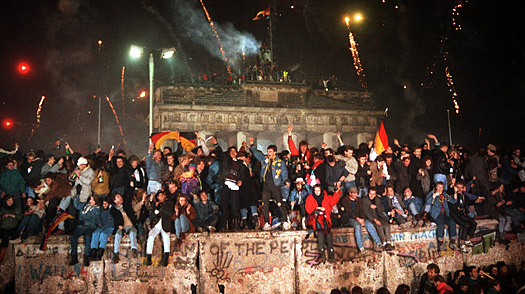
This past weekend, German citizens turned out en masse to recognize the 50th anniversary of East German authorities putting up the Berlin Wall. Coming 15 years after Winston Churchill’s Sinews of Peace speech, this barrier was the embodiment of the Iron Curtain that the British Prime Minister (ex-PM at the time) had spoken of in March 1946. The Wall not only carved Berlin in twain, but also the political and philosophical world–with liberal democracies with capitalist economic models on the western side and the totalitarian Communist regimes on the eastern.

Many desperate souls from the east (at least 136 reported, with many other likely not counted) died trying to get over the wall and with each failed attempt, the dreams of families hoping for a different life in the west perished, too. The commemoration in Berlin was no celebration, but rather a somber affair marked by church bells pealing out and flags billowing in the breeze at half-mast on the Reichstag. In the spot where the wall stood is now a chapel, which held a memorial service for those who lost their lives during the Wall’s 28-year history.

Before the concrete monstrosity went up, more than 2.5 million Germans had gone to the Allied occupation zones in the west of the city, according to The Daily Telegraph. One of the reasons for constructing the wall was the fear that this flight would leave the eastern part of the city economically destitute. Yet it was also, in many ways, a barrier to keep things out, not least “dangerous” Western ideas about freedom of the ballot box, speech and expression. The 96 miles of guard-patrolled, barbed wire-topped fortification also served the purpose of keeping Western officials and journalists out of Communist Eastern Germany and the nations beyond, preventing them from exposing the continued abuses of power and suppression of individual rights there.

Though it seemed so intimidating and so permanent for so long, the Berlin Wall was only as strong as the Soviet Union and its puppet regimes that had conceived it. By the time Ronald Reagan famously issued his June 1987 plea at the Brandenburg to Soviet General Secretary Mikhail Gorbachev, “Mr. Gorbachev, tear down this wall!”, the bedrock of the U.S.S.R. was already cracking under the pressure of freedom movements in Eastern Europe, an unsustainable military budget, and a flagging economy, not to mention the flourishing of new political ideas within Moscow’s halls of power.

The fall of the Wall two and a half years later, on November 9, 1989, did not solve Germany’s problems, and, in fact, the convergence of two radically different populations presented many new challenges. However, its demise was the symbolic nail in the coffin of the U.S.S.R. and thus, half a century after its creation, the Berlin Wall invokes thoughts of hope, as much as sorrow.

Tuesday, July 19, 2011

Russian History Roundup

.
Michael Johnson, "A Romp Through History," American Spectator, July 18, 2011

Alexander Motyl was clearly having great fun when he wrote his latest book, The Jew Who Was Ukrainian, a comic novel with half-serious historical underpinnings. It manages to amuse and challenge without losing its headlong momentum into the realm of absurdist literature.>>>

Jennifer Siegel, "A Statesman For the Czar," Wall Street Journal, July 18, 2011

No political figure looms quite as large over late imperial Russia as Sergei Iulevich Witte. Among much else, he was Russia's finance minister from 1892 to 1903; its plenipotentiary representative at the Portsmouth negotiations ending the Russo-Japanese War; the foremost instigator of the manifesto that introduced moderate parliamentary representation and united government into the autocratic empire in the wake of the 1905 Revolution; the country's first prime minister; the political and financial architect of the Trans-Siberian Railway; and the mastermind behind the stabilization of the ruble and the implementation of the gold standard, through the construction of an intricate web of foreign capital investment in the empire.>>>

Tony Halpin, "Gulags reveal awful secrets," The Australian, July 18, 2011

The journey to the heart of Joseph Stalin's reign of terror was long and arduous. Finally, hidden behind a clump of trees, the gulag emerged. This is where victims of Stalin's repressions were imprisoned as slave labourers and worked to death on the Road of Bones, the notorious Kolyma highway that connects Khandyga to the port of Magadan, in Russia's far northeast.>>>

Gary J. Bass, "Why the Crimean War Matters," New York Times, July 8, 2011

The Crimean War was the first major war to be covered by professional foreign correspondents, who reported on the disastrous blundering of commanders and the horrors of medical treatment at the battlefront. Today, we remember fragmentary stories: the charge of the Light Brigade, symbolizing the blundering; Florence Nightingale, for the medical treatment. But the real war has faded away, eclipsed by the two vastly worse world wars that were to come.>>>

Thomas Gladysz, "He Who Gets Slapped," San Francisco Chronicle, July 4, 2011

As its closing film, the San Francisco Silent Film Festival will show He Who Gets Slapped (1924). It is, in my mind, the finest "sad clown" movie you'll ever see.

He Who Gets Slapped tells the story of "HE," a disgraced intellectual forced to find work as a circus clown. His popular act consists of being repeatedly slapped by the other clowns whenever he attempts to speak even a simple truth. The crowd, which likes to laugh at the misfortunes of others, loves this bizarre and rather pathetic act.>>>

Thursday, March 31, 2011

Looking East to the Past

Randall Stephens

"Ostalgie." That's East German nostalgia for the quaint days of communism--drab, bunker-like, late-Stalinist architecture, watches that don't work, tiny little cars, and the romance of scarcity. I encountered a slice of that for the first time in the dark comedy film Good Bye Lenin! Since then I've been curious about this strange sort of public memory. A little like being nostalgic about
the Dust Bowl? (Watch the East German National Anthem scene from Top Secret, embedded here.)

A related travel piece that recently appeared in a UK paper got my attention: Stephen McClarence, "Trains and Trabants," Yorkshire Post, 6 March 2011 19:00

FEW cities are as haunted by their past and their politics as Berlin. Around almost every corner there’s a reminder of its turbulent 20th century history – and one of the most potent of those reminders is being celebrated, if that’s the word, this year.

August sees the 50th anniversary of the building of the Berlin Wall and I’ve come to explore what remains of it and the divisions it created across the city. It’s not, however, a wholly sober trip. I’ve signed up for a tour in a Trabant, the notorious national car of East Germany, and there’s the prospect of mainland Europe’s biggest department store. . .

The nostalgia flourishes in a movement called Ostalgie – “nostalgia for the East” – which is celebrated at the absorbing DDR Museum. It explores East Berlin life before the Wall came down in 1989. Visitors poke around a recreated 1970s flat, with its floral wallpaper, net curtains, cassette player, copies of Sputnik magazine... and radiators, we’re alarmed to see, exactly like our own at home.

In the late 1990s Daphne Berdahl wrote an influential essay on the phenomenon: "'(N)Ostalgie' for the Present: Memory, Longing, and East German Things," Ethnos: Journal of Anthropology 64:2 (1999). After the fall of the Berlin Wall, objects and goods from the East became instant camp for West Germans. But the shoddy products of the East also took gave some weird, sentimental comfort. "In this business of Ostalgie," writes Berdahl, "East German products have taken on new meaning when used the second time around. Now stripped of their original context of an economy of scarcity or an oppressive regime, these products largely recall an East Germany that never existed. They thus illustrate not only the way in which memory is an interactive, malleable, and highly contested phenomenon, but also the processes through which things become informed with a remembering--and forgetting--capacity" (198).

Sounds like a fun way to get at "memory" vs "history"!

Tuesday, February 15, 2011

Ronald Reagan vs College Students, 1967

Randall Stephens

"NEW HAVEN, Dec. 4 [1967]--Gov. Ronald Reagan of California, who said he had never taught anything before except swimming and Sunday school, sat on a desk at Yale University today and conducted a class in American history." So reported the New York Times on the Gipper's visit to the ivy, where he was met with student protests and plenty of probing questions (December 6, 1967).

"Should homosexuals be barred from holding public office?" a senior from LA asked. The governor was surprised by the question. Rumors had been swirling that his administration had fired two staff members after their sexual preferences came to light. "It's a tragic
illness," said Reagan, after a pause. And, yes, he did think that homosexuality should remain illegal. Some students earlier had demanded that the school rescind its invitation to Reagan. The governor, who visited Yale as a Chubb fellow, gave his $500 honorarium to charity.

The confrontation between the 56-year-old governor and Yale students in 1967 speaks to the culture wars that roiled the decade and continue to reverberate to this day. In the video embedded here the students, with haircuts that make them look like clones of Rob from My Three Sons, square off with Reagan on poverty, race, and Vietnam.

The commemoration of the one-hundredth birthday of the 40th president brought with it the usual fanfare of radio specials, documentaries, guest editorials, and the like. The new HBO doc
Reagan, like PBS's American experience bio, spans the actor-turned-politician's career. (Watch the latter in full here.)

Lost in the telling, sometimes, is the scrappy, intensely ideological cold and cultural warrior from the 1960s and early 1970s. To correct that a bit, see the governor go at it with the somewhat nervous Yalies. Or, observe him lashing out against that "mess in Berkeley." (A clip from the HBO doc showing the governor dress down Berkeley administrators shows that pretty well.) The public memory version--rosy-cheeked, avuncular, sunny--overshadows that more fiery aspect of his personality and politics.

Americans remember their leaders as they choose. (The myths and legends are as stubborn as a Missouri mule.) But it is good to remind ourselves that the politicians and public figures we revere and/or study are rarely as one-dimensional as we'd sometimes think they are.