Showing posts with label Family History. Show all posts

Thursday, October 17, 2013

When History Hits Home

Elizabeth Lewis Pardoe


In my job as a fellowships advisor I stress to applicants that a strong application demonstrates three things: depth of expertise in a given field; breadth of interests and experiences; and the applicant’s change over time, i.e. history. The third pillar of the triad constitutes the all-important biographical element. Americans' hunger for personal history makes Ancestry.com’s stockholders rich and guarantees the flood of genealogists to the shores of Salt Lake.
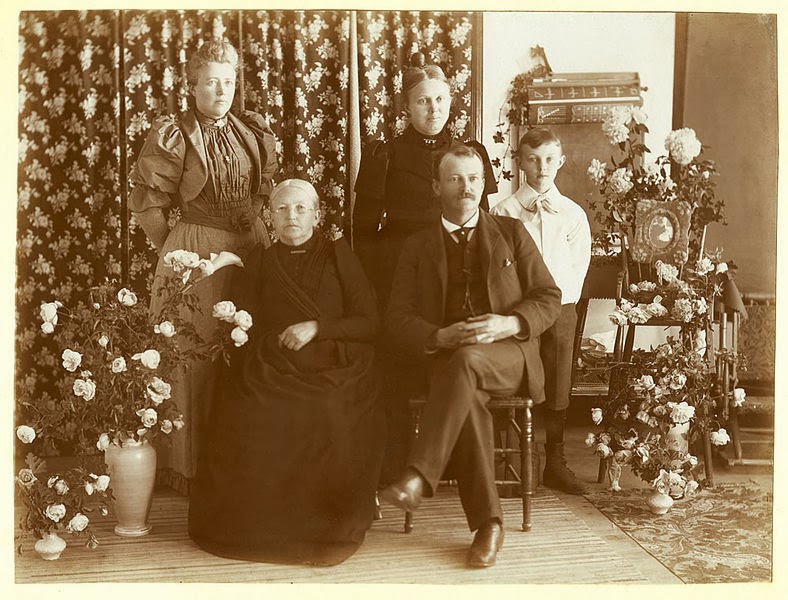
The Ball family of Lompoc, California, ca. 1894. 
My sons started high school and middle school at the end of August. As I delivered my nearly­ men to the doors of their new institutions, my desire to make history from memory overwhelmed me. The hundreds of digital images stored on the family computer cried out for a chronology with which to capture the evolution of my chubby-­cheeked chappies into the skinny tweens who seek escape from their mother’s needy embrace.

My compulsion has since produced three photo­books, and I am at work on two more. My mother used to assemble such tomes from the fragile prints of an earlier age. My photo­books exist in a cyber “cloud” as well as on my coffee table. My ability to shape the past into the form I like resembles the easier editing now accessible to authors of all history books. While David Hume wrote by hand and Oscar Handlin clattered at a keyboard, post­modern respondents to Clio’s call can, in a matter of seconds, place images on pages and produce flourishes that only the most able medieval monks could make over many days.

Monday, July 8, 2013

A Preview of Historically Speaking, June 2013

Randall Stephens

In not too long Project Muse will post the June issue of Historically Speaking.  In the meantime, copies are being shipped across the country and overseas to subscribers. 

The latest issue contains a lively range of essays.  This month we have the last of Joe Amato's three essays on revitalizing local history. Here he sketches a sensory history of 20th-century rural America. He then explores some causes and effects of the countryside’s marginalization in modern American society. On a related note, Don Yerxa interviews Canadian cultural historian Constance Classen about sense history.  Classen has written extensively on the senses, exploring the lived experiences of embodiment from the Middle Ages to modernity and helping us appreciate the tactile foundations of Western culture.  

Also in this issue are pieces on history and political thought, Mormon historical studies, Stalin and Nazi Germany, Civil War naval history, Britain and the Treaties of 1713 and 1763, family life in colonial New England, and a critique of hagiographical popular history. To round it out, Sean McMeekin speaks with Don Yerxa about the significance of July 1914 and the coming of World War I.

Thursday, February 14, 2013

Theodore Roosevelt and Valentine’s Day

Heather Cox Richardson

While for many people today February 14 brings images of candy, roses and a fancy dinner, for others that day has brought tragedy. To few has it brought more heartache than to Theodore Roosevelt.

February 16, 1880, marked one
Alice Hathaway Lee Roosevelt (1861-1884)
of the happiest days of TR’s life. He and the woman he had courted for more than a year, Alice Hathaway Lee, announced their engagement. Roosevelt was over the moon: “I can scarcely realize that I can hold her in my arms and kiss her and caress her and love her as much as I choose,” he recorded in his diary. The next four years were, according to TR, “three years of happiness greater and more unalloyed than I have ever known fall to the lot of others.”

Just four years later, on February 12, Roosevelt’s beloved wife Alice gave birth to the couple’s first child, a daughter, in the family’s New York City home. TR was at the state legislature in Albany, and learned the happy news by telegram. But Alice did not recover from the birth; she slid downhill from something at the time called “Bright’s Disease,” an unspecified kidney illness. A doctor friend tells me was probably caused, in her case, by a strep infection, incubated in the teeming city’s crowded homes.

Thursday, February 7, 2013

Black History Month: What We Owe to the Black Domestic Servants of the Jim Crow South

Katherine van Wormer*

Cheering a speaker in a Montgomery
bus boycott church meeting. From Life
magazine, February 6, 1956.
For Black History Month, let us honor the women who worked as domestic servants for white families in the Jim Crow South. They endured the indignities of segregation to help support their families. Moving in between black and white worlds, such women played enormously important roles in the first successful Civil Rights struggle: the Montgomery bus boycott of 1955-56, where the young Martin Luther King, Jr., got his start. 

David W. Jackson III, Charletta Sudduth, and I (one the descendant of Louisiana slave owners, the others the descendants of slaves) have written a book based on interviews with former housekeepers, caretakers, and cooks and members of the white families they worked for, The Maid Narratives: Black Domestics and White Families in the Jim CrowSouth (Louisiana State University Press, 2012). 

Wednesday, February 6, 2013

Birth Control in the First Half of the 19th Century*

Dan Allosso
 
Charles Knowlton believed that his enemies’ big objection to The Fruits of Philosophy, which he published in 1831 and was imprisoned for in 1833, wasn’t so much that it gave people the power to reduce the sizes of their families, but that he had claimed in his “Philosophical Proem” that religion should have nothing to say about the matter.  He was jailed for three months at hard labor, Charles said, “ostensibly, for diffusing scientific knowledge of practical utility; but, really, for giving thee a small pill in connection with it, slyly wrapped up, which thou canst not swallow.”  Other freethinkers, such as Abner Kneeland and Robert Dale Owen, focused on the idea that by giving regular people the ability to limit family sizes, they were instigating a major social change.  By reducing the number of poor wage-workers, they said, families would become better able to demand higher wages and the money they earned would go farther toward giving all children the nourishment and educations they needed.  Most freethinkers agreed that it was important to give everybody the right to choose, and that the social reforms they supported would be advanced by effective family planning.

So was Knowlton’s method effective?  Should he be remembered as an early champion of the idea of choice, or as someone who actually helped people change the sizes of their families in ways that led to social change?  Either way, he was ahead of his time and helped move American society from its Calvinist roots toward the world we live in today, where for most people the choice to have children and how many to have is just assumed to be a private, family decision.

Monday, January 14, 2013

Reeling in the Years: The Up Series

Randall Stephens

It's been seven years. That means it's time for another installment of the perennial favorite UP Series, which has followed the lives of over a dozen English men and women since they were 7. (The latest is running on PBS this month.) Granada Television first aired the program in 1964.  Other updates came in 1970, 1977, 1984, 1991, 1998, 2005, 2012.  The brainchild of Michael Apted, the series has tracked the participants hopes, fears, interests, successes, failures, and more. It ranks as one of the best, most original documentaries of the 20th century.

Fifty years ago Apted hoped to shine light on the deep class divisions in England and to see how that would shape the lives of these individuals as the grew into adulthood.

Here's what Rebecca Mead writes about it at the New Yorker blog (January 9, 2013):

The series began with a political agenda. Taking the Jesuit maxim “Give me a boy until he is seven, and I will give you the man,” it suggested that the prospects of the participants were determined by the class into which they were born. To a certain extent, this turned out to be true, particularly for those participants belonging to the social and educational élite. John, the prep-school boy, became a barrister, while his classmate Andrew became a solicitor. . . Less predictable were the fates of the working-class and middle-class characters.

Monday, May 28, 2012

Exploring Family History

Randall Stephens

This weekend NPR featured an interesting story about one scholar's quest to learn more about his family.
Eyre Crowe, Slaves Waiting for Sale, Richmond, Virginia, ca. 1861

"Lawrence Jackson went through most of his life not knowing much about his family history," reports Guy Raz.  Continues Raz:

So he began a search, armed with only early boyhood memories, for his late grandfather's old home by the railroad tracks in Blairs, Va. Jackson describes his journey in a new book, My Father's Name: A Black Virginia Family after the Civil War.

Shortly after Jackson began a search for his roots, he found out his great-grandfather was a slave.

"If you said to me that my father's grandfather grew up in slavery and actually spent maybe the first 10 or 15 years of his life as human chattel, I wouldn't have been able to take that idea so seriously" . . . 


This short segment well illustrates how the past still impacts the present.  A course that deals with 19th century US history might make use of stories like this.  In addition programs like Henry Louis Gates' African-American Lives uncover the past in a very personal way.  What better sense could students get of the significance of history?

I'll admit, I've never incorporated a genealogy project into the curriculum.  Yet, stories like these above make me wonder if it would work.