Showing posts with label Ancient History. Show all posts

Friday, February 28, 2014

Robin Hood and Remote Rule

Elizabeth Lewis Pardoe

British North America developed from a landscape of religions into a nation of races over the course of the eighteenth century.This process culminated in a hot, locked Philadelphia hall in 1787, but the lessons upon which the drafters drew reached back to the Reformation of the sixteenth century and earlier to Rome.

Americans had, after all, just rejected their inclusion in the British variant. If they failed to grasp the significance of their success, Edward Gibbon’s Decline and Fall of Rome, David Hume’s History of England, and the tales of Robin Hood1 served to remind them of the dangers of remote rule.


Early Modern Europe possessed two empires with established Protestant populations inhabiting borders under perpetual threat.The Holy Roman Empire’s borderland Protestants included the Southwestern Germans of Wuerttemberg and the Rhineland-Palatinate, for whom “cuius regio, eius religio” offered precious little protection from neighboring Catholic armies. The British Empire sent forth Scots to settle among and pacify the Catholics a few leagues away in Northeastern Ireland. These two groups moved away from their fraught locations on Europe’s bloodiest frontiers topopulate the so-called backcountry of eighteenth-century British North America from the Kennebec to the Altamaha.2

Friday, January 10, 2014

Roundup: Digging up the Past

.
"Ancient Ancestors Come to Life," National Geographic, January 3, 2014

See our ancient ancestors come to life through paleoartist John Gurche's realistic human likenesses for the Smithsonian's Hall of Human Origins.
"The human story is really nothing short of the story of a little corner of the universe becoming aware of itself," says Gurche.>>>

Louise Iles, "Year in digs: How 2013 looked in archaeology," BBC, December 31, 2013

. . . . This year's research also gave us a glimpse into the private lives of our hominid cousins, reopening debates that might shed light on the evolution of our species.

The first complete Neanderthal genome was published, at the same time showing inbreeding within Neanderthal groups as well as reports of interbreeding between Neanderthals and anatomically modern humans.>>>

Thursday, December 5, 2013

Life Is a Verb

Steven Cromack

The study of antiquity in American schools is superficial, lackluster, and in a state of asphyxia. State curriculum frameworks have all but stripped the histories of ancient Greece and Rome of depth, meaning,
Ancient bust of Seneca.
and relevancy. Ancient Greece was more than the origin of democracy, more than a group of city-states, and stood for more than a mythology. Rome was not just an empire, and it offered the world more than the concept of a senate. At the heart of these cultures was the idea that life is a verb, something that humans must do; something they must will into their world.

Greek democracy failed miserably. The other city-states quivered under the threat of Athens and her oppressive empire. Furthermore, the Greeks often envisaged humans caught in a double-bind, ensnared in webs of conflicting moral obligations between their relations and the meddling gods. As a result, the Greeks thought themselves to be better off dead than living. “For man the best thing is never to be born, never to look upon the sun’s rays,” bemoaned Theognis of Megara. “That the best thing for a man is not to be born, and if already born, to die as soon as possible,” bewailed Silenus.
 

Wednesday, August 7, 2013

Got Lactase?

Randall Stephens

In a recent issue of Nature, Andrew Curry offers up the latest theories on milk and civilization in the West.  How and why did ancient herders supplement their diets with cheese roughly 6,800 to 7,400 years ago?  Who were these early cheese makers? What were the results of the new cheese diet and the later reliance on milk?

Says Curry:

farming started to replace hunting and gathering in the Middle East around 11,000 years ago, cattle herders learned how to reduce lactose in dairy products to tolerable levels by fermenting milk to make cheese or yogurt. Several thousand years later, a genetic mutation spread through Europe that gave people the ability to produce lactase — and drink milk — throughout their lives. That adaptation opened up a rich new source of nutrition that could have sustained communities when harvests failed.


Monday, April 29, 2013

Science, Religion, and the Modern West: The April Issue of Historically Speaking

Randall Stephens

In the coming week the April 2013 issue of Historically Speaking will be posted to the Project Muse site.  Subscribers can expect it soon in mailboxes.  The issue includes essays on environmental history, ancient religion, teaching, and Harry Truman.It also features interviews with Matthew Bowman on Mormonism in American history, John R. Gillis on seacoasts in history, and turning points of World War I with Ian F.W. Beckett. 

In addition the April issue includes a lively forum on "Scientific Culture in the Modern Era" with intellectual historian Stephen Gaukroger (University of Sydney).  "One of the most distinctive features of Western culture since the 17th century is the gradual assimilation of all cognitive values to scientific ones," writes Gaukroger in his lead essay. "A particular image of the role and aims of scientific understanding is tied up in a very fundamental way with the self-image of Western modernity. One striking illustration of this is the way that the West’s sense of what its superiority consisted of shifted seamlessly in the early decades of the 19th century from religion to science. From that time on, but particularly in the second half of the 20th century, this self-understanding has been exported as an essential ingredient in the process of modernization."

Thursday, January 3, 2013

History through the Eyes of . . . Pytheas the Greek

Randall Stephens

I've been reading Peter Ackroyd's wonderful Foundation: The History of England, Volume 1 (Pan, 2012). In typical fashion, Ackroyd's prose sparkles and he ranges effortlessly from the misty realms of prehistory to the demise of the first Tudor monarch, Henry VII, in 1509.  Fascinating anecdotes, panoramic descriptions of geography, and the voices of the dead make the book come alive.  One character in particular in the early pages piqued my interest. 

He was one of the earliest travelers to describe the landscape and customs of the British Isles. Greek geographer and explorer Pytheas made his voyage to northern Europe in roughly 325 BC.  Pytheas's chief work, On the Ocean, is lost somewhere in the dustbin of history.  But, we know of his discoveries through the Greek historian Polybius and the Greek geographer Strabo, as well as Pliny the Elder in later years.  And he was cited by around 18 others as well.

Here is Strabo on suspicions surrounding the Greek wanderer: "Pytheas asserts that he explored in person the whole northern region of Europe as far as the ends of the world—an assertion which no man would believe, not even if Hermes made it." Zing. The ancients used him as a model of untrustworthiness.  He was, in their words, a liar.

Wednesday, June 20, 2012

Ἀρετή: The Greek Way to Define Life

Steven Cromack

Achilles and Patroclus, from a red-figure kylix, ca. 500 BC
While Americans pride themselves on being the first great individualistic nation, the idea of self-actualization is actually distinctly Greek.  The Ancient Greeks called the idea of being “the best you can be” or “reaching your highest potential” areté.[1]   Achieving areté was the Greeks’ reason for living, and a matter of honor (timé).  This sense of life, however, also stemmed from their sense of death.  The Ancient Greeks were a death-centered culture.  Having nothing to die for meant one had nothing for which to live.  When that reason to die became clear—for one’s polis or family, for the honor of one’s leader, or for a friend, life became meaningful and precious.  Achieving areté made life worth living, valuable, and therefore offered a means for the Greeks to meet death head on.   

Nothing captures areté better than the characters in Homer’s Iliad.  Its characters champion “reaching your highest potential.”  The story revolves around Achilleus[2],  the great Achaean warrior who undergoes an internal struggle to find a reason to die.  Everybody is going to die eventually, and each character is aware of this, as is the rest of Greek society.  Because all humans have to die, however, they should earn a noble death.  Society will then remember them with honor.  Those individuals who give their life for what they value become institutions, immortals, and heroes. 

Having withdrawn from the Trojan War, Achilleus allowed his good friend Patroklos to enter battle wearing his personal armor.  During the battle, however, the Trojan prince Hektor killed Patroklos.  The death of his dear friend at the hands of the Trojans drove Achilleus into a rage.  He now had something for which to die.  Achilleus could now fight and die for Patroklos, as Protoklos fought and died for him.  In doing so, Achilleus could now live gloriously—fight with all his might against the Trojans.  He declared, “Now I shall go, to overtake that killer of a dear life, Hektor; then I will accept my own death, at whatever time Zeus wishes to bring it about, and the other immortals.”[3]   When Achilleus arrived on the battlefield, Athene circled his head, from which came a great blaze of fire.  Homer writes, “There he stood, and shouted, and from her place Pallas Athene gave cry, and drove endless terror upon the Trojans.  As loud as comes the voice that is screamed out by a trumpet by murderous attackers who beleaguer a city.”[4]   Achilleus became the best he could be on the battlefield.  He was full of life and glory, something that only came with the death of his best friend.  With that newfound sense of life, Achilleus won the war for the Achaeans.

The Greeks not only loved Homer’s characters, but also internalized timé.  Such was the case during the Greco-Persian Wars.  When Persia invaded Greece, Athens was in grave danger.  If conquered, the Athenian people would fall under the tyranny of Persia.  And so, the Athenian soldiers met their enemy at the shores of Marathon for a final stand.  They were ready to die for their families and their polis.  When the battle began, the Athenian hoplites charged the Persian troops at full speed.  According to Herodotus, “The Persians, therefore, when they saw the Greeks coming on at speed, made ready to receive them, although it seemed to them that the Athenians were bereft of their senses, and bent upon their own destruction.”[5]   The Athenians were indeed “bent upon their own destruction,” since they were ready to die.   That day, the Athenian hoplites “fought in a manner worthy of being recorded.”[6]   The Greeks found their reason for living, the preservation of their city-state.  These hoplites believed that if they were going to die, they might as well do so with a sense of timé.  At Marathon, because the Greeks were willing to die for their families, their polis, and for each other, much like Achilleus did, they were able to push the Persians out of Greece.

Ἀreté, as defined by the characters of Homer’s Iliad, and internalized by the Greek soldiers was what gave many Greeks meaning.  If the Greeks could find those things most precious to them, then they could live (and die) gloriously.

__________________

1. Richard Hooker, "Areté," Washington State University, http://www.wsu.edu/~dee/GLOSSARY/ARETE.HTM

2. I used the Lattimore translation, which uses Achilleus, as opposed to Achilles.  For the evolution of the name, see Herbert Jordan at http://www.iliadtranslation.com/homeric_names.html

3. Homer, The Iliad, trans. Richard Lattimore, (Chicago: University of Chicago Press, 1951), 18.114-116.

4. Ibid., 18.204-220.

5. Herodotus, The Persian Wars, trans. George Rawlinson (New York:, 1942), 6.112.

6. Ibid.

Monday, June 4, 2012

Coping with the Tyrants

Steven Cromack

Caesar Augustus
Nearly a century of civil war, in the 1st century BC, led to the collapse of the Roman Republic and shattered the spirit of the Romans.  The Romans needed to come to a new understanding of “emperor.” They populous also coped with the loss of everything they had held most dear—honor, pudor, and virtus.  Flattery, lying, accusations, hypocrisy, and outright insubordination were common tools utilized to numb the pain of living under tyrants.  Ultimately, these Romans hoped to maintain some shred of dignity and honor.

Before the civil war, the Romans hated tyrants.  They idolized the story of Brutus who declared after killing the King, that there would never be a King of Rome, again.  After a century of fighting, however, the Senate, composed of Rome’s most prominent and ancient families, was ready to crown a King and end the violence.  When Augustus came to power, the Senate bestowed upon him the title, “Father of His Country.”  According to the historian Suetonius, in his work The Twelve Caesars, the representative chosen to speak for the Senate told Augustus, “The Senate agree with the People of Rome in saluting you as Father of your Country.”  Augustus responded with a tear in his eye, “What more can I ask of the immortal Gods than that they may permit me to enjoy your approval until my dying day?” (76-77). The only way for the people of Rome to return to the peaceful existence they enjoyed before the wars was to declare Augustus king.  By forcing themselves to bow before Augustus, they would have their lives back.  They yearned for that peace and tranquility—at any cost, even if that meant giving up what they had held dear for five hundred years.

Flattery was the most common tool utilized by the Romans to cope with their newfound emperors.  Romans voluntarily made gods of their tyrants.  They put them on a pedestal by applauding the emperor’s horrible deeds.  They supported and affirmed the decisions and spectacles of the tyrants.  By doing this, they made their nightmare easier to bear. 

The emperor Nero (who lived from 37 to 68 AD) loved to sing and according to Suetonius, he was awful at it (217), and yet, the people flattered him by cheering.  Suetonius wrote of Nero’s singing, “Cities which regularly sponsored musical contests had adopted the practice of sending him every available prize for lyre playing.”  People would invite Nero to dinner and beg him to sing.  Suetonius continued, “They would beg Nero to sing when the meal was over, and applaud his performance to the echo . . . .” (219)  Romans did not confine this flattery to Nero’s musical talent.  Nero was in a chariot race.  During the race, he fell off the chariot, could not continue, and left early.  Nevertheless, the judges declared him the winner and awarded him the prize (220).  If the judges had awarded the prize to any other contestant, Nero would have gotten angry, and no one wanted to provoke the anger of the emperor.  This is why they tried so hard to flatter and humor their tyrants’ every wish.

Every act of flattery was an attempt to keep the emperors content and calm because the tyrants’ anger was frightening.  Romans did not want to invoke or witness such fury.  Caligula often declared, “Let them hate me, so long as they fear me” (161).  He would confine those individuals who criticized his shows or failed to call him genius in cages.  These prisoners had to crouch on all fours like animals.  If they refused, Caligula had them sawed in half (160).  Caligula also required citizens to bequeath something to Tiberius or himself.  If any person did not, Caligula voided their will.  Suetonius wrote, “People would openly declare that he was one of their heirs, with strangers listing him among their friends and parents among their children; but if they continued to live after the declaration he considered himself tricked, and sent several of them presents of poisoned sweets” (166).  In flattering the tyrant by declaring him their child, many Romans hoped he would leave them and their families alone so that they could just live their lives in peace. 

During this period, the Romans suffered from hopelessness.  They wallowed in anguish as they reflected on the fact that they no longer had what made them Roman.  Honor, or the internal spirit that drove an individual’s existence, was gone.  Cicero in his Ad Atticum wrote, “The sun, as you say in one of your letters, seems to me to have fallen out of the universe.  As a sick man is said to have hope as long as he has breath, so I did not cease to hope [that life could go on as usual] so long as Pompey was in Italy.”  It is no wonder the Stoicism, Epicureanism, Cynicism, and Christianity emerged during the Empire years.

Wednesday, March 14, 2012

The Confucians Who Saved Middle Earth

Steven Cromack

It is particularly hard to get students interested in United States history. But this can seem almost impossible when studying ancient civilizations. How could a teacher get her students interested in Confucianism? If 19th-century U.S. history seems distant, what about the Warring States period in 481 B.C.?

One of the ways might be to take the ideas Confucius posited and find them in today’s culture. According to Confucius, an individual must be great, humble, and exhibit tremendous self-discipline. In The Lord of the Rings, Frodo and Sam are Confucian heroes. A teacher can use Tolkien’s Middle Earth to examine Confucianism and the Warring States Period of China.

In Tolkien’s Lord of the Rings, Middle Earth stands upon the brink of destruction. All that the dark lord Sauron needs to destroy the world is his “ring of power.” Frodo Baggins, a hobbit, possessed the one ring and brought it to the Council of Elrond. There he sat quietly as the leaders of the free races debated what to do with the ring. Eventually, the group decided that someone must cast the ring back into Mount Doom, where it was forged. No one, however, could agree on who could or should take the ring. At long last Frodo volunteered to carry the burden, bear its suffering, and resist the temptation to use its power. Tolkien writes, “At last with an effort he spoke, and wondered to hear his own words, as if some other will was using his small voice. ‘I will take the Ring,’ he said, ‘though I do not know the way.’”[1] In the wake of this declaration, the free peoples of Middle Earth rallied behind the hobbit, and so began the journey of the fellowship of the ring. Throughout the journey, Frodo was tempted to use the ring and to surrender to its temptation. But, he resisted, often with the help of friend Sam.

With the collapse of the Zhou Dynasty, China entered a civil war that would last for several centuries. At the center of the Warring States conflict was a debate over the role and purpose of the emperor. In his Analects, Confucius posited that the king needed to exhibit te, or the great magnetic, moral force produced by holding fast to the “way of the ancestors,” (the tao.) In order to do this, the king had to follow the li, or the traditional, ritually prescribed actions including etiquette. In The Analects, the Master [Confucius] said, “He who rules by moral force (te) is like the pole-star, which remains in its place while all the lesser stars do homage to it” (Analects, Book 2, Ch. 1). Confucius continued that the king must, “govern them by moral force (te), keep order among them by ritual (li), and they will keep their self respect and come to you by their own accord” (2.3).

Confucius’s words about how the king should act were merely an idealistic vision of what a good emperor should look like. He saw the reality of the Chinese monarchy: every dynasty rose in the glory of victory and fell violently from power. For Confucius, there was no good king, no savior, no real exhibitor of te at the top. Confucius believed that no living man could separate himself from the corrupting power that comes with ruling. If the king at the top could not provide order to tame the chaos, or provide stability for the bottom, what hope was there for the world, or those living in it?

Confucius believed that humans could impose their will on the world. As there was no savior coming to rescue the world, every person must act as the good king. Each individual must be the savior of everyone else and have the wholeness of a king. Everyone must exhibit te. On the part of the person, this takes tremendous self-discipline (8.4). According to the Analects, self-discipline meant that individuals must overcome selfish desires, remove all traces of arrogance, and “be loyal and true to your every word, serious and careful in all you do.” As for the person who has “taken goodness for his load,” as Frodo did, Confucius wrote (8.3):

In fear and trembling,
With caution and care,
As though on the brink of chasm
As though treading on thin ice.

Frodo and Sam took “goodness” for their loads and acted because Middle Earth was “on the brink of chasm.” For Confucius, the tao was “the way” to take control of the chaos, to free oneself from the pain of living in the midst of civil war or strife. Every individual has the capability to do this.

In The Lord of the Rings, Frodo and Sam exhibited te (moral force). They held fast to the simple ways of their people and were not corrupted like the race of men. They were the saviors of Middle Earth, had the wholeness of kings, and exercised tremendous self-discipline to resist a multitude of temptations. In the wake of their willingness to make the impossible possible, Middle Earth fell in line behind them. Frodo and Sam stepped in and acted as great kings.

What other Confucian heroes can you think of?
_______________

[1] J.R.R. Tolkien, The Lord of the Rings: The Fellowship of the Ring (New York: Houghton Mifflin, 1954), 264.

Monday, February 6, 2012

American Pre-history

Dan Allosso
.

I thought I’d try something different this fall, to add an element of perspective and Big History to the beginning of my US History survey.


So I pulled some of the latest ideas from genetics-enhanced archaeology from books I’ve read recently, including Clive Finlayson’s The Humans Who Went Extinct: Why Neanderthals Died Out and How We Survived, Colin Tudge’s Neanderthals, Bandits and Farmers: How Agriculture Really Began, and David J. Meltzer’s First Peoples in a New World: Colonizing Ice Age America. Although most textbooks nowadays briefly mention pre-Columbian America, the impression you get is of a pre-history that is vaguely understood, remote, and largely irrelevant to American history. By starting my syllabus at 36,000 BP rather than 1492 and devoting my first lecture to “Pre-history,” I tried to suggest to the students that the pre-Columbian American past is interesting and relevant.


Of course, you’d be interested in pre-Columbian Americans if you carried their blood, and I thought my students might be interested to know that outside the U.S., the majority of Americans are partly descended from the people who were here when the Europeans arrived. Norteamericanos are unique in the degree to which we didn’t mix, although the Mexicans and even the Canadians did much better than those of us living in the middle third of our continent. And I thought my students ought to understand that three out of the five most important staple crops in the modern world (maize, potatoes, and cassava – the other two are rice and wheat) were developed by early American farmers. Even the 2010 textbook I’m using fails to escape the gravity-well of the master narrative, repeating the myth that Indians were poor farmers and that agriculture was invented in the eastern Mediterranean and later in China.


Finally, I was really fascinated (and I hope some of my students were as well) by the recent developments in theories of migration. Although anthropologists are not yet unanimous on the issue, there is growing support for the theory that most of the people alive today are principally descended from an ancestral population of plains hunter-gatherers who migrated from Africa between 80,000 and 50,000 years ago and settled on the steppe north of the Black Sea. When the last ice age began, steppe and tundra environments spread across Eurasia from the Atlantic to the Pacific, and these people followed the herds of caribou, mammoth, and wooly rhinoceros. The plains hunters prospered as earlier human populations and their temperate forest habitats dwindled. By about 30,000 to 26,000 years ago, some of these plains hunters had spread westward into Europe (where based on genetic evidence they mixed with some older groups, including Neanderthals), while others had covered the entire breadth of Siberian and arrived at Beringia, their gateway to the Americas.


Most of my students seemed vaguely aware that the first Americans migrated from Asia across a “land bridge.” I tried to impress on them that Beringia, which lasted for 16,000 years and was 1,100 kilometers wide, was really not a “bridge,” and the people who crossed it weren’t “migrating.” They were living in Beringia and northwestern Alaska, just as they had done for hundreds of generations. But I think the most important element of this story is that it helps the students recognize that Native Americans and the Europeans they encountered in the Caribbean in 1492 were cousins who had expanded in different directions from the same ancestor population. The differences between them were extremely recent – as is recorded history.


As a final example of this recent rapid change, I talked a little about milk. Most people in the world cannot digest milk after childhood. The ability of Europeans to synthesize lactase and digest lactose is a recent mutation, dating to about 10,000 years ago. It corresponds with the domestication of the aurochs into the modern cow (several African groups like the Masai share this trait, but scientists believe they developed it and domesticated cattle independently), and the mutation probably spread rapidly because it gave its bearers a tremendous nutritional advantage in times of famine. This rapid spread of a biological change, I hope, will suggest other ways that Europeans and Native Americans diverged from their shared ancestry, while at the same time reminding my students of this shared heritage.

Monday, December 26, 2011

The Classics in Crisis

Randall Stephens

Over at the NYRB Mary Beard worries that when it comes to the future of the classics "the basic message is a gloomy one." ("Do the Classics Have a Future?" January 12, 2012.) With some horror she writes that "Literally hundreds of books, articles, reviews, and Op-Ed pieces have appeared over the last ten years or so, with titles like 'The Classics in Crisis,' 'Can the Classics Survive?,' 'Who Killed Homer?,' 'Why America Needs the Classical Tradition,' and 'Saving the Classics from Conservatives.'" It all sounds like similar lamentations about the humanities in general, which we have covered here, here, and here.

Beard turns turns questions about decline back on themselves. "What drives us so insistently to examine the 'state' of the classics," she wonders, "and to buy books that lament their decline?" In Beard's view, notes about decline tell us as much about what people think about the classics and what they think about their own era. Reports "on the decline of the classics are not commentaries upon it, they are debates within it: they are in part the expressions of the loss and longing and the nostalgia that have always tinged classical studies." We see our own predicament and the direction of history in the study of the ancients.

In the end, she offers a good defense for the humanities by way of the classics. (Her argument is not unlike those made by Anthony Grafton and others in the NYRB.) "The important cultural point is that some people should have read Virgil and Dante," concludes Beard. "To put it another way, the overall strength of the classics is not to be measured by exactly how many young people know Latin and Greek from high school or university. It is better measured by asking how many believe that there should be people in the world who do know Latin and Greek, how many people think that there is an expertise in that worth taking seriously—and ultimately paying for."

Thursday, June 9, 2011

Editing over the Decades

Randall Stephens

I've worked, at most, 7 years on a single project. But, I'm just one person, toiling on my books and articles. The scholars at the Jefferson Papers--Bland Whitley is one of them--have been editing away for over 60 years. I wonder how long the researches at Yale have been doing the same with the Jonathan Edwards Papers? There must be a record for longest ongoing project. 100 years? 200 years? 1,000 years?

See the June 6 article in the NYT, "After 90 Years, a Dictionary of an Ancient World," by John Noble Wilford. Writes Wilford: "Ninety years in the making, the 21-volume dictionary of the language of ancient Mesopotamia and its Babylonian and Assyrian dialects, unspoken for 2,000 years but preserved on clay tablets and in stone inscriptions deciphered over the last two centuries, has finally been completed by scholars at the University of Chicago."

And the dictionary is more of an encyclopedia than simply a concise glossary of words and definitions. Many words with multiple meanings and extensive associations with history are followed by page after page of discourse ranging through literature, law, religion, commerce and everyday life. There are, for example, 17 pages devoted to the word “umu,” meaning “day.”

The word “ardu,” for slave, introduces extensive material available on slavery in the culture. And it may or may not reflect on the society that one of its more versatile verbs was “kalu,” which in different contexts can mean detain, delay, hold back, keep in custody, interrupt and so forth. The word “di nu,” like “case” in English, Dr. Cooper pointed out, can refer to a legal case or lawsuit, a verdict or judgment, or to law in general.>>>

The dictionary set costs a fortune, but can be downloaded for free in PDF form. So, if you're hankering to know what the earliest recorded wisdom was on love, food, work, law, and more, browse away!

Thursday, May 5, 2011

Ancient History & Archeology Roundup

.
"The Inca Empire," National Geographic (May 2011)

See the extent of the Inca Empire in this interactive map.>>>

Melik Kaylan, "Rare Objects, Rarer Practices," Wall Street Journal, May 5, 2011

Great archaeological finds accrue history and tell fresh stories long after they're snugly ensconced in museums, not least because, as times change, the world asks new questions about ancient cultures and archaeology itself. Were the excavators heroes or looters? Did they, on balance, preserve or harm the site? Do we now approve of the site's original inhabitants—how did they treat their women or minorities? Can we garner any tips on how we might live today? The splendidly informative "Dura-Europos" show at the Boston College McMullen Museum touches on many such matters with dexterity—but it also lets us enjoy the old-fashioned delights of peering across the millennia in wonder.>>>

Megan Gambino, "What Secrets Do Ancient Medical Texts Hold?" Smithsonian (May 2011)

In 2002, Alain Touwaide came across an article about the discovery, some years before, of a medical kit salvaged from a 2,000-year-old shipwreck off the coast of Tuscany. Divers had brought up a copper bleeding cup, a surgical hook, a mortar, vials and tin containers. Miraculously, inside one of the tins, still dry and intact, were several tablets, gray-green in color and about the size of a quarter.

Touwaide, a science historian in the botany department at the National Museum of Natural History, recognized that the tablets were the only known samples of medicine preserved since antiquity. “I was going to do everything I could to get them,” he says.>>>

Peter Thonemann, "The Messiah codex decoded," TLS, April 6, 2011

"Are Lead Tablets Discovered in a Remote Cave in Jordan the Secret Writings About the Last Years of Jesus?” the Daily Mail wondered. “A group of 70 or so ‘books’, each with between five and 15 lead leaves bound by lead rings, was apparently discovered in a remote arid valley in northern Jordan somewhere between 2005 and 2007 . . . . They could, just possibly, change our understanding of how Jesus was crucified and resurrected, and how Christianity was born”: thus the BBC’s religious affairs correspondent. “Containing cryptic messages in Hebrew and Ancient Greek, the codices were etched in an indecipherable code”, added the Daily Telegraph. “Academics speculate that they are actually the lost collection of codices mentioned in the Bible’s Book Of Revelation . . . [they] appear to refer to the Messiah and possibly even to the Crucifixion and Resurrection”: the Mail again.>>>

"The 'Clash' At Marathon Shaped Greece, And The West," NPR, April 25, 2011

At the start of the fifth century B.C., the Persian empire was the world's paramount power, stretching from the Mediterranean Sea to North Africa to the Indian subcontinent. But the Persian emperor, King Darius, did not control Athens — and defeating its much smaller army seemed a relatively small matter.

In September of 490 B.C., Persian troops advanced on 10,000 vastly outnumbered Greek soldiers on the Plain of Marathon. But the Greeks managed to crush the Persian army that day and, as the story goes, ran all the way home to preserve their victory.>>>

Tuesday, January 18, 2011

"A little wine for thy stomach's sake": Wine History Roundup

Randall Stephens

Marc Kaufman, "Ancient Winemaking Operation Unearthed," Washington Post, January 11, 2011

Now actual proof of early vintners comes from a cave near a remote Armenian village, which, perhaps not coincidentally, is within 60 miles of Mount Ararat. Scientists have unearthed a surprisingly advanced winemaking operation, surrounded by storage jars, and say it dates back 6,000 years, making it the earliest known site in the world for wine-making with grapes, by far.>>>

Stephen Meuse, "But Was It Plonk?" Boston Globe, January 13, 2011

The earliest known winery has been discovered in an Armenian cave complex. An international team investigating the site has identified a treading platform for crushing grapes, a vat for storing wine, a drinking cup and bowls believed to be more than 6000 years old.>>>

Wynne Parry, "In Vino Veritas: Wine Cups Tell History of Athenian Life," MSNBC, January 12, 2011

Over centuries, the ancient Athenian cocktail parties went full circle, from a practice reserved for the elite to one open to everyone and then, by the fourth century B.C., back to a luxurious display of consumption most could not afford. The wine cups used during these gatherings, called symposia, reflect this story, according to Kathleen Lynch, a University of Cincinnati professor of classics.>>>

Talia Baiocchi, "Vintage America: A Brief History of Wine in America," eater.com, January 3, 2011

But America's wine history reaches much further back than the 1970s and covers much more ground than the West Coast. In many places, the remnants of 500 years of wine growing and consumption are still evident. Ohio still grows Catawba, the native grape that was the centerpiece of Nicholas Longworth's first commercial winery in the United States in the 1830s; Virginia's Roanoke Island is still home to a 400-year-old Scuppernong vine trained by the Englishmen that washed up there in the late 1500s; and Texas, whose winemaking history dates back to the mid 1600s, may just be the next great American wine producing state.>>>

Jeremy Bowen, "Lebanon's Vines on the Frontline," BBC, January 12, 2011

Compared with the world's wine superpowers, Lebanon's wine production is tiny but its history goes back to the Phoenician civilisation in the ancient world. In Baalbek, in the Bekaa Valley, the Romans left a temple to Bacchus, the god of wine, which still stands.>>>

Thomas Jefferson to M. de Neuville, December 13, 1818, in Memoir, Correspondence, and Miscellanies: From the Papers of Thomas Jefferson, ed. Thomas Jefferson Randolph (Charlottesville, 1829), 312.

I rejoice, as a moralist, at the prospect of a reduction of the duties on wine, by our national legislature. It is an error to view a tax on that liquor as merely a tax on the rich. It is a prohibition of its use to the middling class of our citizens, and a condemnation of them to the poison of whiskey, which is desolating their houses. No nation is drunken where wine is cheap; and none sober, where the dearness of wine substitutes ardent spirits as the common beverage. It is, in truth, the only antidote to the bane of whiskey.>>>

Thursday, December 9, 2010

Dogs through Time

Randall Stephens

No other animal has been as shaped by humankind as Canis lupus, the gray wolf. There are now 400 different official breeds. They range in size from the itty-bitty Chihuahua, which can sit comfortably in a teacup, to the Mastiff, weighing in at well over 200 lbs.

And just how much has human history been shaped and altered by dogs, and domestic animals in general? Ancient grave sites are littered with animal bones. The domestication of animals more than 10,000 years ago brought with it significant changes. Groups could settle and channel energies into new cultural pursuits. And since we first figured out how to keep cats around, use yeast to make intoxicants, and herd cattle, our lives have been caught up with the lives of animals.

A recent article in Der Spiegel, "The Pharoahs' Pups: Egyptian Bones Could Help Solve Canine Conundrum," looks into the roots of human-dog interaction. The earliest archeological evidence suggests that we've been linked closely to them for 14,000 years. Even more surprising: "Scholars believe that wolves first started to have peaceful interactions with Stone Age humans about 30,000 years ago."

"How did all of these various [dog] breeds develop?" asks the author in Der Spiegel.

Reliefs, grave paintings and statues indicate that the ancient Egyptians played a major role in this development. The first known depictions of dogs come from rock carvings along the Nile River dating back almost 5,000 years ago. Not long thereafter, the pharaohs were already hunting with slender greyhounds. A leashed dog with black-and-white spots that vaguely resembles a dalmation is painted on a sarcophagus from the 6th dynasty, or roughly 4,000 years back.

Around 1500 B.C., small, bowlegged mutts and lapdogs were already scurrying around the palaces of the pharaohs. Brawny hunting dogs were bred for the battlefield, and mastiffs imported from Assyria were crossed with the domestic breed. A bronze figure from the grave of King Tut strongly resembles a dachshund.>>>

For more on the amazing transformation of dogkind over the ages, and for a look at how humans have interacted with dogs, watch Nova's Dogs Decoded (2010) and The Science of Dogs (National Geographic, 2007) on Netflix. (Each is a "watch instantly" title.)

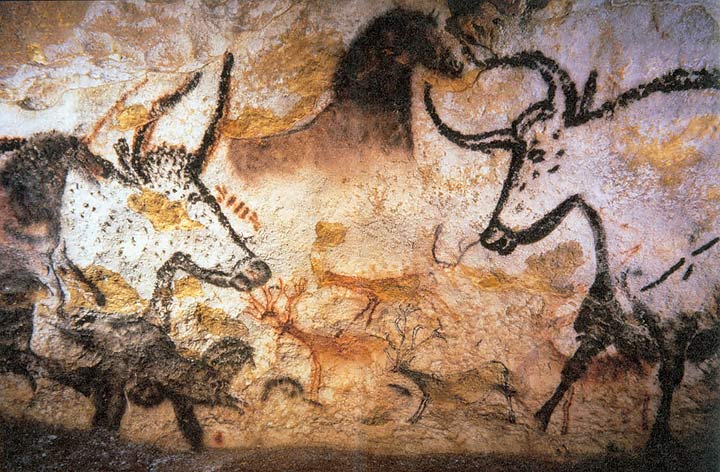
On a related note, check out this preview of Werner Herzog's new 3-D documentary, Caves of Forgotten Dreams, about a group of 32,000-year-old cave paintings of animals and humans in southern France.

Friday, October 22, 2010

History of the World in 100 Objects

Randall Stephens

For those who missed it, check out BBC Radio 4's "History of the World in 100 Objects." (The series ends this week.) I read about it in the TLS a few weeks back. The reviewer praised the audio exhibit for its elegant, almost cinematic qualities, something that stretched the radio format in amazing ways. Yesterday, the Guardian lauded host Neil MacGregor, who "wears his knowledge lightly. He manages to both charm and enthuse at the same time, a hard trick that, but at the core of each bite-sized podcastable talk is an ardent and contemporaneous message: civilisations do not so much clash as learn and borrow from each other. One picks up from where the other leaves off."

The program might work well in the classroom. (How often do we listen to audio, rather than watch film, with students? Once in a blue moon, I'll find a segment on NPR that fits into what we are going over, but otherwise, it's rare.) Here are a few bits from the series:

035 Head of Augustus, 21 May 2010, Listen, Duration: 15 mins

Head of Augustus, the first Roman emperor. Neil MacGregor, Director of the British Museum, looks at one of the world’s most famous rulers, whose powerful, God-like status is brilliantly enshrined in a 2000-year-old bronze head with striking eyes. He explores how Augustus dramatically enlarged the Roman Empire, establishing his image as one of its most familiar objects. The historian Susan Walker and the Mayor of London, Boris Johnson, help explain the power and methodology of Augustus.

057 Hedwig glass beaker, 22 Jun 2010, Listen, Duration: 15 mins

Glass beaker from central Europe probably made by a Muslim craftsman. Neil MacGregor, Director of the British Museum, examines a glass beaker made in Syria or Egypt at a time when Christians were warring with Muslims in the crusades. The glass became associated with the miracles of a Christian saint, Hedwig, who turned water into wine when it touched her lips. But how did Islamic glass reach Christian Europe during the Crusades?

088 North American buckskin map, 6 Oct 2010, Listen, Duration: 14 mins

Map of the area between the Mississippi and Ohio rivers. Neil MacGregor, Director of the British Museum, explores the differing attitudes towards land and living of Europeans and Native Americans in the 18th century. He looks at a buckskin map drawn up by a Native American as the British negotiated for land between the Great Lakes and the Mississippi. With contributions by cartographer Martin Lewis and historian David Edmunds.

Friday, October 15, 2010

The Usefulness of "Prehistory"?

.
The following guest post come from Randall Foote. This is part of an exchange he had with the eminent historian John Lukacs about the usefulness of the idea of "prehistory." See Foote's earlier post on a related topic here. Foote is retired from his business and now teaches as an adjunct instructor at Roxbury Community College.

Dear Professor Lukacs,

As to your question:

“. . . . Because of your thoughts about the genesis of mankind: do you agree with Barfield (and myself) that, strictly speaking or, rather, thinking, there was no such thing as ‘prehistoric’ man?”

Yes, that goes to the heart of one subject I am working on.

In brief: no, the idea of “prehistoric man” makes no sense to me, in either of the two ways in which it is understood. The sense of “pre-history” as that which comes before written history is very odd, as if the discovery and use of writing were some particular defining moment in human evolution, rather than merely one means by which we understand the present and the past: Man’s past defined solely by our own current means of comprehending it. This concept leads, for example, to a belief that the early Romans were a “historic civilization”, while their neighbors the Celts were a “prehistoric” archaeological Culture-type, who only entered into “History” when Caesar wrote about them in his Commentaries? All that changed was the historical tools by which we can learn about them. It is not difficult to trace these newly “historicized” Celts back to the Hallstatt culture of Central Europe, it merely requires different tools than reading primary sources. And these are similar to the tools that we might use to understand the daily lives of non-literate peasants of medieval Europe – the “testimony of the spade” (pace Bibby).

The broader sense of “prehistoric” is as that time before, for example, the Neolithic Revolution – which actually was a type of defining moment in certain parts of the human world. I would instead use the term “Archaic Man” for this. For me, and I believe for you and for Barfield, there is only one defining moment in the History of Man: which is when human consciousness and human language began, when the Word took human form in some mysterious manner. This may have happened in an instant or it may have been something that occurred over a few generations, but this essential change is not something that “evolved” over a million years in some Darwinian process from hominoids and hominids.

There was time and a place when human history truly began: perhaps 100,000 years ago in the northeast of Africa. A spark went into a physical body that then became Man. God breathed a soul into Adam’s nostrils. Spirit became matter, brain became mind, as consciousness and language were born for the first time. The mechanism for this change in consciousness is not understood yet. Perhaps it is an unknowable Act of God, as the cosmological Big Bang will ever be unknowable, the first moment of Creation.

But just as physics can trace the path back to almost the first moment of the Big Bang, so too can linguistics, genetics and anthropology point roughly to the conception of Man as a conscious being. Language families (and macro-families) converge at some point in the past, pointing to one original language; there still exist traces in the most unrelated of languages of common words for the simplest of things (finger, one, two, eye). In addition, unique elements of human genetic material also converge back in time, circa 100,000 years ago. Further, a modern physical form of Man emerged out of Africa into the Middle East about 80,000 years ago. With this new human (“anatomically modern homo sapiens” in anthropology) is found evidence of burial, symbolic expression (“art”), and apparently unnecessary and changing elements of design in tools and clothing (“fashion”), among other differences from earlier hominids (Neandertal, Erectus, etc.). And the other, older hominids soon vanished before the newcomer, for whatever reason. Human history began as man became fruitful and multiplied, out of Africa and across the earth.

I am only able to understand this and other evidence as pointing to the inception of human language and human consciousness, which define Man (in the image of God). In the beginning was the Word. There does not seem to be any gradual Darwinian “evolution” leading up to this beginning of human culture, of humanity itself (as opposed to the evolution of the hominid body), nor any radical change since that time.

Of course, human culture has evolved over the millennia, just as the understanding of God has evolved, but human Language (as distinct from all the supposed animal “languages”) either is or it is not, across the races of man as well as in the growth of a child. There are no “primitive” or unformed or partial languages. The fact that any human infant can learn any human language fluently argues convincingly for the monogenesis of language, with no significant/essential changes having occurred since that genesis. Evolution of language (as in Barfield) is cultural refinement, not essential change, as is “the evolution of consciousness, which is probably the only evolution there is” (End of an Age). (vide Lincoln: “The only progress is of the human heart”). Human consciousness begins with language, and since that point “evolution” might be refinement and growth, but not a change-of-state.

Perhaps much as you found correspondences to your own historical thinking in Heisenberg’s writings, I have been working to connect science and linguistics (not a science) to my own historical sense of human beginnings. This sense, this human story, is not Darwinian or “scientific”, nor in a strict sense religious--but human, historical, including and larger than science and religion. Currently, science and religion are each devolving into their own forms of fundamentalism, and the time is past when either can alone provide the needed understanding of man’s “evolution” (or of the universe for that matter). I see this “historical Genesis” as the opening chapter of the new kind of history, as that you call for, a history for a new era, following upon a “conscious historical recognition of the opening of a new phase in the evolution of our consciousness.” ( JL, Confessions of an Original Sinner.)

Tuesday, October 12, 2010

Area Historian

Randall Stephens

Heather sends along this amusing satire of historians "making it all up" from the Onion. I knew there was something fishy about the Golden Age of Greece. Especially the 5th century. Just too much fascinating intellectual development for one century. And so long ago!

"Historians Admit To Inventing Ancient Greeks," The Onion, October 7, 2010.

WASHINGTON—A group of leading historians held a press conference Monday at the National Geographic Society to announce they had "entirely fabricated" ancient Greece, a culture long thought to be the intellectual basis of Western civilization.

The group acknowledged that the idea of a sophisticated, flourishing society existing in Greece more than two millennia ago was a complete fiction created by a team of some two dozen historians, anthropologists, and classicists who worked nonstop between 1971 and 1974 to forge "Greek" documents and artifacts.>>>

See more absurdest takes on history from the Onion. Some favorites:

"Second-Grade Class Has No Questions For Visiting Local Historian"

"Historian Has Big News For Grover Cleveland Fans"

"San Francisco Historians Condemn 1906 Earthquake Deniers"

"U.S. Dept. Of Retro Warns: 'We May Be Running Out Of Past'"

Thursday, September 16, 2010

But is it History? II: Deep History

Randall Stephens

Harvard University professor of history Daniel Lord Smail has challenged the idea that history begins only with the advent of writing. In his 2008 book, On Deep History and the Brain (University of California Press), he lays out his arguments about how history and biology have worked together over the long arc of time. Smail asks "When does history begin?" and "What characterizes it?" He follows up on the work of evolutionary biologists and the macro history of Jared Diamond, with a new way of understanding the past.

"The ancient world is unimaginable without archeological evidence;" Smail observes, "the Middle Ages very nearly so; and the effort to reconstitute the lives of peoples without writing has been one of the signal achievements of the twentieth century." In light of that Smail asks: "So what does it matter that the evidence for the deep past comes not from written documents but from the other things that teach--from artifacts, fossils, vegetable remains, phonemes, and various forms of modern DNA?" (On Deep History, 6)

But, as Heather asked earlier on a different topic, is it history? How can we undertsand preliterate humans and societies in a historical sense? Can historians add to our understanding of pre-historic humans in ways that anthropologists and archeologists cannot? Historians inside and outside of the guild will have to figure those questions out for themselves.

What follows are some recent macro-historical, deep history, evolutionary history essays, and tidbits from the web:

Drake Bennett, "How Animals Made Us Human," Boston Globe, September 12, 2010.

. . . . What explains [our] yen to have animals in our lives? An anthropologist named Pat Shipman believes she’s found the answer: Animals make us human. She means this not in a metaphorical way — that animals teach us about loyalty or nurturing or the fragility of life or anything like that — but that the unique ability to observe and control the behavior of other animals is what allowed one particular set of Pleistocene era primates to evolve into modern man.>>>

Cynthia Haven, "Stanford historian tells why the West rules - for now," Stanford University News, September 14, 2010.

. . . . Stanford Classics and History Professor Ian Morris puts forth some bold answers in his ambitious new 750-page book, Why the West Rules – For Now (Farrar, Straus & Giroux). And that places Looty in a longer story going back to the last ice age.

Morris' book argues that history is a slow, complicated tango between geography and social development.>>>

How could a civilization that mastered the planet suddenly Collapse? Inspired by the New York Times best-selling book "Collapse: How Societies Choose to Fail or Succeed", NGC time travels 200 years into the future to see what the world would look like after civilization as we know it collapsed. Guided by author Jared Diamond, we'll piece together the remarkable story of what on earth triggered our decline.

Collapse: Based on the Book by Jared Diamond, National Geographic Channel.

How could a civilization that mastered the planet suddenly Collapse? Inspired by the New York Times best-selling book "Collapse: How Societies Choose to Fail or Succeed", NGC time travels 200 years into the future to see what the world would look like after civilization as we know it collapsed. Guided by author Jared Diamond, we'll piece together the remarkable story of what on earth triggered our decline.>>>

Mary Gray, "Are You Descended from Neanderthals?" New Zealand Herald, September 2, 2010.

. . . . With the expansion of human populations and climate change, Neanderthal populations are thought to have shrunk toward Europe and Spain. Europeans and Neanderthals had potentially longer to interbreed compared to other human populations, but there is no evidence for this - so far. Did waves of human migration from the Middle East replace ancient Neanderthal-human Europeans or did the first human inhabitants of Europe and Neanderthals keep to themselves? >>>

Thursday, August 19, 2010

Roundup: Asian History, Ancient and Modern

History News, Reviews, and the Like from around the World

"N. Korean-Japanese Team Finds Koguryo Tomb in Pyongyang," The Chosun Ilbo, Aug 15, 2010‎.

Academics from North Korea and Japan have unearthed a large tumulus from the Koguryo period in Pyongyang, providing valuable material for studying the history of ancient East Asia, Japan's Kyodo news agency said Saturday. About 4.5 km away from the downtown Pyongyang, the tomb was discovered during construction work in Tongsan-dong, the Lelang District of the Koguryo era and is presumed to have been created around the 5th century. >>>

Jim Eagles, "Silk Road: Tracing the path of ancient footsteps," New Zealand Herald, August 11, 2010.

Jim Eagles travels a well worn path through a historic landscape and finds plenty of remnants from its fascinating past still in place. The old caravanserai stands beside a section of the Silk Road as it has done for over a thousand years. On the other side of the road is an equally ancient cistern built to to provide water for camel caravans plying the hot, dry, dusty path between the timeless cities of Samarkand and Bukhara. >>>

Edward Wong, "China Seizes on a Dark Chapter for Tibet," New York Times, August 9, 2010.

GYANTSE, Tibet — The white fortress loomed above the fields, a crumbling but still imposing redoubt perched on a rock mound above a plain of golden rapeseed shimmering in the morning light. A battle here in 1904 changed the course of Tibetan history. A British expedition led by Sir Francis E. Younghusband, the imperial adventurer, seized the fort and marched to Lhasa, the capital, becoming the first Western force to pry open Tibet and wrest commercial concessions from its senior lamas. >>>

Razib Khan, "Empires of the Word & anti-Babel," Discovery Magazine blog, August 16, 2010.

European nationalism in the 19th and 20th centuries was in large part rooted in the idea that language defined the boundaries of a nation. During the Reformation era some German-speaking Roman Catholic priests declaimed the value of the bond of language against that of religion, praising those non-Germans who adhered to the Catholic cause against German speaking heretics (in the specific case the priest was defending Spanish tercios brought in by the Holy Roman Emperor to put down the rebellion of Protestant German princes). . . . Newer lingua francas, French and later English, lack the deep unifying power of Latin in part because they are also living vernaculars. They may resemble Latin in some particulars of function, but eliding the differences removes far too much from the equation to be of any use. Linguistic diversity is a fact of our universe, but how it plays out matters a great deal, and has mattered a great deal, over the arc of history. >>>

"Pearl Buck in China by Hilary Spurling," New Yorker, August 16, 2010.

Emphasizing the imagination’s power to “make bearable things too ugly to confront directly,” Spurling sensitively traces the biographical background of Buck’s writing. Buck, the daughter of missionaries, spent nearly all of the first forty-two years of her life in China, and her childhood was marked both by grand upheavals such as the Boxer Rebellion and by the stark asperities of everyday poverty. >>>

[I'll be interviewing Spurling about her biography for an upcoming issue of Historically Speaking]