Showing posts with label Civil Rights. Show all posts

Friday, August 30, 2013

Henry Steele Commager on America during the Cold War

Randall Stephens

The November 24, 1954 episode of Longines Chronoscope featured Henry Steele Commager (video embedded here).  That was not unusual for
the news and views program, which regularly featured heads of state, intellectuals, novelists, and other notables.  But the subject of the discussion is particularly interesting all these years later.  Maybe that's especially poignant because Commager was one of America's foremost historians at that time. Here he weighs in on American identity, the pressures of conformity, the post-war economic boom, and freedom of expression.  

This was filmed in the wake of the Korean War, the hydrogen bomb test on Bikini Atoll, and not long after the historic Brown vs. Topeka Supreme Court decision.  Red Scare paranoia remained strong. The coming month of December would see the US Senate reprimand Joseph McCarthy, by a vote of 67–22, for "conduct that tends to bring the Senate into dishonor and disrepute."

Wednesday, August 28, 2013

Sheldon Hackney on C. Vann Woodward as Dissenter

Randall Stephens

Today is the 50th anniversary of the historic March on Washington "For Jobs and Freedom." So, to continue with the theme of Monday's post--concerning history/historians, activism, and civil rights--I excerpt below part of Sheldon Hackney's 2009 essay in Historically Speaking, "C. Vann Woodward, Dissenter."

Here Hackney discusses C. Vann Woodward's political outlook, civil rights work, and the parameters of dissent in the 1960s.

Hackney is the Boies Professor of U.S. History at the University of Pennsylvania. He is the former president of the University of Pennsylvania (1981-1993) and the former chairman of the National Endowment for the Humanities (1993-1997). He is the author of a variety of books and articles, including Populism to Progressivism in Alabama (Princeton University Press, 1969) and Magnolias without Moonlight: The American South from Regional Confederacy to National Integration (Transaction Publishers, 2005):

One of the most striking things about the young C. Vann Woodward was his affinity with dissent. It was not just his authorship of Tom Watson, Agrarian Rebel, the book that launched his academic career in 1938, nor the fact that he approached W. E. B. DuBois earlier with hopes of writing about him, nor his toying with the notion of following his biography of Watson with one of Eugene Debs. Those are important indicators, but it is even more interesting that in every situation he found himself in during his early years, he gravitated toward the most progressive people and places–exploring Harlem when he was a Masters student at Columbia in 1931-32, getting involved in the Angelo Herndon Defense Committee when he was back in Atlanta teaching at Georgia Tech, hanging out at that den of left-wing conspirators, Ab's Book Store in Chapel Hill, when he was working on his Ph.D. and the Watson biography. He was sympathetic to the union organizing movement among cotton mill workers in North Carolina and met Glenn McLeod, who became his wife, because of those pro-union activities. As a young man, he made two trips to Europe, visiting the Soviet Union on both of them, revealing at least a curiosity about communism. When he was teaching at Scripps College, 1940-43, he helped defend a faculty colleague who was under attack for suspected fascist sympathies, an early indication of his devotion to free speech on campus. He was always where the political action was. . . .

Monday, August 26, 2013

The Late Historian Robert Zieger on the 1963 March on Washington

Randall Stephens

From Life magazine, September 6, 1963.
Across the US and around the globe people are marking the 50th anniversary of the "Jobs and Freedom" march on Washington, D.C.  Roughly 200,000 men and women, young and old, black and white gathered to demand justice and equality on Wednesday, August 28, 1963. 

Among the throng who came together around the reflecting pool at the Lincoln Memorial were a collection of historians. (How interesting to think how this event so shaped the writing of those in attendance and many more who witnessed it from afar or learned of it years later.)  Some were soon-to-be historians or historians-in-training from the University of Maryland, Howard University, Johns Hopkins University, UVA, George Washington, and others. Among the many in attendance were Clayborne Carson, Dorothy Drinkard-Hawkshawe, and Robert Zieger

From Life magazine, September 6, 1963.
Zieger, who passed away this year, was Distinguished Professor of History at the University of Florida. He was a remarkable historian, mentor, and all-around mensch.  (Read Paul Ortiz's commemoration here on the blog.)  One of Zieger's last works was For Jobs and Freedom: Race and Labor in America since 1865 (University Press of Kentucky, 2007). Zieger wrote an essay about his experience of researching and writing the book in Historically Speaking. Here he also reflected on that day in August 1963 in D.C. Here's a brief excerpt from "Jobs and Freedom," Historically Speaking (May/June 2008):

Shortly after I had begun active work on [For Jobs and Freedom], historian John Bracey visited [the University of Florida] campus and gave a fascinating talk to students about the state of black history at the time he began graduate school at Northwestern in the early 1960s. It soon became apparent that Bracey and I were of a similar age. He recounted that in the initial syllabus for his 19th-century U.S. history seminar, there were no works by black scholars or, apart from works that dealt with slavery as a political problem, about the black experience in antebellum America. Bracey and a colleague, with the complete support of an abashed seminar director, soon rectified the omission. Bracey told this story as a way of indicating to his undergraduate student audience how far black history and race history had traveled in the four decades since.

Friday, July 26, 2013

History and the Voting Rights Act Roundup


NPR Staff, "The Voting Rights Act: Hard-Won Gains, An Uncertain Future," NPR, July 21, 2013

. . . . Congress also noted, however, that the Voting Rights Act was still needed, and it had
Fort Scott, Kansas, Tribune, August 6, 1965, p. 1
From the Google News Archive.
been used hundreds of times since 1982 to protect against discrimination.

But in his opinion, Chief Justice John Roberts suggested it is a new era. "Our country has changed," he wrote for the majority.

But Rep. Lewis says race is still very much at the forefront.

"I think there has been a deliberate and systematic effort on the part of certain forces in our country to take the whole idea of race out of public policy," he says. "Race is involved in everything that makes up America, and we cannot escape it. We have to deal with it face on.">>>

John Paul Stevens, "The Court & the Right to Vote: A Dissent," New York Review of Books, August 15, 2013

In Bending Toward Justice, Professor Gary May describes a number of the conflicts between white supremacists in Alabama and nonviolent civil rights workers that led to the enactment of the Voting Rights Act of 1965—often just called the VRA. The book also describes political developments that influenced President Lyndon Johnson to support the act in 1965, and later events that supported the congressional reenactments of the VRA signed by President Richard Nixon in 1970, by President Gerald Ford in 1975, by President Ronald Reagan in 1982, and by President George W. Bush in 2006.>>>

Tuesday, June 4, 2013

Will D. Campbell, 1923 - 2013

Randall Stephens

I've just heard the sad news that Will D. Campbell--activist, minister, and author--has passed away.  Many who teach southern history or American religious history will be familiar with Campbell's humorous, insightful, page-turners like Brother to a Dragonfly (1977) and Forty Acres and a Goat (1986).  I've used the latter when I've taught the modern South.

Today, the New York Times eulogizes him:

The Rev. Will D. Campbell, a renegade preacher and author who joined the civil rights struggle in the 1950s, quit organized religion and fought injustice with nonviolent protests and a storyteller’s arsenal of autobiographical tales and fictional histories, died on Monday night in Nashville. He was 88. . . .

Followers and friends called Mr. Campbell hilarious, profound, inspiring and apocalyptic, a bourbon-drinking, guitar-picking, down-home country boy who made moonshine and stomped around his Tennessee cabin in cowboy boots and denim uttering streams of sacred and profane commentary that found their way into books, articles, lectures and sermons. Read on>>>

 
To mark the passing of this remarkable individual, I include an excerpt here from historian and friend Ben Houston's interview with Campbell.  The interview appeared in 2007 in the Journal of Southern Religion, which I was then editing with Bland Whitley:

An Interview with Will D. Campbell

Monday, April 22, 2013

The Emancipators: Jackie Robinson, Branch Rickey, and the Politics of 42

Chris Beneke

In a famous photograph of baseball star Jackie Robinson and Brooklyn Dodgers General Manager Branch Rickey, the African American legend prepares to sign his 1948 contract. As he does so, the viewer of this staged scene can make out a small photo hung above Rickey’s head at top right. From that modest rectangular frame, a young, beardless Abraham Lincoln gazes upon the scene.*

Three years earlier, Robinson met Rickey under that same gaze and the two men discussed, among many other things, their shared Christian devotion. During this tense  and seemingly interminable meeting that would lead to the end of baseball’s longstanding prohibition on black players, Rickey had Robinson read a line from Giovanni Papini’s Life of Christ: “But whosoever shall smite thee on thy right cheek, turn to him the other also.” Robinson agreed to turn the other cheek and in April 1947, he joined the Dodgers as the first African American major leaguer in more than half a century. 

There’s no getting around the fact that the latest retelling of Robinson’s epic first season, Brian Helgeland’s film 42, succumbs to Hollywood sentimentality. It’s certainly not a great film, arguably not a good film, and definitely not a subtle one. It aims at a high-level of verisimilitude and mostly achieves it, but too often at the expense of dramatic effect and historical significance. The awkward conflation of events (Dodger scout Clyde Sukeforth appears to apparate, Harry Potter-style, into a Missouri gas station where Robinson has just negotiated his way into a segregated bathroom) and a syrupy musical backdrop (including an Olympian trumpet fanfare to accompany one of Robinson’s exultant trots to home plate) will surely disappoint viewers who were lured by the gritty, thumping Jay-Z-scored trailer.

Thursday, February 28, 2013

Black History Month?

Heather Cox Richardson

Any high school history teacher knows that February is Black History Month. And almost any American high school student can tell you who Dr. Martin Luther King, Jr., was, because schools tend to focus on him around the time of the federal holiday that honors him.
But, sadly, many Americans know little else about black history.

In an interview with Mike Wallace, Morgan Freeman objected to Black History Month, pointing out that black history should not be relegated to a single month. Black History is American history, and should be taught as generally as any other kind of American history.

Easy, huh?

The last thing high school teachers need is more extra lessons tacked on to old histories. They don’t have time for what they have to do now. So how can we tackle Freeman’s legitimate complaint?

Wednesday, February 27, 2013

Marian Anderson: The Contralto Who Launched the Civil Rights Movement

Heather Cox Richardson

April 9, 1939, fifty-four years to the day after General Robert E. Lee surrendered his army to General Ulysses S. Grant, brilliant contralto Marian Anderson launched the popular civil rights movement.

Born on February 27, 1897, into a musical family in Philadelphia,
Anderson was the granddaughter of a slave. Her astonishing voice caught people’s attention when she was only six. She began to sing in church choirs and, as she got older, sang for pay at local events. Poverty and prejudice kept her from obtaining even a high school education, but her neighbors raised money to enable her to study music privately after an all-white music academy refused her admittance.

A few successful New York concerts could not break through the racial prejudice of 1920s America, but Europeans recognized her talent. A European tour in the early 1930s was a wild success, with composers writing for her and fans flocking to hear the young singer with, as conductor Arturo Toscanini said, a voice heard once in a hundred years.

Thursday, February 7, 2013

Black History Month: What We Owe to the Black Domestic Servants of the Jim Crow South

Katherine van Wormer*

Cheering a speaker in a Montgomery
bus boycott church meeting. From Life
magazine, February 6, 1956.
For Black History Month, let us honor the women who worked as domestic servants for white families in the Jim Crow South. They endured the indignities of segregation to help support their families. Moving in between black and white worlds, such women played enormously important roles in the first successful Civil Rights struggle: the Montgomery bus boycott of 1955-56, where the young Martin Luther King, Jr., got his start. 

David W. Jackson III, Charletta Sudduth, and I (one the descendant of Louisiana slave owners, the others the descendants of slaves) have written a book based on interviews with former housekeepers, caretakers, and cooks and members of the white families they worked for, The Maid Narratives: Black Domestics and White Families in the Jim CrowSouth (Louisiana State University Press, 2012). 

Monday, April 30, 2012

Richard H. King on Why I Became a Historian

Randall Stephens

Why are some youngsters fascinated by the past while others don't have the slightest interest in the subject?  (Indeed, quite a few run to the hills at the mere mention of "history.")  What makes some of us into historians?

While I was at the British Association of American Studies meeting at the University of Manchester I had some time to sit down with the historian Richard H. King.  I asked King the same question I've put to other historians: "Why
did you become a historian?" 

King is a prolific author (now emeritus professor of American intellectual history, University of Nottingham). While in grad school at the University of Florida I read his engaging book A Southern Renaissance: The Cultural Awakening of the American South, 1930-1955 (Oxford University Press, 1980).  Along with that volume he is also the author of a number other influential books, including: The Party of Eros: Radical Thought and the Realm of Freedom (Delta, 1972); Civil Rights and the Idea of Freedom (University of Georgia Press, 1996); Race, Culture and the Intellectuals, 1940-1970 (Johns Hopkins University Press, 2004); and he co-edited Dixie Debates (New York University Press, 1995) with Helen Taylor.

In the interview here, King speaks about his undergraduate experience at the University of North Carolina, Chapel Hill, in the early 1960s.  He also talks about the literary and social forces of the day that led him to study the past.

Tuesday, April 17, 2012

David L. Chappell Responds to Ross Douthat on Religion and the Civil Rights Movement

.
On April 8 the New York Times published Ross Douthat's op-ed "Divided by God." In part Douthat argued that "religious common ground has all but disappeared" in modern America. (In response, Mark Silk penned a step-by-step rebuttal here.) Toward the end of Douthat's op-ed he discussed the common theological ground that blacks and whites once shared, which he thinks helped end desegregation. In an aside Douthat mentions the work of David L. Chappell, Rothbaum Professor of Modern American History at the University of Oklahoma.

In this guest post Chappell responds to Douthat's reading of Chappell's A Stone of Hope: Prophetic Religion and the Death of Jim Crow (UNC Press, 2003). Along with that award-winning book, Chappell has written a number of articles and essays (some with the Journal of the Historical Society and Historically Speaking) on religion in modern America, the civil rights movement, politics, and race. He is also the author of Inside Agitators: White Southerners in the Civil Rights Movement (Johns Hopkins University Press, 1996). His next book, Waking from the Dream: The Battle over Martin Luther King’s Legacy (Random House), will be out in 2013.

Setting the Record Straight
David L. Chappell

I am grateful that Ross Douthat mentioned my book, A Stone of Hope, favorably. ("Divided by God," April 8.) With the best of intentions, however, Mr. Douthat got my story wrong. According to him, I claim that civil rights leaders in the 1950s and 1960s used "moral and theological arguments to effectively shame many [white] southerners into accepting desegregation." That is a familiar version of the story, but the record does not support it.

Civil rights leaders did not shame white southerners but rather undermined their social foundations. The white South's churches could not defend segregation with a straight face, and that hurt the segregationist cause. There is a big difference, however, between being unable to muster a unifying and inspiring defense of an institution and being "shamed" into dismantling it. From beginning to end, I argued in my book, the civil rights movement used political coercion: with boycotts and mass demonstrations, the movement forced white southerners to give up their special privileges against their will.

The civil rights' leaders religious fervor inspired their own black, southern, Christian ranks to rise up out of their despair, fear, and in many cases resignation. But that is as far as the persuasive power of the leaders’ words carried. Rank and filers in the movement earned the respect, and often the awed admiration, of northern black and white liberals, because they were willing to risk their lives, to do jail time, and to endure the clubs, dogs, and fire hoses.

The organized force of black southerners' collective economic power produced the movement's first great victories. Further sustained demonstrations induced the federal government to apply the full force needed to end Jim Crow. The government realized that the only way to restore order and a good investment climate in the South was to enforce the Constitution, nearly a hundred years after it was amended to include black southerners. Thus religion played a key role, but political force carried the day. (So I wrote in my book, at any rate, and I felt I had to correct the record.)

Tuesday, July 5, 2011

Bloody Sundays

Dan Allosso

I was driving home from work the other day, listening to music instead of audiobooks for a change; randomly playing the “top-rated songs” from my iPod. It’s surprising how songs you forgot you’d loved show up there from time to time. I found myself driving along to the snare-drum beat of U2’s 1983 hit, “Sunday Bloody Sunday,” which got me thinking about the events behind the song and about popular protest.

The U2 song refers to the 1972 shooting of unarmed protestors in Derry, Ireland. But the name Bloody Sunday has also been used to describe the reaction to the first Selma March (1965), police violence against unemployed protestors in Vancouver, BC (1938), a 1905 St. Petersburg massacre that helped spark the Russian Revolution, and two other days of violence in the Irish conflict (1920, 1921). The original Bloody Sunday was a November 1887 demonstration in London that was routed by the Army and Metropolitan Police.

The issues that led to 1887’s Bloody Sunday included the 1885-86 Irish Coercion Acts, but the demonstration was really a culmination of tensions brought on by England’s “Long Depression” of the 1870s. East Londoners had been demonstrating against unemployment and poverty in their section of London for several years. The difference in November of 1887 was, they marched westward with their protests, to Trafalgar.

The 1887 East End protestors were not the first to march on London’s centers of power. In 1848, Chartists had planned to march on Parliament, and had only been turned away when the Duke of Wellington placed cannons on the Westminster bridge over the Thames. But less than a generation later, Britain’s Reform League led demonstrations that brought hundreds of thousands of protestors to Trafalgar Square and Hyde Park in 1866, and to the Agricultural Hall and Hyde Park again in 1867. These protests had been declared illegal by government authorities. So how did the reformers “get away with” these massive demonstrations?
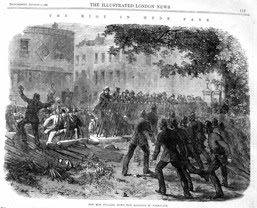
The leaders of the Reform League demonstrations had learned from the 1848 intimidation of the Chartists. Charles Bradlaugh was an East Londoner who had been beaten by police at age 15, while leading an East London sympathy demonstration on the day the Chartists surrendered to Wellington. Bradlaugh was subsequently posted to County Cork with the British Army, where participating in the eviction of starving Irish peasants helped to radicalize him, and where he learned cavalry battle techniques and tactics. Bradlaugh insisted on public protests, against the wishes of many of his fellow Reform League leaders, and personally led them with the military discipline he had learned in Ireland.

200,000 Londoners marched on Hyde Park in July 1866. Home Secretary Spencer Walpole had outlawed the protest a few days earlier, and threatened military action. Bradlaugh and his radical allies in the Reform League leadership declared the government’s position unconstitutional, and announced they would challenge Walpole’s illegal attempt to bar peaceful, free assembly. Of course, in order to be legal, Bradlaugh realized the protest would have to be peaceful. And, aside from the famous destruction of some railings around the “Marble Arch” gate, which marchers led by a carriage of Reform League executives were prevented from entering by a troop of 1,600 police and soldiers, the demonstration was disciplined and nonviolent. Bradlaugh wasn’t at the railings, he was leading another column of protestors across Knightsbridge toward Hyde Park at the time.

To make a long story short, Spencer Walpole resigned in disgrace and the Reform League’s demonstrations established the right of Londoners to march, occupy public parks and squares, and demonstrate for their political rights. In 1868, the Reform Act passed, extending voting rights to working-class people for the first time in British history. And yet, twenty years later, Bloody Sunday. What had changed?

In 1887, Charles Bradlaugh was not at the head of the demonstration. He was exhausted and ill, following a six-year battle to take the seat in Parliament he’d been elected to in 1880. And he had doubts about the programs proposed by the Social Democratic Federation, which was sponsoring the protest. Bradlaugh advised readers of his National Reformer to stay away, and warned SDF and Fabian Society leaders to be cautious and consider the security of their people. Believing the precedent set by the Reform League had established their rights once and for all, Annie Besant, George Bernard Shaw, and the other leaders of the demonstration defied the government and marched. The results were disastrous.

Men, women, and children marchers were beaten by London police. Over two hundred people were hospitalized. Three were killed. Infantry and cavalry troops were on hand, with fixed bayonets; but luckily were not called into action. Several of the march’s leaders were arrested and held behind bars for six weeks.

It’s difficult to pinpoint all the factors that had changed, between 1866 and 1887. There was a new government, with new people in key positions—although in both cases, the Tories were in power. Chicago's Haymarket riot of 1886 was fresh in the minds of both the protestors and the government. The radicals who had been united behind the Reform League had split into factions. Socialists who seemed to be gaining ground in London political circles offered utopian ideals but had little connection with actual working people (the Labour Party was established in 1893, partly in response to these issues). But it’s possible that the key difference was the 1887 leaders’ belief that their right to protest, established 20 years earlier, was inviolable.

The lesson of Bloody Sunday, it seems to me, is that we can’t take our rights for granted. If we are not prepared to defend them, they can be taken from us. Like Charles Bradlaugh and his fellow reformers, we have to be resolute, disciplined, and nonviolent—but prepared to defend ourselves. It’s not insignificant that when Bradlaugh died four years after Bloody Sunday, one of the mourners at his simple secular funeral was twenty-one year old Mohandas Gandhi.

Tuesday, March 22, 2011

Jeremy Bangs's Experience with Sundown Towns

Randall Stephens

Americans born after the 1950s may not know that there ever were such things as sundown towns. James W. Loewen writes about them in Sundown Towns: A Hidden Dimension of American Racism (New Press, 2005). "'Don’t let the sun go down on you in this town.' We equate these words with the Jim Crow South," summarizes the book's website, "but, in a sweeping analysis of American residential patterns, award-winning and bestselling author James W. Loewen demonstrates that strict racial exclusion was the norm in American towns and villages from sea to shining sea for much of the twentieth century."

Jeremy Bangs emailed me the other day about his experience of growing up in Illinois and Kansas and being all-too aware of such villages and hamlets that dotted the midwest. Bangs is the founder of the Leiden American Pilgrim Museum in Leiden and the author of Strangers and Pilgrims, Travellers and Sojourners (General Society of Mayflower Descendants, 2009). Jeremy's father, Carl Bangs, was a leading authority on the life and theology of Jacobus Arminius. (I read his biography of Arminius when I first launched into grad school. I was hooked on history.) With Jeremy's permission, I include below his reminiscence about sundown towns.

When my father moved ca. 1952-53 from Chicago to Bourbonnais, IL, to teach religion and philosophy at Olivet Nazarene College, he first heard about the existence of such towns, including some in the immediate area. Like others on the faculty who were ordained, he sometimes was invited to preach, and, as director of the college's brass choir (which he started), he sometimes was asked to take students to perform in Sunday morning services in Nazarene churches in Illinois as fundraisers for the college.

He refused to accept invitations in towns that were known as sundown towns. He always explained that he would be happy to accept the church's invitation once the village or town had reversed its policy. He was not alone in this vocal opposition to the racist custom, and I think that he and his colleagues made this an issue that was discussed (and officially opposed) by area councils of churches. Further, we did not drive through such towns, taking the long way around, whatever that might be, when going somewhere farther away. Since most roads there were laid out in square patterns, there was always a way to drive around. I think that at least one town officially changed their policy, after being shamed from the pulpits. As I recall, that must have been Manteno, IL, because I know that it was once a sundown town but in later years we did drive through Manteno. (We moved to Kansas City in 1961.)

In Kansas City, looking for a house to buy, my parents were shocked to find out that certain suburbs excluded blacks as well as Jews. This was possible with so-called covenants in the deeds, by which a buyer obliged himself to refuse to sell to blacks or Jews. The suburbs were among those developed and operated by the J. C. Nichols Company, who also built Kansas City's Plaza. My parents refused to buy in such restricted areas and refused to buy from that company. My father also instigated legal action on this point against the J. C. Nichols Company, which led to some retaliation, although I've forgotten what form that took. I think that eventually this action resulted in the company's being forced to drop the policy and restrictive covenants, even before legal changes made them explicitly illegal. As in Illinois, my father was one among numerous clergymen who tried to bring an end to these restrictions.

Saturday, August 28, 2010

Uses of the Past

Randall Stephens

Historians, pundits, and activists are commenting on the Saturday Tea Party rally, called "Restoring Honor," at the Lincoln Memorial. The event--on the anniversary of MLK's 1963 march--brings up some important questions about the legacy and purposes of the past. Here are some of the comments, reflections on the 8/28 gathering:

Kate Zernike, "Where Dr. King Stood, Tea Party Claims His Mantle," New York Times, August 28, 2010.
WASHINGTON — It seems the ultimate thumb in the eye: that Glenn Beck would summon the Tea Party faithful to a rally on the anniversary of the March on Washington, and address them from the very place where the Rev. Dr. Martin Luther King Jr. delivered his “I have a dream” speech 47 years ago. After all, the Tea Party and its critics have been facing off for months over accusations of racism. >>>

Eugene Robinson, "Even Beck Can't Mar King's Legacy," Washington Post, August 27, 2010.
The majestic grounds of the Lincoln Memorial belong to all Americans -- even to egomaniacal talk-show hosts who profit handsomely from stoking fear, resentment and anger. So let me state clearly that Glenn Beck has every right to hold his absurdly titled "Restoring Honor" rally on Saturday. >>>

Martin Luther King III, "Still Striving for MLK's Dream in the 21st Century," Washington Post, August 25, 2010.
Forty-seven years ago this weekend, on a sweltering August day often remembered simply as the March on Washington, my father delivered his "I Have a Dream" speech at the Lincoln Memorial. A memorial to him is being erected at the Tidal Basin, not far from where he shared his vision of a nation united in justice, equality and brotherhood. >>>

Robert Costa, "Armey: Glenn Beck’s ‘Serious, Scholarly Work,’" National Review, August 28, 2010.
Former House Majority Leader Dick Armey (R., Texas) spoke with National Review Online on Friday at FreedomWork’s “Take Back America” conference in Washington. The evening rally, which was attended by thousands of conservative activists, was a precursor of sorts to Saturday’s “Restoring Honor” event at the Lincoln Memorial. Armey calls “Restoring Honor,” which will be hosted by Glenn Beck of Fox News, an “important moment for America.” >>>

"Beck rally Saturday at Lincoln Memorial on anniversary of King's 'I Have a Dream' speech," The Guardian (Canada), August 28, 2010.
. . . . Beck, a Fox News personality and a conservative favourite, insists it's just a coincidence that his "Restoring Honor" rally on the steps of the Lincoln Memorial is overlapping with the 47th anniversary of King's speech. Potential 2012 presidential candidate Sarah Palin is expected to attend along with some 100,000 people. >>>

Philip Elliott, "Glenn Beck Lincoln Memorial rally draws criticism," Christian Science Monitor, August 26, 2010.
. . . . Beck, a popular figure among tea party activists and a polarizing Fox News Channel personality, has said it is merely a coincidence that the event is taking place on the 47th anniversary of King's plea for racial equality. Beck has called President Barack Obama a racist. >>>

Julie Ingersoll, "Beck’s 'Dream'—Our Nightmare," Religion Dispatches, August 25, 2010.
David Barton, Glenn Beck’s favorite history “professor,” is the creator and purveyor of a revisionist history of race in America that is rapidly gaining traction in conservative and Tea Party circles. That history, drawn in part from the writings of Christian Reconstructionists, recasts modern-day Republicans as the racially inclusive party, and modern-day Democrats as the racists supportive of slavery and post-Emancipation racist policies. >>>

Wednesday, December 16, 2009

An Interview with Hank Klibanoff on Civil Rights, the Press, and Recent History

Randall Stephens

Back in October, the renowned journalist and historian Hank Klibanoff came to my school to give a lecture and to speak with students about his work. Klibanoff is a masterful raconteur and his knowledge of what was once called the "race beat" by journalists is remarkable. He sparked my students' interest in reporting, race, and modern American history.

Klibanoff served as managing editor of the Atlanta Journal-Constitution until 2008 and was the Deputy Managing Editor for the Philadelphia Inquirer, where he worked for 20 years. He was also a reporter for the Boston Globe. His book, The Race Beat: The Press, the Civil Rights Struggle, and the Awakening of a Nation, co-authored with Gene Roberts, won the 2007 Pulitzer Prize for History.

Klibanoff summarizes his recent work as follows:

Today in the American South, scores of civil rights murders remain unsolved, uninvestigated, unprosecuted, untold. Those two legacies of violence and silence still haunt the region and continue to damage race relations in the United States.

Many histories have been written about the struggle for civil rights; many documentaries have been made about the movement and the resistance that rose up against it. But the history of the South and of the United States still has huge, important holes where myths and mysteries reside, threatening to undermine the nation’s goal of putting racial conflict behind.

The Cold Case Truth and Justice Project is an unprecedented collaboration bringing together the power of investigative reporting, narrative writing, documentary filmmaking and multimedia development to reveal the long-neglected truth behind unsolved civil rights murders, and to facilitate reconciliation and healing.

Our reporters have produced extraordinary information in high-profile cases that prosecutors have used to build criminal cases against killers and conspirators who had walked free for more than 40 years. To date, every civil rights murder case that has been reopened and successfully prosecuted was the direct result of an investigation initiated by a journalist.

That will continue. But the greater goal and ultimate hope of the project is that the stories we tell, even about cases that can no longer be prosecuted, will bring reconciliation for individuals, for communities and for the nation.

While Klibanoff was up in Quincy, MA, I sat down with him to ask a few questions about his research and writing. I also spoke with him about the challenges of writing recent history. And, I asked about his ongoing work on civil rights, race, and cold cases. The 30-minute interview can be listened to in full below.