Showing posts with label Books. Show all posts

Monday, September 30, 2013

Information Overload: Historians’ Edition

Jonathan Rees

Norge Refrigerator advertisement, 1953.
So I have a new book out.  It’s on the history of the American ice and refrigeration industries and the research and writing only took me thirteen years. Why would anybody work on any subject that long?  Well, to be fair, I have published three other books over that same time.  Still, I developed a few serious problems along the way that really slowed the entire writing process down to a crawl.

The first problem was picking the right level of focus for my work.  The very first documents I looked at were ice and refrigeration industry trade journals.  These are giant periodicals, available bound together in only the largest libraries, and written primarily for the refrigerating engineers who used to make what is now a mostly forgotten industry function.   Being something of a perfectionist, I was determined to understand everything they understood, from how ammonia compression refrigeration works to what the heck “raw water ice” was.  As I no longer live near any of the largest libraries in America, getting time and resources to do this research, let alone understand what I was reading, took an awful lot of time.

Monday, July 1, 2013

Finishing a Book: Ditch the Ego, Act on the Criticism, Pick the Hills to Die On

Philip White

Well, I’ve done it, and I’m pretty pleased with myself. I finally finished the remaining three chapters of my next book. Well, kinda. In fact, what I really did was send the rest of the first draft to the two generous souls who are reviewing my manuscript.

Now for the fun part. And by fun, I mean death-to-the-ego-and-all-my-hopes-and-dreams. Unfortunately for me, some editors just want to watch the world burn.

You see, soon enough my inbox will light up with e-mails, containing page after page of edit afflicted prose. And with each new comment, redline and question, I will die a little. Or at least my ego will.

In a perfect, pain-free world, writers could just churn out a bunch of words, revise them ourselves and then fling them out to the unsuspecting public. Oh, wait, we can. I keep forgetting about self-publishing.

But alas, those of us who go the traditional route of talking an academic or trade press into publishing our portable monuments to how smart we think we are, are resigned to several months of editorial torture that we willingly brought upon ourselves.

Here are a few tips to get you through the process:

Friday, June 21, 2013

Tom Watson Brown Book Prize, Society of Civil War Historians


The Society of Civil War Historians is soliciting nominations for the Tom Watson Brown Book Prize for books published in 2013.

All genres of scholarship on the causes, conduct, and effects, broadly defined, of the Civil War are eligible. This includes, but is not exclusive to, monographs, synthetic works presenting original interpretations, and biographies. Works of fiction, poetry, anthologies, and textbooks will not be considered. Jurors will consider nominated works’ scholarly and literary merit as well as the extent to which they make original contributions to our understanding of the period.

Thavolia Glymph, Associate Professor of African and African-American Studies at Duke University, will chair the prize jury. The other members are Alice Fahs, Professor of History and Director of the Humanities Honors Program at the University of California – Irvine, and Kenneth Noe, Alumni Professor and Draughon Professor of Southern History at Auburn University. Tad Brown, President of the Watson-Brown Foundation, Inc., will serve as a non-voting member of the jury.

Publishers are asked to send nominated books (only those published in 2013 will be considered) directly to the four jurors no later than January 31, 2014. The winner will be announced by August 1, 2014. The award will be presented at the SCWH banquet at the Southern Historical Association meeting, where the winner will deliver a formal address that will be published in a subsequent issue of the Journal of the Civil War Era. 

More information>>>

Friday, April 12, 2013

Turning it into a Book

Randall Stephens

Over at the Religion in American History blog I have a short piece on publishing.  Here's an excerpt and link to the full piece.

Few could have accused Ernest Hemingway of being too subtle. “The first draft of anything is shit,” he once quipped.  True.  And still we plod on, hoping to spin that dross into gold. We spend hour upon hour crafting, redrafting, proofing, worrying, and rewriting.

Several years back the historian Stephen Pyne wrote in a forum I put together for Historically Speaking that "History is a book culture. We read books, we write books, we promote and award tenure on the basis of books, and at national meetings we gather around book exhibits. We’re a book-based discipline."* 

But figuring out how to land a publisher, what press to go with, and answering a range of other questions can be daunting. 

And so, I was happy when my colleague Brian Ward at Northumbria University organized an afternoon session on publishing last month.  Humanities Publishing in the 21st Century: A Workshop was particularly aimed at early-career historians.  We had the pleasure of hearing from and picking the brains of Linda Bree (Cambridge University Press); Susan Ferber (Oxford University Press); Stephanie Ireland (Oxford University Press); and John Watson (Edinburgh University Press).  We all benefited from their advice and experience.  Plus we got a chance to pepper them with questions.

Read more here>>>

Monday, April 8, 2013

Catholics, Protestants, and Sectionalism in Antebellum American: An Interview with W. Jason Wallace

Conducted by Randall Stephens

W. Jason Wallace is a professor of history at Samford University. He is the author of Catholics, Slaveholders, and the Dilemma of American Evangelicalism, 1835–1860 (Notre Dame University Press, 2010). I recently caught up with Jason to ask him some questions about his work on Christianity in pre-Civil War America and to discuss some of the
Wall Street, 1847. Courtesy of the Library of Congress.
connections between religion, politics, and historical consciousness in the nineteenth century U.S.


Randall Stephens: What makes the era between 1835 and 1860 such a critical period in American religious history?

W. Jason Wallace:
Between 1835 and 1860 most aspects of American social, political, and economic life reached something of a ferment.  Religion, and especially Christianity, underwent substantial trials as well.  Religious disestablishment was then, and still is, a young phenomenon in the scope of world history.  Unlike European churches, American churches had to compete in the marketplace of ideas for adherents.  People had choices.  Religious affiliation was not simply a matter of genealogy or geography.  As a result, in Nathan Hatch’s great phrasing, the democratization of the churches began in earnest.  With the First Great Awakening the confessional boundaries established over the course of a century or so after the Reformation slowly lost influence.  The Second Great Awakening all but ended the confessional church tradition in America.  Revivalism combined with broad conceptions of evangelicalism to create new Protestant identities.  By the middle decades of the nineteenth century many Protestant traditions that valued creeds and liturgy found themselves overwhelmed by evangelical sentiment.  Doctrine became less important than the individuals’ personal relationship with God, and behavior and public virtue came to be seen more and more as marks of “genuine” Christianity.  In some ways these theological shifts made evangelicalism valuable to the growing country because it gave sanction to the importance of virtue and morality for national life.  In other words, Christianity provided a code of behavior that could benefit everyone.  But for Christianity to be useful it had to be contained.  If disputes over theology and doctrine spilled into public life then Christianity could become divisive and socially destabilizing.  In part, this is exactly what happened in the debate over slavery. 

Monday, April 1, 2013

The Long Career of Immigration Control in America

Hidetaka Hirota

A detail of Carol M. Highsmith's aerial view of the Ellis
Island immigration station. Courtesy of the
Library of Congress, Prints and Photographs Div.
The recent publication of books on Ellis Island in New York and Angel Island in California—Vincent J. Cannato, American Passage: The History of Ellis Island (HarperCollins, 2009); Erika Lee and Judy Yung, Angel Island: Immigrant Gateway to America (Oxford University Press, 2010)—reminds us of aspects of the American immigration experience that cannot be overlooked.

At these landing stations immigrants were inspected and often detained under the provisions of federal immigration law. Those of undesirable character, such as paupers, people “likely to become a public charge,” and “feeble-minded persons,” were denied landing and ordered to return to their countries of origin. To Chinese immigrants, a separate set of exclusion and deportation laws applied between 1882 and 1943. 

Wednesday, October 31, 2012

Blueberries

Dan Allosso

When I read old books, I’m always on the lookout for references to other old books, or to topics that were relevant when the book was written, but that may not be well known now.  These sometimes lead in new and surprising directions.  There were several things in Bolton Hall’s Three Acres and Liberty, the book that launched the back-to-the-land movement in 1907, that seemed to deserve more investigation.  The thing that really jumped out at me, though, was a passing remark he made about blueberries.

In spite of being a hardy native plant that the Indians had harvested from time immemorial, Hall says “with our present knowledge of the blueberry, it is doubtful if it can be made a commercially cultivated crop.”  This surprised me, since one of my family’s favorite activities when we lived out East was picking blueberries at a big berry farm in the shadow of Mount Monadnock.  But Bolton Hall was no dummy.  Three Acres and Liberty describes a variety of intensive gardening techniques that are popular today (and that many people think were invented by their current proponents), including the use of manure instead of commercial fertilizers; “super close culture,” where plants are set very close together to use the land and water efficiently and keep down weeds; “companion cropping” and “double cropping,” to extend the growing season; rotation to reduce the impact of pests; soil inoculation using nitrogen-fixing legumes (just recently discovered when he wrote); mulching to save water; raising chickens, ducks and rabbits to use waste and produce food and manure; canning and drying to preserve even small quantities of food; and even disposal of city sewage by using human waste on urban gardens.  So I had to believe he was right about blueberries not being commercially viable in 1907.  And of course, the obvious next question was, when did this change?

Wednesday, June 6, 2012

Roundup on Writing


From a cafe in Grunerløkka, Oslo
William Zinsser, "Looking for a Model," American Scholar blog, ND

Writing is learned by imitation; we all need models. “I’d like to write like that,” we think at various moments in our journey, mentioning an author whose style we want to emulate. But our best models may be men and women writing in fields different from our own. When I wrote On Writing Well, in 1974, I took as my model a book that had nothing to do with writing or the English language.>>>

PageView Editor, "My Daily Read: [an interview with] Helen Sword," Chronicle, May 2, 2012

Q: What is your greatest criticism of much academic writing?

A. In contrast to Sinclair’s lucid and engaging paper, many academic articles are quite frankly unreadable, not only by disciplinary outsiders but by close colleagues.  Often the problem is simply poor craftsmanship:  perhaps the author has tried to cram three or four major ideas into a single sentence, leaving the reader to do the hard work of disentangling all those nested subordinate clauses.  Another common issue is an excessive allegiance to the discourse of abstraction: it’s not uncommon to find nine, ten, or more spongy abstract nouns (examples: allegiance, discourse, abstraction) cohabiting in a single sentence. The human attention span has trouble coping with that much vagueness.  Stylish academic writers anchor abstract ideas in the physical world, using stories, case studies, metaphors, illustrations, concrete nouns, and vivid verbs, and lots and lots of examples.
>>>

Isabel Kaplan, "Classic Literature Isn't Dead: No Ifs, Ands, or Buts," Huff Post Books, June 5, 2012

THIS JUST IN: Contemporary writers are no longer influenced by classic literature -- or so claim a team of mathematicians from Dartmouth and Wisconsin in a recently published paper entitled, "Quantitative patterns of stylistic influence in the evolution of literature.">>>

Gail Collins, "How Texas Inflicts Bad Textbooks on Us," New York Review of Books, June 21, 2012

No matter where you live, if your children go to public schools, the textbooks they use were very possibly written under Texas influence. If they graduated with a reflexive suspicion of the concept of separation of church and state and an unexpected interest in the contributions of the National Rifle Association to American history, you know who to blame.>>>

Maria Popova, "Ray Bradbury on Facing Rejection ... and Being Inspired by Snoopy," Atlantic Monthly, May 21, 2012

Famous advice on writing abounds—Kurt Vonnegut's 8 tips on how to make a great story, David Ogilvy's 10 no-bullshit tips, Henry Miller's 11 commandments, Jack Kerouac's 30 beliefs and techniques, John Steinbeck's six pointers, and various invaluable insight from other great writers. In Snoopy's Guide to the Writing Life, Barnaby Conrad and Monte Schulz, son of Peanuts creator Charles M. Schulz, bring a delightfully refreshing lens to the writing advice genre by asking 30 famous authors and entertainers to each respond to a favorite Snoopy comic strip with a 500-word essay on the triumphs and tribulations of the writing life.>>>

Thursday, October 6, 2011

Surviving a Book Edit

Philip White

The title of this blog post may have drawn more readers if it read “Surviving a Shark Attack” or “Surviving a Tsunami” but, though it may lack the same drama, I hope this particular musing will be more useful for the would-be book writer.

I have been working on my book (shameless plug alert!), Our Supreme Task: How Winston Churchill’s Iron Curtain Speech Defined the Cold War Alliance, since March 2009. From its genesis, it has gone through multiple metamorphoses, with entire chapters re-written and axed, new sources discovered and integrated, and days spent at the Churchill Archives Center, the National Churchill Museum, the Harry S. Truman Library and other archival treasure troves.

When I first settled on September 1 as my manuscript submission date, almost nine months ago, it seemed a lifetime away. After all, I’d already put hundreds or even thousands of hours into the project, had what I thought were five complete chapters (of 11) on my hard drive, and was rolling along with the remainder.

However, the deadline that once seemed so far off soon appeared right before my nose, like the knights caught unawares by Sir Lancelot in Monty Python and the Holy Grail. Liz Murphy, archivist at the National Churchill museum, came across a batch of pertinent Churchill letters just days before, and I was still hurrying to incorporate this new material. I was also hastily acquiring rights for photos from the Potsdam Conference and Churchill’s 1946 visit to the U.S., while trying to cut bloat from certain chapters. Arrggh! I thought I had this under control! How did it become this mad panic?

Anyway, I got the manuscript and images away a couple days early, and took a deep breath. Two weeks later, my editor mailed back a Yellow Pages-sized packet of paper, with red pen to indicate her first read comments and blue pen to show comments from the second pass. The first eight chapters were smooth sailing, but numbers nine and eleven were anything but – too much detail, too long, too everything other than ready to go to print. So I spent an entire day cutting away, and eventually, after four and a half days of hard work, sent back my response to her comments. In the midst of cutting almost 20,000 words, re-formatting a chapter and putting my pride to the sword, here’s what I learned:

Organization

As I’ve written before on this blog, I am not a naturally organized person. But I’ve developed some habits and systems to force myself to be less haphazard and they’ve proved effective. When I first opened the UPS envelope from PublicAffairs, I laid each chapter face down in its own pile on the kitchen table, with chapter one on the far left. Completed chapters went into a “Sept 2011 edits” folder.

As I moved through each section, I jotted down notes on my tablet to remind me about global changes, such as replacing the use of “C-T Day” (referring to Churchill and Truman’s March 6, 1946 visit to Fulton, Mo.) with “Churchill-Truman Day,” and removing overly complicated numerical details. I then addressed these as I went along. Though the temptation was there to discover the scope of my challenge, I did not so much as peek at chapter two before I was done with chapter one. It was agony. Nonetheless, these simple steps proved highly effective.

Venue

I recently read an old article on David McCullough’s writing, and discovered he works in a converted shed in his back garden. He built this haven so his grandkids wouldn’t have to tiptoe around the house while he was working, and so that he could focus. The bonus disc in the HBO adaptation of John Adams also features this hideaway.

Now, I doubt my tyrannical homeowner’s association would tolerate such a structure even if could summon the practical muster to build one (my wife will laugh when she reads this, as I can barely hammer a nail into the wall to hang a picture). So, when it came time to hunker down I left the family at home and went to the library at my alma mater, and when it closed, to my local Starbucks. Hey, good enough for Obama’s chief speechwriter, good enough for me. The combo of a large desk and silence at the former and my noise-canceling headphones and enough caffeine to kill a small horse at the latter did the job.

Know Thy Limits

With the afore-mentioned caffeine coursing through me and my enthusiasm stoked, I wanted to plough through the night on the first day of this process. It wouldn’t be the first time. But about six months ago I “hit the wall,” as a friend and fellow writer describes it – I can no longer work until 3:00 a.m., get up three hours later and repeat as needed. So I stopped at 1:45 a.m. that night, got six hours sleep, and then put the stovetop espresso maker back on. I had a lot more clarity in both my main job and the editing process than if I’d pushed myself to the limit of exhaustion.

Balance

Though much of the weekend was a write-off, I spent at least two hours with my sons and wife each day, worked out, and got enough sunshine to replenish my vitamin D levels so I didn’t feel like a cave troll. When pushing hard to make a deadline, it is tempting to shut every other part of your world down, but that’s counter-productive. By making time for myself and those around me, I kept myself focused and emotionally stable when I returned to my labors.

Receptivity

When you’ve spent more than two and a half years on a book, you become too close to it and the people who inhabit its pages, to the detriment of perspective and the authorial agenda – i.e. what to keep and what to discard. In my case, I wanted to honor the time commitment of each person I interviewed by recording as much of their stories on the page as possible. This added depth to the narrative and gave history a human touch, but it also slowed down the pace and distracted the reader (my editor).

Initially, I reacted poorly to the red and blue ink on the page – particularly in the chapters with entire pages crossed out. But once I’d examined my motivation for keeping those passages and recognized that it may not be constructive, I got over myself and forged ahead. That being said, there were certain sections she wanted to cut that I knew should stay, so I retained them and was ready to advocate for them. To develop and maintain a productive relationship with your editor, you must trust them and recognize that their comments are going to make your work better – ego by darned!

Commitment

“Good enough” is not good enough! It’s pointless to put in full effort in the research and writing phases if you’re going to phone it in during editing. Sure, you may be sick of the sight of your manuscript, but you must close out strong for your book to be its best. If you need to ask for a few extra days so you can do another complete read, then do so. Above all, don’t submit your final version until you’re sure you’ve done everything possible to make it a success.

To those of you who’ve also been through book submission and editing, or indeed thesis review, I pose a question: What have you learned about the process and yourself?

Monday, September 26, 2011

What the Amazon Tablet Means for Bookselling

Philip White

Yep, I’m well aware that this is not a technology blog. But for the next few paragraphs, please indulge me by reading how a forthcoming, yet-to-be-confirmed gadget (and, while we’re on the subject, the Borders meltdown) will impact the bookselling business.

So here’s the rub. In November, Amazon will almost certainly introduce its own tablet. Now, on the surface, this may provoke a yawn and something like, "Really, another iPad clone?" And you would be justified for such a response--numerous non-Apple manufacturers have tried to emulate the success of the iPad. Most (even my own beloved HTC Flyer, which, unlike the rest, allows you to write on the screen, synch the notes to Evernote and perform a full-text search to find them--a true digital notepad) have sold a moderate number of units, but nothing to trouble the Cupertino-based behemoth. Others, like the ill-fated Motorola Xoom and, even worse, the discontinued HP Touchpad have tanked.

But here is where Amazon is different. Unlike its afore-mentioned peers, the company isn’t trying to create an all things to all people device, and doesn’t have some kind of inferiority complex about the iPad that leads to throwaway features such as a rear-facing camera--which will own the Worst Tablet Thingy Nobody Uses title until tablet makers get the hint and stop including it.

By contrast, Amazon CEO Jeff Bezos and his crew know their customers--not least because they have millions of data points from all the amazon.com transactions--and realize what they want. With the Kindle, this was the largest selection of ebooks, long battery life, no screen glare, and the convenient, portable size of a paperback book. With the forthcoming Amazon Kindle Tablet or whatever they call it, the first three of these will hold true. The fourth is trickier because it will be a glossy touchscreen instead of an e-ink display. However, from my own tablet experience, if you set the background color to sepia and reduce the contrast to minimum, the eye strain issue typical of reading on a shiny screen goes away.

Amazon also knows that its customers want music and movies on the go, and don’t want to worry about storing them on a tiny device. So what has it done in advance? Boosted the selection of its instant video streaming service, and launched its own cloud-based music offering. Amazon’s MP3 store is a winner--consistently offering albums cheaper than iTunes with an equal selection. There are rumors that those who buy the Kindle Tablet will get the video subscription fee waved for a year. Double win. And it’s not a coincidence that on the "Shop All Departments" menu on the Amazon homepage, its video, MP3 and e-book "departments" are #s1, 2 and 3 on the list. The next reason for buying the Kindle Tablet will be the price: the estimated $250 cost is half that of the cheapest iPad. Due to its convenient form factor, focus on e-books, movies and music (instead of apps, a market that Apple dominates) and brand loyalty, I predict that the device will own the #2 spot in the tablet sales charts.

Anyway, I digress--back to books. The ability to reach tens of millions of customers via one device (Kindle) put Amazon in a strong position in its continuing pricing negotiations with publishers. With two such devices (not counting the Kindle DX flop here), this will be solidified. Amazon is also riding the wave of the Borders implosion. As publishers will no longer to fight over table space at the big B--though Barnes & Noble is still a factor--they will focus their attention on getting books onto Amazon’s "best of" lists, on offering early discounts for forthcoming bestsellers, and to finally getting e-book pricing right. Now, the debate over what an ebook is worth will continue, because Amazon knows its users are ticked off when ebook prices go over 10 bucks (some Kindle user groups even flag such books to dissuade others from buying), and the publishers need to maintain the perceived value of books and boost per-copy margins. But with the power of its ever-wider reach, Amazon will be, for better or worse, in a stronger position to tip that argument towards its side of the see-saw. It will also be fascinating to see how the success of the Kindle Tablet and decline of Borders affects hardback and softback prices on amazon.com. If only we’d see the start of e-book and hardback bundles.

Another factor that bolsters Amazon’s position as the primary bookseller is its publishing arm. Initially focusing on obscure books and relatively unknown authors, this is now pinching big-name writers such as Timothy Ferriss, author of The Four-Hour Work Week. And the interesting thing? Instead of being wooed, Ferriss and his fellow defectors come to Amazon! As the company expands its roster and its catalog, it is developing a seamless, end-to-end model--signing talent, publishing their books, and selling these titles through its own distribution point. This is a powerful new variation of Amazon’s self-publishing empire, which already has an almost unassailable position in that ever-growing niche.

How traditional publishers will compete with these factors remains to be seen. From a writer’s perspective, the benefits of going with a publisher instead of Amazon’s publishing arm are undeniable--skilled editors with years of experience, publicity managers with large contact books, and relationships with newspapers, magazines, radio stations and bloggers. Same goes for the "why to sell rights to a publisher instead of self-publishing" list, to which you can also add guaranteed money up front. Also, it’s unclear (to this writer, at least) whether Amazon will publish physical copies or just ebooks. If it’s just the latter, are they missing out on potential revenue, or merely reading the tea leaves and seeing ever-increasing ebook sales, diminishing hard copy revenue and more bookstores closing? Regardless, Amazon is the dominant force in bookselling, and with its latest gadget soon to be unveiled and its publishing wing taking off, that won’t be changing any time soon.

Wednesday, August 3, 2011

Larry McMurtry on Books and Collecting

Randall Stephens

Like many historians, I have spent hours upon hours in well-stocked bookstores. It always helps if the shopkeeper is friendly and if the prices are good. It helps even more if he or she allows me to bring Beatrice, my border collie, into the store. (Two bookstore owners in Maine recently invited me and the dog into their shops!)

I usually look for strong religious studies, history, local interest, music, and literature sections. But it's enjoyable enough just to browse around the labyrinth of shelves, heaving with books, ready to topple at any moment.

Western novelist and book dealer Larry McMurtry well captures the subtle joys of book collecting and the ambiance of book stores in his rambling memoir Books (Simon and Schuster, 2008). (I gather it would make a good companion to another one of his autobiographical volumes, Walter Benjamin at the Dairy Queen: Reflections at Sixty and Beyond.)

McMurtry describes some of the fussy, cantankerous, bizarre, brilliant characters he's met during his life in the trade. He makes the rumpled old codgers of the business sound like super heroes. That is a real feat in itself! He talks about his own interest--first editions, comics, literary fiction--and the big finds he has scored over the decades. As a bonus, the book combines two of my favorite things, the memoir and obsessive collecting.

Here's a typical passage, written in McMurtry's keen, to-the-point style. He makes me appreciate the tactile qualities of book collecting all over again:

One might pose this question: If you don't enjoy the physical work of handling books, why be an antiquarian book seller at all? There are certainly better ways to make money than selling secondhand books. The pleasure of a hands-on approach to book selling is both intellectual and tactile. The best bookmen rarely lose or exhaust their curiosity about editions) variants, points, bindings, provenance, cost codes, and the like. The things there are to know about a given book-particularly if it's a complicated book, with a complicated text-absorb the attention of the best dealers for a lifetime. And certainly a normal lifetime is not long enough to enable one to learn even half of what there is to know about antiquarian books in general.

As we've discussed on this blog in the past, there's a strong case to be made for the physicality of old books and paper print sources. I love the easy access of reading on my iPad, but it doesn't beat the book as far as I'm concerned. And I can't imagine any virtual replacement for the charming, creaking old book shop!

Tuesday, July 26, 2011

Bertram Wyatt-Brown, Southern Honor, and Festschrift

Randall Stephens

I was in Boothbay Harbor, Maine, last week visiting with Bertram and Anne Wyatt-Brown. Both have been longtime members and supporters of the Historical Society and have participated in our national conferences. Bert has contributed several essays to Historically Speaking the Journal of the Historical Society, and this blog.

Before I left Boothbay and made my way back down to a sweltering Boston, I asked Bert some questions about his classic book Southern Honor: Ethics and Behavior in the Old South and his research into how honor continues to shape the world today. (Listen to audio of interview here.)

As some readers of this blog might know, Wyatt-Brown is the author of over 100 scholarly articles and essays and has written a variety of acclaimed books. Southern Honor was a finalist for the Pulitzer Prize. The study of masculinity, gender, violence, and southern culture has thrived in the years since Bert wrote his book. Not long after its publication the it won high praise. Novelist Walker Percy called it "A remarkable achievement--a re-creation of the living reality of the antebellum South from thousands of bits and pieces of the dead past." And David Herbert Donald observed that, "Unlike so many historians who have been interested in handing down judgments, favorable or unfavorable, on the Old South, Wyatt-Brown has studied Southerners much as an anthropologist would an aboriginal tribe. An important, original book which challenges so many widely held beliefs about the Old South."

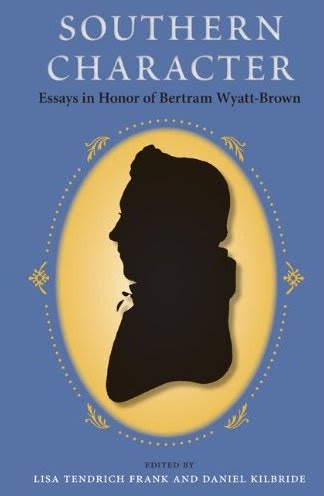
In celebration of Bert's long career and his impact, the University Press of Florida will soon publish a Festschrift to honor him. Edited by Daniel Kilbride and Lisa Tendrich Frank, the volume includes essays by a number of Bert's students and others on which he had a significant influence. It will be out just in time for the Southern Historical Association meeting in October.