
Randall Stephens
I took some time out of my large lecture course this week to talk to students about writing. Fresh on my mind was Rachel Toor's essay.
I always enjoy reading Toor "on writing" in the Chronicle of Higher Ed. This week's piece was especially interesting. Toor muses on the question: "So how do you learn to edit yourself?" True enough, seeing faults in your own work is sometimes harder than seeing them in the work of others. It's the splinter in his/her eye vs. the plank in yours.
Rachel Toor, "How Do You Learn to Edit Yourself?" Chronicle of Higher Education, September 27, 2010.
"Where do you go for help? The obvious first step is, of course, to acknowledge that you need help. Then go buy one of the zillions of books on writing well. They all say basically the same things. Find one that speaks to you in a way that you can hear.
Call me fusty and old-fashioned, but I heart Strunk and White's The Elements of Style, now in its 956th edition. My students receive it like a gift and tend to have two reactions: "How come no one ever told me to read this book?" And "OMG, I'm so embarrassed—I'm a terrible writer and make tons of mistakes." As Dorothy Parker said, "If you have any young friends who aspire to become writers, the second-greatest favor you can do them is to present them with copies of The Elements of Style. The first-greatest, of course, is to shoot them now, while they're happy.">>>
See also,
Lewis Thomas, "Notes on Punctuation."
William Zinsser, "Writing English as a Second Language," American Scholar (Winter 2010).
Michael C. Munger, "10 Tips on How to Write Less Badly," Chronicle of Higher Education, September 6, 2010.
Heather Cox Richardson, "Richardson's Rules of Order, Part VId: Tips for Writing Research Papers for a College History Course," THS Blog, July 27, 2009.
Thursday, September 30, 2010

Wednesday, September 29, 2010
History, Politics, and the Art of Compromise
Heather Cox Richardson
On Saturday, September 19, the New York Times published an article titled: “Hey, Political Zealots; Listen to a Conversation from 1963.” It reveals the contents of a conversation between President Kennedy and Everett Dirksen, a senator from Illinois, captured on a tape that has recently been released by the JFK Library in Boston. In the recording, the president and Dirksen—and others, including Robert S. McNamara—are discussing the Nuclear Test Ban Treaty. Dirksen, a Republican, counsels Kennedy, a Democrat, on how to sell the treaty to anxious Republican senators, even offering language that would allay those anxieties. Kennedy thanks Dirksen, adopts his suggestions, and the treaty passed.
The article was about the conversation, but its point was to emphasize to today’s political partisans the value of political compromise in achieving important national goals.
The article is of interest to historians because it underscores an approaching sea change in national politics. A political historian watching closely can see a quiet swell of Burkean conservatism in American political language. It is an ideological shift that has enormous implications for the Republican Party and for the nation.
It also has important implications for historians.
As pundits on the right have become increasingly shrill and doctrinaire, more traditional conservatives have begun to push back against Republican Party leaders. Conservative thinkers are increasingly distinguishing between the movement conservatism that endorsed the Republican Party and actual conservative beliefs. In The Death of Conservatism (2009), Sam Tanenhaus explores how the pursuit of political dominance made movement conservatives in the Republican Party abandon their advocacy of the small government and fiscal austerity so important to traditional conservatism. More important, though, he emphasizes that they had abandoned true conservatism, since traditional conservative governance works through compromise to embrace changes demanded by the community.
Tanenhaus was excoriated by right-wing pundits for his observations, but they did not disappear. On his popular blog at The Atlantic, Andrew Sullivan hammers daily on extremism both right and left, and calls for political compromise to achieve national ends. As the New York Times piece about Dirksen and Kennedy indicates, such a call is also beginning to crop up more and more often in national newspapers.
And this emphasis on debate and political compromise has begun to show up in the writings of historians. Two new biographies of Henry Clay celebrate him as “The Great Compromiser” and denigrate the shrill partisans who tore his compromises to shreds and brought on a devastating war with their hyperbole and violence.
The growing momentum behind this language change suggests a political realignment, to be sure, but it also suggests that tomorrow’s historians are going to weigh the past with a different scale than their recent predecessors did.
On Saturday, September 19, the New York Times published an article titled: “Hey, Political Zealots; Listen to a Conversation from 1963.” It reveals the contents of a conversation between President
Kennedy and Everett Dirksen, a senator from Illinois, captured on a tape that has recently been released by the JFK Library in Boston. In the recording, the president and Dirksen—and others, including Robert S. McNamara—are discussing the Nuclear Test Ban Treaty. Dirksen, a Republican, counsels Kennedy, a Democrat, on how to sell the treaty to anxious Republican senators, even offering language that would allay those anxieties. Kennedy thanks Dirksen, adopts his suggestions, and the treaty passed.The article was about the conversation, but its point was to emphasize to today’s political partisans the value of political compromise in achieving important national goals.
The article is of interest to historians because it underscores an approaching sea change in national politics. A political historian watching closely can see a quiet swell of Burkean conservatism in American political language. It is an ideological shift that has enormous implications for the Republican Party and for the nation.
It also has important implications for historians.
As pundits on the right have become increasingly shrill and doctrinaire, more traditional conservatives have begun to push back against Republican Party leaders. Conservative thinkers are increasingly distinguishing between the movement conservatism that endorsed the Republican Party and actual conservative beliefs. In The Death of Conservatism (2009), Sam Tanenhaus explores how the pursuit of political dominance made movement conservatives in the Republican Party abandon their advocacy of the small government and fiscal austerity so important to traditional conservatism. More important, though, he emphasizes that they had abandoned true conservatism, since traditional conservative governance works through compromise to embrace changes demanded by the community.
Tanenhaus was excoriated by right-wing pundits for his observations, but they did not disappear. On his popular blog at The Atlantic, Andrew Sullivan hammers daily on extremism both right and left, and calls for political compromise to achieve national ends. As the New York Times piece about Dirksen and Kennedy indicates, such a call is also beginning to crop up more and more often in national newspapers.
And this emphasis on debate and political compromise has begun to show up in the writings of historians. Two new biographies of Henry Clay celebrate him as “The Great Compromiser” and denigrate the shrill partisans who tore his compromises to shreds and brought on a devastating war with their hyperbole and violence.
The growing momentum behind this language change suggests a political realignment, to be sure, but it also suggests that tomorrow’s historians are going to weigh the past with a different scale than their recent predecessors did.
Tuesday, September 28, 2010
Interview with Donald Yerxa on Historically Speaking
Randall Stephens
Johns Hopkins University Press is now in the business of podcasts. You can listen to my interview with Historically Speaking senior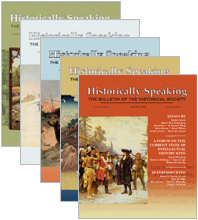 editor Donald Yerxa here. (That page also includes interviews with Adeed Dawisha, Journal of Democracy, and Michael D. Wiatrowski and Jack A. Goldstone, Journal of Democracy.)
In the interview, I talk to Yerxa about our recent neglected fields forums, and the September naval history forum in particular. Yerxa also describes some of the ways that Historically Speaking has changed since he and senior editor Joseph Lucas came on board in fall 2001. HS aims for the general, educated reader, and tries to avoid jargon or the insider language of subfields, says Yerxa. He reflects on the niche the magazine fills and offers some examples of its success.
Johns Hopkins University Press is now in the business of podcasts. You can listen to my interview with Historically Speaking senior
editor Donald Yerxa here. (That page also includes interviews with Adeed Dawisha, Journal of Democracy, and Michael D. Wiatrowski and Jack A. Goldstone, Journal of Democracy.)In the interview, I talk to Yerxa about our recent neglected fields forums, and the September naval history forum in particular. Yerxa also describes some of the ways that Historically Speaking has changed since he and senior editor Joseph Lucas came on board in fall 2001. HS aims for the general, educated reader, and tries to avoid jargon or the insider language of subfields, says Yerxa. He reflects on the niche the magazine fills and offers some examples of its success.
Monday, September 27, 2010
Slavery in New England
.
The Sunday Ideas section of the Boston Globe features an interesting essay on slavery in New England. Francie Latour lays bare some of the myths related to regionalism and slavery.
Francie Latour, "New England’s Hidden History," Boston Globe, September 26, 2010.
"When it comes to slavery, the story that New England has long told itself goes like this: Slavery happened in the South, and it ended thanks to the North. Maybe we had a little slavery, early on. But it wasn’t real slavery. We never had many slaves, and the ones we did have were practically family. . . .
As the nation prepares to mark the 150th anniversary of the American Civil War in 2011, with commemorations that reinforce the North/South divide, researchers are offering uncomfortable answers to that question, unearthing more and more of the hidden stories of New England slavery — its brutality, its staying power, and its silent presence in the very places that have become synonymous with freedom." >>>
The Sunday Ideas section of the Boston Globe features an interesting essay on slavery in New England. Francie Latour lays bare some of the myths related to regionalism and slavery.
Francie Latour, "New England’s Hidden History," Boston Globe, September 26, 2010.
"When it comes to slavery, the story that New England has long told itself goes like this: Slavery happened in the South, and it ended thanks to the North. Maybe we had a little slavery, early on. But it wasn’t real slavery. We never had many slaves, and the ones we did have were practically family. . . .
As the nation prepares to mark the 150th anniversary of the American Civil War in 2011, with commemorations that reinforce the North/South divide, researchers are offering uncomfortable answers to that question, unearthing more and more of the hidden stories of New England slavery — its brutality, its staying power, and its silent presence in the very places that have become synonymous with freedom." >>>
Representing Empires (to Students)
Heather Cox Richardson
This simple graphic depiction of France, England, Portugal, and Spain from 1800 to the present strikes me as a useful way to start a class on modern world history. It could also work in a class on colonial or modern American history—less so for a nineteenth-century course on the U.S.
The growth and conflicts and jockeying of the dots are interesting enough, but when the video gets to the 1960s, the explosion is so dramatic any student can see just what a world watershed the mid-twentieth century was.
For a single country, see also this animated history of Poland. HT to Ralph Luker at HNN
This simple graphic depiction of France, England, Portugal, and Spain from 1800 to the present strikes me as a useful way to start a class on modern world history. It could also work in a class on colonial or modern American history—less so for a nineteenth-century course on the U.S.
The growth and conflicts and jockeying of the dots are interesting enough, but when the video gets to the 1960s, the explosion is so dramatic any student can see just what a world watershed the mid-twentieth century was.
For a single country, see also this animated history of Poland. HT to Ralph Luker at HNN
Saturday, September 25, 2010
The Western Image, Continued
Heather Cox Richardson
The classic version of the American Western hero is Louis L’Amour’s Flint. Flint is a westerner, adopted by a gunslinger, then educated at fancy eastern schools. He plays the eastern game, becoming a rich businessman in the cutthroat world of industry. But his life has a twist. The secret to his eastern success is that he listens to the little guy, the cabbie who hears a stock tip, the waitress who learns about a business takeover. He values them and their hard work; he treats them as equals.
When an eastern doctor incorrectly diagnoses Flint with cancer, he chucks over his fame as a robber baron to go back to his roots. There, he sticks up for the small ranchers against the big guys, backed by the eastern system. He wins, of course. He’s better with cards, guns, and women than any easterner ever born. And he’s a lot smarter.
Does this image still appeal to Americans?
This TV show (below), appropriately named Outlaw, starts this week.
When an eastern doctor incorrectly diagnoses Flint with cancer, he chucks over his fame as a robber baron to go back to his roots. There, he sticks up for the small ranchers against the big guys, backed by the eastern system. He wins, of course. He’s better with cards, guns, and women than any easterner ever born. And he’s a lot smarter.
Does this image still appeal to Americans?
This TV show (below), appropriately named Outlaw, starts this week.
Thursday, September 23, 2010
Index cards are so 1985
Jonathan Rees
Today's guest post comes from Jonathan Rees, professor of history at Colorado State University - Pueblo. He's the author of Representation and Rebellion: The Rockefeller Plan at the Colorado Fuel and Iron Company, 1914-1942 (University Press of Colorado, 2010). He also blogs about historical matters at More or Less Bunk.
I’ve never taken a poll on the subject, but I strongly suspect that many of my fellow historians first encountered a college library the same way I did: as a member of their high school debating team. If by chance you weren’t a debate geek like me, let me briefly explain the way the system worked (and still does). The National Forensics League, the big national high school debate group, would give all students in the country a big, broad topic. The one I remember most fondly from my years in high school was court reform. You would research a more specific reform to propose when you were taking the affirmative. My partner Ahmed and I proposed a federal reporter shield law that year. You had to have a case for reform with plenty of specific factual evidence ready before the summer was even over if you were going to compete successfully on a national level. That’s why you had to go to a college library, to find lots of relevant information fast.
The harder side to argue was always the negative. While you could prepare your affirmative case in advance, you never knew what reform the other team would propose until their first speaker started talking. That’s when you had to make a mad dash to your file box of index cards to prepare a crash course on just about anything so that you could convince the judge to shoot their case down. Speed was of the essence. If you couldn’t gather your evidence before it was your turn to speak, you might very well stand up there with no experts to cite, and who’d believe you then?
When I went to graduate school, I took my debate-ready research habits with me. My dissertation was like a big affirmative case with loads of index cards covering every aspect of my subject and huge piles of copies replacing the debate briefs that some firms sold in order to make arguing anything easier. Lucky for me, there was no time limit. I’m not talking about the overall project (which I got done in what was a very reasonable time for a history PhD, if I say so myself). I’m talking about finding individual quotations from sources that I’d copied or transferred to index cards. I can’t tell you how many hours I spent digging through cards and papers looking for something I knew I had read, but couldn’t exactly remember where.
When I started my second book in 1999, the one after my dissertation, I decided to rectify this problem. I bought an early-computerized notes program. After writing a different book in the interim, I just finished almost all of the manuscript from that earlier project in a major writing tear over this last summer. As a result of my delay, it took me ten years to realize how great computerized notes programs really are. It was hard enough back in graduate school to find things that I’d read only a month or a year before. Try finding things that you wrote down over a decade ago! Even the program I bought way back in 1999 allowed me to search my notes by individual words. This not only saved me time, it made it possible for me to quickly regain intellectual control over a huge amount of information.
Recently, I asked two separate historians whose work I greatly admire what notes program they used. In each instance, they looked at me like I was speaking Greek. I tried to explain to them the advantages that I’ve described here, but they were both of the “If it ain’t broke, don’t fix it” school of research. Certainly using pen and paper for notes won’t prevent them from doing more great work in the future (albeit slower than it would otherwise have to be), but I figure my students might as well keep up with the times. I’m teaching both the undergraduate and graduate history research classes this semester, so I’ve required them to use the newest generation in notes programs: Zotero.
Unlike the hundred dollars I plopped down in 1999, Zotero is free. It was created by the Center for History and New Media at George Mason University and it’s really quite an incredible program. It not only allows you to search through your notes by word or by category the same way my decade-old notes program did, it allows you to pull in PDFs or screenshots from the web and search through those too. Suppose you find a full-view book on Google Books that you like (a common occurrence for those of us who work on American history before 1923). Zotero will record the entire lengthy, complicated URL automatically so that you can get back to it easily. Furthermore, you don’t need a web connection to use Zotero, so you can enter information manually and search through that the same way that you find material in these easy-to-record web items.
Until very recently, I would have said the one pitfall of using Zotero is that it only worked through the Firefox browser, a browser that has looked less and less useful to me the more I experiment with other choices. It turns out they just took care of that problem. Indeed, you can now get Zotero as a stand alone program so that you don’t even need to use a browser at all.
With the introduction of Google Books, newspaper databases like Chronicling America from the Library of Congress and comprehensive journal databases like Jstor, history research has changed forever. You don’t need to be near a great library to have access to scads of excellent primary sources. The main problem that students and historians alike now face, if they want to write about the last two or three hundred years, is not too little information, but too much. In the future, the quantity of sources will tell us little about research, it’s the ability to find the right information for any given point that will matter the most. You can still write history using methods that stood in good stead back in 1985, but if there’s a new way to manage gobs of information faster, why wouldn’t you want to try it?
Today's guest post comes from Jonathan Rees, professor of history at Colorado State University - Pueblo. He's the author of Representation and Rebellion: The Rockefeller Plan at the Colorado Fuel and Iron Company, 1914-1942 (University Press of Colorado, 2010). He also blogs about historical matters at More or Less Bunk.
I’ve never taken a poll on the subject, but I strongly suspect that many of my fellow historians first encountered a college library the same way I did: as a member of their high school debating team. If by chance you weren’t a debate geek like me, let me briefly explain the way the system worked (and still does). The National
 Forensics League, the big national high school debate group, would give all students in the country a big, broad topic. The one I remember most fondly from my years in high school was court reform. You would research a more specific reform to propose when you were taking the affirmative. My partner Ahmed and I proposed a federal reporter shield law that year. You had to have a case for reform with plenty of specific factual evidence ready before the summer was even over if you were going to compete successfully on a national level. That’s why you had to go to a college library, to find lots of relevant information fast.
The harder side to argue was always the negative. While you could prepare your affirmative case in advance, you never knew what reform the other team would propose until their first speaker started talking. That’s when you had to make a mad dash to your file box of index cards to prepare a crash course on just about anything so that you could convince the judge to shoot their case down. Speed was of the essence. If you couldn’t gather your evidence before it was your turn to speak, you might very well stand up there with no experts to cite, and who’d believe you then?
When I went to graduate school, I took my debate-ready research habits with me. My dissertation was like a big affirmative case with loads of index cards covering every aspect of my subject and huge piles of copies replacing the debate briefs that some firms sold in order to make arguing anything easier. Lucky for me, there was no time limit. I’m not talking about the overall project (which I got done in what was a very reasonable time for a history PhD, if I say so myself). I’m talking about finding individual quotations from sources that I’d copied or transferred to index cards. I can’t tell you how many hours I spent digging through cards and papers looking for something I knew I had read, but couldn’t exactly remember where.
When I started my second book in 1999, the one after my dissertation, I decided to rectify this problem. I bought an early-computerized notes program. After writing a different book in the interim, I just finished almost all of the manuscript from that earlier project in a major writing tear over this last summer. As a result of my delay, it took me ten years to realize how great computerized notes programs really are. It was hard enough back in graduate school to find things that I’d read only a month or a year before. Try finding things that you wrote down over a decade ago! Even the program I bought way back in 1999 allowed me to search my notes by individual words. This not only saved me time, it made it possible for me to quickly regain intellectual control over a huge amount of information.
Recently, I asked two separate historians whose work I greatly admire what notes program they used. In each instance, they looked at me like I was speaking Greek. I tried to explain to them the advantages that I’ve described here, but they were both of the “If it ain’t broke, don’t fix it” school of research. Certainly using pen and paper for notes won’t prevent them from doing more great work in the future (albeit slower than it would otherwise have to be), but I figure my students might as well keep up with the times. I’m teaching both the undergraduate and graduate history research classes this semester, so I’ve required them to use the newest generation in notes programs: Zotero.
Unlike the hundred dollars I plopped down in 1999, Zotero is free. It was created by the Center for History and New Media at George Mason University and it’s really quite an incredible program. It not only allows you to search through your notes by word or by category the same way my decade-old notes program did, it allows you to pull in PDFs or screenshots from the web and search through those too. Suppose you find a full-view book on Google Books that you like (a common occurrence for those of us who work on American history before 1923). Zotero will record the entire lengthy, complicated URL automatically so that you can get back to it easily. Furthermore, you don’t need a web connection to use Zotero, so you can enter information manually and search through that the same way that you find material in these easy-to-record web items.
Until very recently, I would have said the one pitfall of using Zotero is that it only worked through the Firefox browser, a browser that has looked less and less useful to me the more I experiment with other choices. It turns out they just took care of that problem. Indeed, you can now get Zotero as a stand alone program so that you don’t even need to use a browser at all.
With the introduction of Google Books, newspaper databases like Chronicling America from the Library of Congress and comprehensive journal databases like Jstor, history research has changed forever. You don’t need to be near a great library to have access to scads of excellent primary sources. The main problem that students and historians alike now face, if they want to write about the last two or three hundred years, is not too little information, but too much. In the future, the quantity of sources will tell us little about research, it’s the ability to find the right information for any given point that will matter the most. You can still write history using methods that stood in good stead back in 1985, but if there’s a new way to manage gobs of information faster, why wouldn’t you want to try it?
Wednesday, September 22, 2010
James Cobb on "The Necessary South" in Historically Speaking
_
In the Latest issue of Historically Speaking, James Cobb writes about the role the South has played on the national political stage. Read his essay on the what pundits, historians, and others have made of the South. Here's an excerpt:
James Cobb, "The Necessary South," Historically Speaking (September 2010)
Since the earliest days of the republic the South has served primarily as what Jack P. Greene called “a negative example of what America had to overcome before it could finally realize its true self.” The struggle to transcend this burdensome regional anomaly would play out over the better part of two centuries, but by the time it appeared finally to have run its course, some were beginning to complain that, in the end, it was the South that had actually overcome, and, in the process, prevented the nation from becoming all that it could be. Even before 30 million Americans outside the South chose a bona fide representative of a racially transformed and economically vibrant Dixie to lead the country out of its post-Watergate funk in 1976, liberals were bemoaning the ominous “rise of the Southern Rim” and the insidiously conservatizing effects of the “Southernization of America.” That such rhetoric is still in vogue more than a generation later suggests that not all of the resistance to integrating the South into national life has originated in the South itself. For all the evidence that a once-recalcitrant Dixie is, for better or worse, now one with the rest of the country, many outside the region and even a few within it still cling to a static vision of a defiantly unchanged, indisputably inferior South, which, in turn, provides the negative counterpoint necessary to sustain their equally rigid and decidedly idealized vision of America’s “true self.”
Pointing to critical changes in the South, a veritable slew of pundits had suggested that the perceived differences between region and nation were disappearing long before John Egerton referred in 1973 to the “Americanization of Dixie.” On the other hand, Egerton was one of the first to argue that the South’s loss of distinctiveness had actually been accelerated by the concomitant “Southernization of America,” observing that “the North, for its part, seems more overtly racist than it had been; shorn of its pretensions of moral innocence, it is exhibiting many of the attitudes that once were thought to be the exclusive possession of white Southerners.”
Egerton used “Southernization” merely as a figurative description of what he saw happening in the 1970s, but a host of liberal commentators quickly seized on the term as a literal explanation, in which a sudden, aggressive, nationwide contagion of southern white values became primarily responsible for America’s pronounced tilt to the right during the last quarter of the 20th century. “Southernization,” wrote George Packer, “was an attitude that spread north—suspicion of government, antielitism, racial resentment, a highly personal religiosity.”
Catering to white Southerners’ resentment of Democratic support for civil rights advances, Barry Goldwater had carried five southern states in 1964, and by 1966 Richard Nixon was already assuring Pat Buchanan that the GOP’s future lay “right here in the South.” Yet in the “Southernization” version of events it was not until George Wallace, the presumed embodiment of the southern white mentality, had expertly manipulated the race issue in 1968 that the Republican Party was seduced into its infamous, racially coded “southern strategy.” This strategy, in turn, succeeded in forging southern white racial antagonism (not unlike the violent sentiments on shocking public display at the time in Chicago or Detroit or Boston) into such a sizable and solid core of Republican support in the South that the GOP was able to win the presidency four out of five times between 1972 and 1988. To be sure, the virtual certainty of strong support from southern whites allowed Republican candidates to concentrate their resources elsewhere. Still, Richard Nixon and Ronald Reagan claimed at least 90% of the remaining electoral votes nationally in 1972, 1980, and 1984, and George H.W. Bush drew nearly 75% in 1988, meaning that all of them ran nearly as well outside the South as within it, and thus not a single southern vote had been essential to any of their victories. >>>
In the Latest issue of Historically Speaking, James Cobb writes about the role the South has played on the national political stage. Read his essay on the what pundits, historians, and others have made of the South. Here's an excerpt:
James Cobb, "The Necessary South," Historically Speaking (September 2010)
Since the earliest days of the republic the South has served primarily as what Jack P. Greene called “a negative example of what America had to overcome before it could finally realize its true self.” The struggle to transcend this burdensome regional anomaly would play out over the
 better part of two centuries, but by the time it appeared finally to have run its course, some were beginning to complain that, in the end, it was the South that had actually overcome, and, in the process, prevented the nation from becoming all that it could be. Even before 30 million Americans outside the South chose a bona fide representative of a racially transformed and economically vibrant Dixie to lead the country out of its post-Watergate funk in 1976, liberals were bemoaning the ominous “rise of the Southern Rim” and the insidiously conservatizing effects of the “Southernization of America.” That such rhetoric is still in vogue more than a generation later suggests that not all of the resistance to integrating the South into national life has originated in the South itself. For all the evidence that a once-recalcitrant Dixie is, for better or worse, now one with the rest of the country, many outside the region and even a few within it still cling to a static vision of a defiantly unchanged, indisputably inferior South, which, in turn, provides the negative counterpoint necessary to sustain their equally rigid and decidedly idealized vision of America’s “true self.”
Pointing to critical changes in the South, a veritable slew of pundits had suggested that the perceived differences between region and nation were disappearing long before John Egerton referred in 1973 to the “Americanization of Dixie.” On the other hand, Egerton was one of the first to argue that the South’s loss of distinctiveness had actually been accelerated by the concomitant “Southernization of America,” observing that “the North, for its part, seems more overtly racist than it had been; shorn of its pretensions of moral innocence, it is exhibiting many of the attitudes that once were thought to be the exclusive possession of white Southerners.”
Egerton used “Southernization” merely as a figurative description of what he saw happening in the 1970s, but a host of liberal commentators quickly seized on the term as a literal explanation, in which a sudden, aggressive, nationwide contagion of southern white values became primarily responsible for America’s pronounced tilt to the right during the last quarter of the 20th century. “Southernization,” wrote George Packer, “was an attitude that spread north—suspicion of government, antielitism, racial resentment, a highly personal religiosity.”
Catering to white Southerners’ resentment of Democratic support for civil rights advances, Barry Goldwater had carried five southern states in 1964, and by 1966 Richard Nixon was already assuring Pat Buchanan that the GOP’s future lay “right here in the South.” Yet in the “Southernization” version of events it was not until George Wallace, the presumed embodiment of the southern white mentality, had expertly manipulated the race issue in 1968 that the Republican Party was seduced into its infamous, racially coded “southern strategy.” This strategy, in turn, succeeded in forging southern white racial antagonism (not unlike the violent sentiments on shocking public display at the time in Chicago or Detroit or Boston) into such a sizable and solid core of Republican support in the South that the GOP was able to win the presidency four out of five times between 1972 and 1988. To be sure, the virtual certainty of strong support from southern whites allowed Republican candidates to concentrate their resources elsewhere. Still, Richard Nixon and Ronald Reagan claimed at least 90% of the remaining electoral votes nationally in 1972, 1980, and 1984, and George H.W. Bush drew nearly 75% in 1988, meaning that all of them ran nearly as well outside the South as within it, and thus not a single southern vote had been essential to any of their victories. >>>
Tuesday, September 21, 2010
From John Henry Newman's Era to Our's
Randall Stephens
Today I spoke to students in my civ class about the historic significance of the Pope Benedict's visit to England. (It helped that we had gone over the reformations of the 16th century in previous weeks.) While in England--along with facing the largest protest of a papal visit in history--the Pope beatified John Henry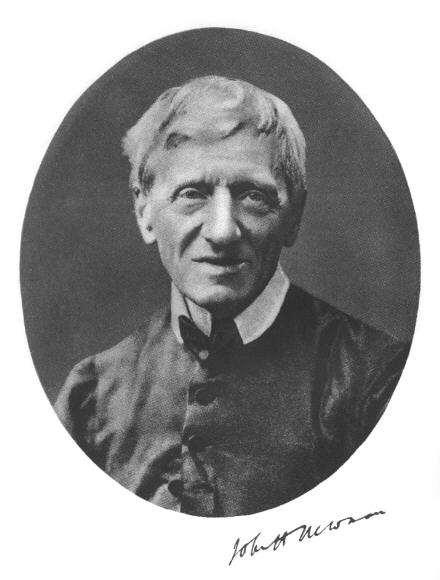 Newman on September 19. Newman achieved fame in the 19th century as one of the most critical thinkers of his age, a leader of the Oxford Movement, and a convert from Anglicanism to Catholicism.
English philosopher and public intellectual Roger Scruton seizes on the moment to write about Newman's views on higher education. Oh how things have declined, laments Scruton in the American Spectator. "What is expected of the student in many courses in the humanities and social sciences is ideological conformity, rather than critical appraisal," he writes, "and censorship has become accepted as a legitimate part of the academic way of life." He ventures into choppy political waters and makes some sweeping indictments of the new American system. Seems overdone to me. Don't think hyper-political correctness is the problem.
Still, Newman's eloquent summary of the mission of the university and his ode to the life of the mind is well worth revisiting.
Excerpt: John Henry Newman, The Idea of a University (reprint: 1852, London, 1899), ix, 101-102.
THE view taken of a University in these Discourses is the following: — That it is a place of teaching universal knowledge. This implies that its object is, on the one hand, intellectual, not moral; and, on the other, that it is the diffusion and extension of knowledge rather than the advancement. If its object were scientific and philosophical discovery, I do not see why a University should have students; if religious training, I do not see how it can be the seat of literature and science.
Such is a University in its essence, and independently of its relation to the Church. But, practically speaking, it cannot fulfil its object duly, such as I have described it, without the Church's assistance; or, to use the theological term, the Church is necessary for its integrity. Not that its main characters are changed by this incorporation: it still has the office of intellectual education; but the Church steadies it in the performance of that office. . . .
It is a great point then to enlarge the range of studies, which a University professes, even for the sake of the students; and, though they cannot pursue every subject which is open to them, they will be the gainers by living among those and under those who represent the whole circle. This I conceive to be the advantage of a seat of universal learning, considered as a place of education. An assemblage of learned men, zealous for their own sciences, and rivals of each other, are brought, by familiar intercourse and for the sake of intellectual peace, to adjust together the claims and relations of their respective subjects of investigation. They learn to respect, to consult, to aid each other. Thus is created a pure and clear atmosphere of thought, which the student also breathes, though in his own case he only pursues a few sciences out of the multitude. He profits by an intellectual tradition, which is independent of particular teachers, which guides him in his choice of subjects, and duly interprets for him those which he chooses. He apprehends the great outlines of knowledge, the principles on which it rests, the scale of its parts, its lights and its shades, its great points and its little, as he otherwise cannot apprehend them. Hence it is that his education is called "Liberal." A habit of mind is formed which lasts through life, of which the attributes are, freedom, equitableness, calmness, moderation, and wisdom; or what in a former Discourse I have ventured to call a philosophical haunt. This then I would assign as the special fruit of the education furnished at a University as contrasted with other places of teaching or modes of teaching. This is the main purpose of a University in its treatment of its students.
Today I spoke to students in my civ class about the historic significance of the Pope Benedict's visit to England. (It helped that we had gone over the reformations of the 16th century in previous weeks.) While in England--along with facing the largest protest of a papal visit in history--the Pope beatified John Henry
Newman on September 19. Newman achieved fame in the 19th century as one of the most critical thinkers of his age, a leader of the Oxford Movement, and a convert from Anglicanism to Catholicism.English philosopher and public intellectual Roger Scruton seizes on the moment to write about Newman's views on higher education. Oh how things have declined, laments Scruton in the American Spectator. "What is expected of the student in many courses in the humanities and social sciences is ideological conformity, rather than critical appraisal," he writes, "and censorship has become accepted as a legitimate part of the academic way of life." He ventures into choppy political waters and makes some sweeping indictments of the new American system. Seems overdone to me. Don't think hyper-political correctness is the problem.
Still, Newman's eloquent summary of the mission of the university and his ode to the life of the mind is well worth revisiting.
Excerpt: John Henry Newman, The Idea of a University (reprint: 1852, London, 1899), ix, 101-102.
THE view taken of a University in these Discourses is the following: — That it is a place of teaching universal knowledge. This implies that its object is, on the one hand, intellectual, not moral; and, on the other, that it is the diffusion and extension of knowledge rather than the advancement. If its object were scientific and philosophical discovery, I do not see why a University should have students; if religious training, I do not see how it can be the seat of literature and science.
Such is a University in its essence, and independently of its relation to the Church. But, practically speaking, it cannot fulfil its object duly, such as I have described it, without the Church's assistance; or, to use the theological term, the Church is necessary for its integrity. Not that its main characters are changed by this incorporation: it still has the office of intellectual education; but the Church steadies it in the performance of that office. . . .
It is a great point then to enlarge the range of studies, which a University professes, even for the sake of the students; and, though they cannot pursue every subject which is open to them, they will be the gainers by living among those and under those who represent the whole circle. This I conceive to be the advantage of a seat of universal learning, considered as a place of education. An assemblage of learned men, zealous for their own sciences, and rivals of each other, are brought, by familiar intercourse and for the sake of intellectual peace, to adjust together the claims and relations of their respective subjects of investigation. They learn to respect, to consult, to aid each other. Thus is created a pure and clear atmosphere of thought, which the student also breathes, though in his own case he only pursues a few sciences out of the multitude. He profits by an intellectual tradition, which is independent of particular teachers, which guides him in his choice of subjects, and duly interprets for him those which he chooses. He apprehends the great outlines of knowledge, the principles on which it rests, the scale of its parts, its lights and its shades, its great points and its little, as he otherwise cannot apprehend them. Hence it is that his education is called "Liberal." A habit of mind is formed which lasts through life, of which the attributes are, freedom, equitableness, calmness, moderation, and wisdom; or what in a former Discourse I have ventured to call a philosophical haunt. This then I would assign as the special fruit of the education furnished at a University as contrasted with other places of teaching or modes of teaching. This is the main purpose of a University in its treatment of its students.
Monday, September 20, 2010
How did They Perceive the World?
Randall Stephens
A recent BBC documentary explores the world of Medieval Europe. Among other things the program asks: How did they live, think, and behave?
Watching it, I wondered why more history documentaries don't explore the day-to-day lives of regular people in the past. It would be terrific to have a film on 17th-century colonial America, which looked at the mindset of Puritans and Native Americans. (The first installment of We Shall Remain was ok on this. PBS's Colonial House had a fun take on daily life in the 1600s.) A similar program on what it was like to live poor and destitute in mid 19th-century New York City would be illuminating. In fact, one could think of a number of eras that could do with a "lived history" documentary.
Of course, the BBC program embedded here, Inside the Medieval Mind, is not without its baroque hyperboles. (New BBC docs make heavy use of lighting effects and deep contrast/saturation tricks.) But, I'd take that over our History Channel's parade of ancient aliens, Nostradamus, and Mayan apocalypse any day. Here's part of the description of Inside the Medieval Mind.
Robert Bartlett of St Andrew's University, investigates the intellectual landscape of the medieval world.
In the first programme, Knowledge, he explores the way medieval man understood the world - as a place of mystery, even enchantment. The world was a book written by God. But as the Middle Ages grew to a close, it became a place to be mastered, even exploited.
A recent BBC documentary explores the world of Medieval Europe. Among other things the program asks: How did they live, think, and behave?
Watching it, I wondered why more history documentaries don't explore the day-to-day lives of regular people in the past. It would be terrific to have a film on 17th-century colonial America, which looked at the mindset of Puritans and Native Americans. (The first installment of We Shall Remain was ok on this. PBS's Colonial House had a fun take on daily life in the 1600s.) A similar program on what it was like to live poor and destitute in mid 19th-century New York City would be illuminating. In fact, one could think of a number of eras that could do with a "lived history" documentary.
Of course, the BBC program embedded here, Inside the Medieval Mind, is not without its baroque hyperboles. (New BBC docs make heavy use of lighting effects and deep contrast/saturation tricks.) But, I'd take that over our History Channel's parade of ancient aliens, Nostradamus, and Mayan apocalypse any day. Here's part of the description of Inside the Medieval Mind.
Robert Bartlett of St Andrew's University, investigates the intellectual landscape of the medieval world.
In the first programme, Knowledge, he explores the way medieval man understood the world - as a place of mystery, even enchantment. The world was a book written by God. But as the Middle Ages grew to a close, it became a place to be mastered, even exploited.
Saturday, September 18, 2010
Goodbye to Teaching
-
See Wellesley College historian Jerold S. Auerbach's description of the joys and sorrows of a last year of teaching. Love what he calls that final year!

Jerold S. Auerbach, "Victory Lap," Chronicle of Higher Education, September 16, 2010.
"As the end approached, I was frequently reminded of my own best college teachers who, in their varied ways, had burrowed under my intellectual skin. . . .
I wanted at least part of my final survey class to be open and spontaneous. In brief concluding remarks, I referred to the pleasures of uncovering the past while trying to make sense of it to students in their very different present. Then we had a delightful conversation. Inevitably, a student asked where I was during the 1960s, and what I had done to save the world. . . .">>>
See Wellesley College historian Jerold S. Auerbach's description of the joys and sorrows of a last year of teaching. Love what he calls that final year!
Jerold S. Auerbach, "Victory Lap," Chronicle of Higher Education, September 16, 2010.
"As the end approached, I was frequently reminded of my own best college teachers who, in their varied ways, had burrowed under my intellectual skin. . . .
I wanted at least part of my final survey class to be open and spontaneous. In brief concluding remarks, I referred to the pleasures of uncovering the past while trying to make sense of it to students in their very different present. Then we had a delightful conversation. Inevitably, a student asked where I was during the 1960s, and what I had done to save the world. . . .">>>
Friday, September 17, 2010
The Western Tradition . . . Continued?
Heather Cox Richardson
When I teach the American West, I always start the weeks on the American West as entertainment with “When the Work’s All Done This Fall,” the first cowboy song recorded by Carl T. Sprague. Appearing in 1925, it sold close to a million copies and remains a favorite old time western song.
I had always thought the poem on which the song was based reflected late nineteenth-century America, with its quick deaths, poverty, and sentimentality.
So imagine my surprise this summer, when I heard modern western songwriter Slaid Cleaves doing “Horses Quick as Dreams.” This seems almost to be an updated version of the classic song:
Is the song simply part of a musical tradition? Or is it a reflection of modern American culture?
When I teach the American West, I always start the weeks on the American West as entertainment with “When the Work’s All Done This Fall,” the first cowboy song recorded by Carl T. Sprague. Appearing in 1925, it sold close to a million copies and remains a favorite old time western song.
I had always thought the poem on which the song was based reflected late nineteenth-century America, with its quick deaths, poverty, and sentimentality.
So imagine my surprise this summer, when I heard modern western songwriter Slaid Cleaves doing “Horses Quick as Dreams.” This seems almost to be an updated version of the classic song:
Is the song simply part of a musical tradition? Or is it a reflection of modern American culture?
Thursday, September 16, 2010
But is it History? II: Deep History
Randall Stephens
Harvard University professor of history Daniel Lord Smail has challenged the idea that history begins only with the advent of writing. In his 2008 book, On Deep History and the Brain (University of California Press), he lays out his arguments about how history and biology have worked together over the long arc of time. Smail asks "When does history begin?" and "What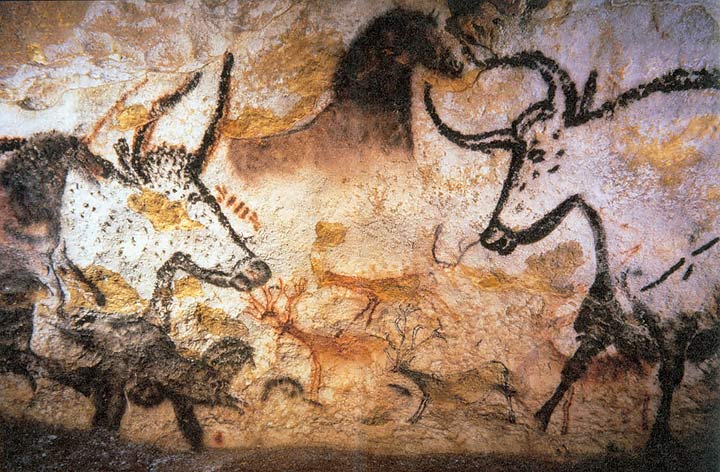 characterizes it?" He follows up on the work of evolutionary biologists and the macro history of Jared Diamond, with a new way of understanding the past.
"The ancient world is unimaginable without archeological evidence;" Smail observes, "the Middle Ages very nearly so; and the effort to reconstitute the lives of peoples without writing has been one of the signal achievements of the twentieth century." In light of that Smail asks: "So what does it matter that the evidence for the deep past comes not from written documents but from the other things that teach--from artifacts, fossils, vegetable remains, phonemes, and various forms of modern DNA?" (On Deep History, 6)
But, as Heather asked earlier on a different topic, is it history? How can we undertsand preliterate humans and societies in a historical sense? Can historians add to our understanding of pre-historic humans in ways that anthropologists and archeologists cannot? Historians inside and outside of the guild will have to figure those questions out for themselves.
What follows are some recent macro-historical, deep history, evolutionary history essays, and tidbits from the web:
Drake Bennett, "How Animals Made Us Human," Boston Globe, September 12, 2010.
. . . . What explains [our] yen to have animals in our lives? An anthropologist named Pat Shipman believes she’s found the answer: Animals make us human. She means this not in a metaphorical way — that animals teach us about loyalty or nurturing or the fragility of life or anything like that — but that the unique ability to observe and control the behavior of other animals is what allowed one particular set of Pleistocene era primates to evolve into modern man.>>>
Cynthia Haven, "Stanford historian tells why the West rules - for now," Stanford University News, September 14, 2010.
. . . . Stanford Classics and History Professor Ian Morris puts forth some bold answers in his ambitious new 750-page book, Why the West Rules – For Now (Farrar, Straus & Giroux). And that places Looty in a longer story going back to the last ice age.
Morris' book argues that history is a slow, complicated tango between geography and social development.>>>
How could a civilization that mastered the planet suddenly Collapse? Inspired by the New York Times best-selling book "Collapse: How Societies Choose to Fail or Succeed", NGC time travels 200 years into the future to see what the world would look like after civilization as we know it collapsed. Guided by author Jared Diamond, we'll piece together the remarkable story of what on earth triggered our decline.
Collapse: Based on the Book by Jared Diamond, National Geographic Channel.
How could a civilization that mastered the planet suddenly Collapse? Inspired by the New York Times best-selling book "Collapse: How Societies Choose to Fail or Succeed", NGC time travels 200 years into the future to see what the world would look like after civilization as we know it collapsed. Guided by author Jared Diamond, we'll piece together the remarkable story of what on earth triggered our decline.>>>
Mary Gray, "Are You Descended from Neanderthals?" New Zealand Herald, September 2, 2010.
. . . . With the expansion of human populations and climate change, Neanderthal populations are thought to have shrunk toward Europe and Spain. Europeans and Neanderthals had potentially longer to interbreed compared to other human populations, but there is no evidence for this - so far. Did waves of human migration from the Middle East replace ancient Neanderthal-human Europeans or did the first human inhabitants of Europe and Neanderthals keep to themselves? >>>
Harvard University professor of history Daniel Lord Smail has challenged the idea that history begins only with the advent of writing. In his 2008 book, On Deep History and the Brain (University of California Press), he lays out his arguments about how history and biology have worked together over the long arc of time. Smail asks "When does history begin?" and "What
characterizes it?" He follows up on the work of evolutionary biologists and the macro history of Jared Diamond, with a new way of understanding the past."The ancient world is unimaginable without archeological evidence;" Smail observes, "the Middle Ages very nearly so; and the effort to reconstitute the lives of peoples without writing has been one of the signal achievements of the twentieth century." In light of that Smail asks: "So what does it matter that the evidence for the deep past comes not from written documents but from the other things that teach--from artifacts, fossils, vegetable remains, phonemes, and various forms of modern DNA?" (On Deep History, 6)
But, as Heather asked earlier on a different topic, is it history? How can we undertsand preliterate humans and societies in a historical sense? Can historians add to our understanding of pre-historic humans in ways that anthropologists and archeologists cannot? Historians inside and outside of the guild will have to figure those questions out for themselves.
What follows are some recent macro-historical, deep history, evolutionary history essays, and tidbits from the web:
Drake Bennett, "How Animals Made Us Human," Boston Globe, September 12, 2010.
. . . . What explains [our] yen to have animals in our lives? An anthropologist named Pat Shipman believes she’s found the answer: Animals make us human. She means this not in a metaphorical way — that animals teach us about loyalty or nurturing or the fragility of life or anything like that — but that the unique ability to observe and control the behavior of other animals is what allowed one particular set of Pleistocene era primates to evolve into modern man.>>>
Cynthia Haven, "Stanford historian tells why the West rules - for now," Stanford University News, September 14, 2010.
. . . . Stanford Classics and History Professor Ian Morris puts forth some bold answers in his ambitious new 750-page book, Why the West Rules – For Now (Farrar, Straus & Giroux). And that places Looty in a longer story going back to the last ice age.
Morris' book argues that history is a slow, complicated tango between geography and social development.>>>
How could a civilization that mastered the planet suddenly Collapse? Inspired by the New York Times best-selling book "Collapse: How Societies Choose to Fail or Succeed", NGC time travels 200 years into the future to see what the world would look like after civilization as we know it collapsed. Guided by author Jared Diamond, we'll piece together the remarkable story of what on earth triggered our decline.
Collapse: Based on the Book by Jared Diamond, National Geographic Channel.
How could a civilization that mastered the planet suddenly Collapse? Inspired by the New York Times best-selling book "Collapse: How Societies Choose to Fail or Succeed", NGC time travels 200 years into the future to see what the world would look like after civilization as we know it collapsed. Guided by author Jared Diamond, we'll piece together the remarkable story of what on earth triggered our decline.>>>
Mary Gray, "Are You Descended from Neanderthals?" New Zealand Herald, September 2, 2010.
. . . . With the expansion of human populations and climate change, Neanderthal populations are thought to have shrunk toward Europe and Spain. Europeans and Neanderthals had potentially longer to interbreed compared to other human populations, but there is no evidence for this - so far. Did waves of human migration from the Middle East replace ancient Neanderthal-human Europeans or did the first human inhabitants of Europe and Neanderthals keep to themselves? >>>
Wednesday, September 15, 2010
Larry Friedman on Erich Fromm and Public Intellectuals
Randall Stephens
See the new issue of Historically Speaking, now available on the Project Muse site. (Most will only be able to access the full issue from a university computer or with a university account.)
I excerpt here part of my review with Larry Friedman, professor of history in Harvard’s Mind, Brain, and Behavior Initiative at Harvard University. Friedman has published a variety of books and articles on the history of psychology, the history of race and racism, and the history of social reform movements. His books include: The White Savage: Racial Fantasies in the Postbellum South (Prentice-Hall, 1970), Inventors of the Promised Land (Knopf, 1975), Gregarious Saints: Self and Community in American Abolitionism, 1830–1870 (Cambridge University Press, 1982), Menninger: The Family and the Clinic (Knopf, 1990) and a definitive study of developmental psychologist and psychoanalyst Erik Erikson: Identity’s Architect (Harvard University Press, 1999). He’s currently working on a biography of one of the most influential psychologists and public intellectuals of the 20th century, Erich Fromm.
"Erich Fromm and the Public Intellectual in Recent American History: An Interview with Larry Friedman," conducted by Randall Stephens, Historically Speaking, September 2010.
Randall Stephens: The popular psychologist and social critic Erich Fromm was once one of the most influential public intellectuals in the West. Yet many are unfamiliar with his life and work today. Could you say something about his context and significance?
Larry Friedman: Yes, that’s true. But his influence is still felt in many quarters around the globe and, as you say, he was once a major public figure. . . .
Fromm is significant for a number of reasons. But, perhaps most importantly, he had a wide influence as a best-selling author. His first book, Escape from Freedom (1941), linked Nazi and authoritarian regimes with the individual’s fear of freedom and autonomy. To escape from freedom was to find a greater sense of order in sadomasochism and its cycle of degrading others. Fromm’s The Sane Society (1955) railed against consumerism and made the case for local face-to-face democracy. His most enduring and popular work, The Art of Loving (1956), called for the love of self as a central component in the capacity to befriend and love others. It sold a staggering 30 million copies globally and was available in airports, drug stores, you name it. In 1973 he published The Anatomy of Human Destructiveness, which suggested that a conflict exists in all people between necrophilia and biophilia, a rage for death and annihilation on one hand and an affirmation and love of life on the other. To complete this book, Fromm took up the study of neuroscience, physical anthropology, linguistics, and other fields far outside of his training in psychoanalysis to explain why some favored death and destruction while others preferred life and love. We might speculate that if mainline psychoanalysis had branched into other fields as Fromm had done, psychoanalysis might have escaped the doldrums of recent decades. . . .
Stephens: How relevant are [Erich] Fromm's interests and causes to the average educated reader today?
Friedman: For one, his writings on war and devastation are still remarkably discerning. Of course, in Escape from Freedom he was concerned with the perils of Nazism and Stalinism. But he also pointed to future developments, like McCarthyism and the Red Scare. And he is exceedingly relevant even to today's world. Take, for instance, his position on the Mideast, specifically Israel. He was very critical of Israeli belligerence. His views bear some resemblance to those of Noam Chomsky.
Stephens: Your historical work has had a heavy psychological component. What's your opinion of the psychohistory of the 1960s and 1970s?

Friedman: I thought much psychohistory had become reductionist by the late 1960s. I felt that it was giving psychological exploration a bad name. It overemphasized the psychoanalytical element and did not employ cognitive psychology or neuroscience. It tended to be ahistorical. Now what is sometimes called the new cultural history is heavily psychological, but less reductionist than the old psychohistory of the 1960s and early 1970s.
Stephens: Your next book is about Richard Hofstadter and the mid-century New York scene. I wonder if you'd say something about that.
Friedman: Hofstadter was one of the greatest historians of the modern era. You can say he's wrong on a number of points, but he's brilliantly wrong and always worth going back to. Current debates about the role of conservative religion in America or the influence of anti-intellectualism revolve around some of Hofstadter's basic ideas. His take on the American political tradition continues to influence high school curricula. He remains amazingly relevant. What interests me especially is mid-century New York City. His friends and associates who lived there, intellectual giants like Peter Gay, helped shape our basic understandings of history and culture. Hofstadter also interacted with Manhattan's theater community and art world. Hofstadter's New York in the 1950s and 1960s was a fascinating intellectual and cultural hub. >>>
See the new issue of Historically Speaking, now available on the Project Muse site. (Most will only be able to access the full issue from a university computer or with a university account.)
I excerpt here part of my review with Larry Friedman, professor of history in Harvard’s Mind,
 Brain, and Behavior Initiative at Harvard University. Friedman has published a variety of books and articles on the history of psychology, the history of race and racism, and the history of social reform movements. His books include: The White Savage: Racial Fantasies in the Postbellum South (Prentice-Hall, 1970), Inventors of the Promised Land (Knopf, 1975), Gregarious Saints: Self and Community in American Abolitionism, 1830–1870 (Cambridge University Press, 1982), Menninger: The Family and the Clinic (Knopf, 1990) and a definitive study of developmental psychologist and psychoanalyst Erik Erikson: Identity’s Architect (Harvard University Press, 1999). He’s currently working on a biography of one of the most influential psychologists and public intellectuals of the 20th century, Erich Fromm.
"Erich Fromm and the Public Intellectual in Recent American History: An Interview with Larry Friedman," conducted by Randall Stephens, Historically Speaking, September 2010.
Randall Stephens: The popular psychologist and social critic Erich Fromm was once one of the most influential public intellectuals in the West. Yet many are unfamiliar with his life and work today. Could you say something about his context and significance?
Larry Friedman: Yes, that’s true. But his influence is still felt in many quarters around the globe and, as you say, he was once a major public figure. . . .
Fromm is significant for a number of reasons. But, perhaps most importantly, he had a wide influence as a best-selling author. His first book, Escape from Freedom (1941), linked Nazi and authoritarian regimes with the individual’s fear of freedom and autonomy. To escape from freedom was to find a greater sense of order in sadomasochism and its cycle of degrading others. Fromm’s The Sane Society (1955) railed against consumerism and made the case for local face-to-face democracy. His most enduring and popular work, The Art of Loving (1956), called for the love of self as a central component in the capacity to befriend and love others. It sold a staggering 30 million copies globally and was available in airports, drug stores, you name it. In 1973 he published The Anatomy of Human Destructiveness, which suggested that a conflict exists in all people between necrophilia and biophilia, a rage for death and annihilation on one hand and an affirmation and love of life on the other. To complete this book, Fromm took up the study of neuroscience, physical anthropology, linguistics, and other fields far outside of his training in psychoanalysis to explain why some favored death and destruction while others preferred life and love. We might speculate that if mainline psychoanalysis had branched into other fields as Fromm had done, psychoanalysis might have escaped the doldrums of recent decades. . . .
Stephens: How relevant are [Erich] Fromm's interests and causes to the average educated reader today?
Friedman: For one, his writings on war and devastation are still remarkably discerning. Of course, in Escape from Freedom he was concerned with the perils of Nazism and Stalinism. But he also pointed to future developments, like McCarthyism and the Red Scare. And he is exceedingly relevant even to today's world. Take, for instance, his position on the Mideast, specifically Israel. He was very critical of Israeli belligerence. His views bear some resemblance to those of Noam Chomsky.
Stephens: Your historical work has had a heavy psychological component. What's your opinion of the psychohistory of the 1960s and 1970s?

Friedman: I thought much psychohistory had become reductionist by the late 1960s. I felt that it was giving psychological exploration a bad name. It overemphasized the psychoanalytical element and did not employ cognitive psychology or neuroscience. It tended to be ahistorical. Now what is sometimes called the new cultural history is heavily psychological, but less reductionist than the old psychohistory of the 1960s and early 1970s.
Stephens: Your next book is about Richard Hofstadter and the mid-century New York scene. I wonder if you'd say something about that.
Friedman: Hofstadter was one of the greatest historians of the modern era. You can say he's wrong on a number of points, but he's brilliantly wrong and always worth going back to. Current debates about the role of conservative religion in America or the influence of anti-intellectualism revolve around some of Hofstadter's basic ideas. His take on the American political tradition continues to influence high school curricula. He remains amazingly relevant. What interests me especially is mid-century New York City. His friends and associates who lived there, intellectual giants like Peter Gay, helped shape our basic understandings of history and culture. Hofstadter also interacted with Manhattan's theater community and art world. Hofstadter's New York in the 1950s and 1960s was a fascinating intellectual and cultural hub. >>>
Tuesday, September 14, 2010
History and the Common Core Standards
Heather Cox Richardson
In early June, the National Governors’ Association and the Council of Chief State School Officers released the Common Core School Standards. Alaska and Texas opted out of the project, but officers of the other forty-eight states (plus two Territories and Washington D.C.) came together to design standards they hoped would provide uniformity and high standards to K-12 teaching across the nation.
While news reports have focused almost exclusively on the English and Mathematics standards in the CCSS, there are also suggested history standards. What is in them is significant.
The history standards are very short. Unlike many state curriculum standards, they do not specify content. Rather, they call for the development of critical thinking. They establish that students in middle school should be taught to distinguish the information in a primary source from opinions in secondary sources. They should also learn to “distinguish among fact, opinion, and reasoned judgment in a text.” In the first two years of high school, they should learn to identify key arguments in secondary texts, and be able to compare and evaluate the arguments of different authors by examining supporting primary evidence. A student leaving high school should be able to identify the central ideas of primary and secondary texts, compare them, and evaluate different arguments about the same historical event “by assessing the authors’ claims, reasoning, and evidence.”
It’s easy to see why Texas, with its politically charged State Board of Education, opted out. These standards are not so much bipartisan as nonpartisan.
But the CCSS also challenge Texas—and any states similarly inclined to skew history—by embracing another dramatic pedagogical change. The new emphasis on the use of primary documents in the teaching of K-12 history will drastically reduce the ability of any state to develop its own version of history. The rising cost of textbooks and the ubiquity of the internet mean that it is growing far easier and cheaper now to teach history directly from primary sources than from textbooks. This emphasis on primary sources shows up in the CCSS.
Indeed, the focus on primary sources, embraced by the CCSS, has already been a driving factor in the Texas curriculum debates. Late last year, the Texas legislature changed the way the state funds classroom materials. No longer are schools tied to the choices of the Texas Board of Education, the body that wrote the widely-castigated curriculum). Instead, while schools are obliged to buy at least a few of the books selected by the Board, they can use any allotted funds to buy digital material, or to gather material provided free on the internet to create a long-term stockpile of information for students.
For history teachers, this means the ability to use primary sources in their classrooms, just as the CCSS recommends.
This pedagogical change has the potential to restore open inquiry to history. It is no accident that the Texas Board of Education fervently opposed the laws that set this change in motion, complaining that standards would slip if it could no longer regulate the curriculum that Texas schools could teach.
The states have steadily adopted the CCSS over the past two months. How the standards will be implemented—or even if they will survive in states that have not won Race to the Top grants—remains to be seen. But historians interested in the way schools teach history should probably be paying attention.
In early June, the National Governors’ Association and the Council of Chief State School Officers released the Common Core School Standards. Alaska and Texas opted out of the project, but officers of the other forty-eight states (plus two Territories and Washington D.C.) came together to design standards they hoped would provide uniformity and high standards to K-12
teaching across the nation.While news reports have focused almost exclusively on the English and Mathematics standards in the CCSS, there are also suggested history standards. What is in them is significant.
The history standards are very short. Unlike many state curriculum standards, they do not specify content. Rather, they call for the development of critical thinking. They establish that students in middle school should be taught to distinguish the information in a primary source from opinions in secondary sources. They should also learn to “distinguish among fact, opinion, and reasoned judgment in a text.” In the first two years of high school, they should learn to identify key arguments in secondary texts, and be able to compare and evaluate the arguments of different authors by examining supporting primary evidence. A student leaving high school should be able to identify the central ideas of primary and secondary texts, compare them, and evaluate different arguments about the same historical event “by assessing the authors’ claims, reasoning, and evidence.”
It’s easy to see why Texas, with its politically charged State Board of Education, opted out. These standards are not so much bipartisan as nonpartisan.
But the CCSS also challenge Texas—and any states similarly inclined to skew history—by embracing another dramatic pedagogical change. The new emphasis on the use of primary documents in the teaching of K-12 history will drastically reduce the ability of any state to develop its own version of history. The rising cost of textbooks and the ubiquity of the internet mean that it is growing far easier and cheaper now to teach history directly from primary sources than from textbooks. This emphasis on primary sources shows up in the CCSS.
Indeed, the focus on primary sources, embraced by the CCSS, has already been a driving factor in the Texas curriculum debates. Late last year, the Texas legislature changed the way the state funds classroom materials. No longer are schools tied to the choices of the Texas Board of Education, the body that wrote the widely-castigated curriculum). Instead, while schools are obliged to buy at least a few of the books selected by the Board, they can use any allotted funds to buy digital material, or to gather material provided free on the internet to create a long-term stockpile of information for students.
For history teachers, this means the ability to use primary sources in their classrooms, just as the CCSS recommends.
This pedagogical change has the potential to restore open inquiry to history. It is no accident that the Texas Board of Education fervently opposed the laws that set this change in motion, complaining that standards would slip if it could no longer regulate the curriculum that Texas schools could teach.
The states have steadily adopted the CCSS over the past two months. How the standards will be implemented—or even if they will survive in states that have not won Race to the Top grants—remains to be seen. But historians interested in the way schools teach history should probably be paying attention.
Monday, September 13, 2010
James McPherson and Gordon Wood on Writing History
Randall Stephens
I've been looking here and there for good material to use in a Senior Thesis course I'm teaching this fall. I wanted to find ways for students to better understand the writing process. We have days set aside in the syllabus--which I borrowed shamelessly from my colleague Don Yerxa--for discussing research topics; history-writing standards; taking notes; proper citation; style; building an argument; etc.
But from the outset, I figured it would be useful to introduce them to some heavyweights in the field who have good advice to dispense. Lucky for me that Book TV includes many of its clips on YouTube. (Others streamed on the Book TV site haven't worked quite as well for me. Plus, the great thing about YouTube is that you can load the complete video before heading off to class, and still show it even if you don't have an internet connection.)
In the embedded and linked clips below, which I'll be showing in class tomorrow, Gordon Wood and James McPherson talk about the writing process, organizing research, and more. I would embed the Wood clip here also, but looks like that feature has been disabled. (Will like to see what my students think about McPherson's use of an electric typewriter.)
Book TV: Gordon Wood on Writing and Research, September 2010.
See also: John Fea's great live-blogging coverage of Wood's recent appearance on Book TV; Timothy L. Schroer, "Placing the Senior Capstone Course within the History Program," Perspectives on History, April 2009; and Heather Cox Richardson's series of posts on this blog concerning "Richardson's Rules of Order: Tips for Writing Research Papers for a College Course."
I've been looking here and there for good material to use in a Senior Thesis course I'm teaching this fall. I wanted to find ways for students to better understand the writing process. We have
 days set aside in the syllabus--which I borrowed shamelessly from my colleague Don Yerxa--for discussing research topics; history-writing standards; taking notes; proper citation; style; building an argument; etc.
But from the outset, I figured it would be useful to introduce them to some heavyweights in the field who have good advice to dispense. Lucky for me that Book TV includes many of its clips on YouTube. (Others streamed on the Book TV site haven't worked quite as well for me. Plus, the great thing about YouTube is that you can load the complete video before heading off to class, and still show it even if you don't have an internet connection.)
In the embedded and linked clips below, which I'll be showing in class tomorrow, Gordon Wood and James McPherson talk about the writing process, organizing research, and more. I would embed the Wood clip here also, but looks like that feature has been disabled. (Will like to see what my students think about McPherson's use of an electric typewriter.)
Book TV: Gordon Wood on Writing and Research, September 2010.
See also: John Fea's great live-blogging coverage of Wood's recent appearance on Book TV; Timothy L. Schroer, "Placing the Senior Capstone Course within the History Program," Perspectives on History, April 2009; and Heather Cox Richardson's series of posts on this blog concerning "Richardson's Rules of Order: Tips for Writing Research Papers for a College Course."
Sunday, September 12, 2010
The Enduring Power of the Cowboy Image
Heather Cox Richardson
Many years ago, I had the good luck to hear Werner Sollors illustrate the importance of cultural understanding in interpreting popular history. He did it by describing what a Martian would guess about American life if his only source of information was The Brady Bunch.
The Martian would assume that American humans in the 1960s reproduced by cloning, Sollors guessed, since it was clear that the adults had no sexual contact. Male clones were always brunette and females blonde. And a Martian could easily conclude that humans kept older members of the species set off from the others in the kitchen, like a sort of pet.
I remembered Sollors’s talk recently when I discovered the new Old Spice advertising campaign. The ads have certainly hit a popular chord; the videos have gotten more than 12 million hits and have boosted sales of Old Spice by more than 107%.
And the ad campaign shows, again, just how much cultural understanding you need to make sense of popular history. This particular image plays on age-old popular stereotypes of the American West, with their heroic men and devoted women. But without that cultural knowledge, what on earth would a Martian examining modern American life through this image conclude?

Many years ago, I had the good luck to hear Werner Sollors illustrate the importance of cultural understanding in interpreting popular history. He did it by describing what a Martian would guess about American life if his only source of information was The Brady Bunch.
The Martian would assume that American humans in the 1960s reproduced by cloning, Sollors guessed, since it was clear that the adults had no sexual contact. Male clones were always brunette and females blonde. And a Martian could easily conclude that humans kept older members of the species set off from the others in the kitchen, like a sort of pet.
I remembered Sollors’s talk recently when I discovered the new Old Spice advertising campaign. The ads have certainly hit a popular chord; the videos have gotten more than 12 million hits and have boosted sales of Old Spice by more than 107%.
And the ad campaign shows, again, just how much cultural understanding you need to make sense of popular history. This particular image plays on age-old popular stereotypes of the American West, with their heroic men and devoted women. But without that cultural knowledge, what on earth would a Martian examining modern American life through this image conclude?

Saturday, September 11, 2010
Free History Lectures in Quincy, Mass
Randall Stephens
For those who live in the Boston area, my department and college are hosting several history lectures in the fall. Our history and English departments are exploring Boston and New England themes from the colonial era to the period of the Early Republic. Plenty of early American action in this neck of the woods. (For example, check out the fall activities at the Paul Revere House and the series of lectures at Old South Church, the Harvard Book Store, and the Massachusetts Historical Society.)
In the past, with the aid of an assistant, I've created a list of area lectures in history, religion, the arts, and more. I require students to get plugged into the cultural opportunities of the city. It's a nice way to broaden out the curriculum. It's almost always a plus for students, who remark favorably about it on course evaluations.
Eastern Nazarene College, Fall 2010:
FRIDAY, OCTOBER 15, at 3:00pm: Thomas S. Kidd (Baylor University), “God of Liberty: A Religious History of the American Revolution.” The Donald S. Metz Lecture in American Christian History.
THURSDAY, NOVEMBER 4, at 7:00pm: Gordon Wood (Brown University), "Empire of Liberty: A History of the Early Republic, 1789-1815." The Donald A. Yerxa Lecture in History.
THURSDAY, NOVEMBER 18, AT 7:00PM: Jill Lepore (Harvard University), "Poor Richard's Poor Jane."
For those who live in the Boston area, my department and college are hosting several history
 lectures in the fall. Our history and English departments are exploring Boston and New England themes from the colonial era to the period of the Early Republic. Plenty of early American action in this neck of the woods. (For example, check out the fall activities at the Paul Revere House and the series of lectures at Old South Church, the Harvard Book Store, and the Massachusetts Historical Society.)
In the past, with the aid of an assistant, I've created a list of area lectures in history, religion, the arts, and more. I require students to get plugged into the cultural opportunities of the city. It's a nice way to broaden out the curriculum. It's almost always a plus for students, who remark favorably about it on course evaluations.
Eastern Nazarene College, Fall 2010:
FRIDAY, OCTOBER 15, at 3:00pm: Thomas S. Kidd (Baylor University), “God of Liberty: A Religious History of the American Revolution.” The Donald S. Metz Lecture in American Christian History.
THURSDAY, NOVEMBER 4, at 7:00pm: Gordon Wood (Brown University), "Empire of Liberty: A History of the Early Republic, 1789-1815." The Donald A. Yerxa Lecture in History.
THURSDAY, NOVEMBER 18, AT 7:00PM: Jill Lepore (Harvard University), "Poor Richard's Poor Jane."
Friday, September 10, 2010
But is it History?
Heather Cox Richardson
James Bridle has just constructed a twelve-volume history of the Iraq War. But this is no common history. It is a record of every edit made to the Wikipedia entry on the war from December 2004 to November 2009. The 12,000 changes take up 7,000 pages.
Bridle, a British writer and editor, is best known for his observations about books and technology. He produced these volumes to illustrate that history is not fact, but rather a process. History, he claims, is less important than “historiography,” which he redefines as the process by which humans come to understand an event. According to Bridle, culture is argument, dissent, and gradual codification of a narrative that may or may not be correct.
By illuminating every single voice in the history of a particular moment, Bridle wants readers to see how that process works. His goal, he concludes, is “to challenge absolutist narratives of the past, and thus, those of the present and our future.”
This set of volumes strikes me as a fascinating document for future scholars of the Iraq War, who will be able to watch ideas about the war change over time.
But it can not replace scholarly history.
Bridle’s claim that the process of cultural construction of understanding is more important than what actually happens illustrates a dangerous trend in our interpretation of human society. It forces the insights of deconstruction to carry far more weight than they are strong enough to bear.
The deconstruction movement was invaluable for historians, teaching us to question the biases inherent in narratives. But the fact that all narratives are biased is no reason to discard the idea that it is possible to come close to a factual account of historical events.
To argue otherwise is to claim that the comment of one Wikipedia user—“Saddam Hussein was a dickhead”—is as important as Colin Powell’s February 2003 speech before the United Nations Security Council advocating military force against the Iraq regime.
If these two voices are equally valuable in the history of the war, it’s hard not to argue that each lone voice is equally valuable in current affairs. This is the ultimate in deconstructionism—that a lifetime spent studying the Middle East is no more valuable for devising foreign policy than a gut sense; that an understanding of the rules of Congress is less important than a knee-jerk demonization of a political opponent; that actual facts can be discarded in favor of comfortable fiction.
The work of constructing fictional worlds belongs to novelists, and it is a rich world where each facet of human relations can be probed and prodded all the way to the extremes of behavior. But historians study the way real human societies work. To do that, while we must always try to look at all the different voices we can discern in the muddle that is our evidence, we must also try our best to find the actual facts that drive historical change.
James Bridle has just constructed a twelve-volume history of the Iraq War. But this is no common history. It is a record of every edit made to the Wikipedia entry on the war from December 2004 to November 2009. The 12,000 changes take up 7,000 pages.
Bridle, a British writer and editor, is best known for his observations about books and technology. He produced these volumes to illustrate that history is not fact, but
rather a process. History, he claims, is less important than “historiography,” which he redefines as the process by which humans come to understand an event. According to Bridle, culture is argument, dissent, and gradual codification of a narrative that may or may not be correct.By illuminating every single voice in the history of a particular moment, Bridle wants readers to see how that process works. His goal, he concludes, is “to challenge absolutist narratives of the past, and thus, those of the present and our future.”
This set of volumes strikes me as a fascinating document for future scholars of the Iraq War, who will be able to watch ideas about the war change over time.
But it can not replace scholarly history.
Bridle’s claim that the process of cultural construction of understanding is more important than what actually happens illustrates a dangerous trend in our interpretation of human society. It forces the insights of deconstruction to carry far more weight than they are strong enough to bear.
The deconstruction movement was invaluable for historians, teaching us to question the biases inherent in narratives. But the fact that all narratives are biased is no reason to discard the idea that it is possible to come close to a factual account of historical events.
To argue otherwise is to claim that the comment of one Wikipedia user—“Saddam Hussein was a dickhead”—is as important as Colin Powell’s February 2003 speech before the United Nations Security Council advocating military force against the Iraq regime.
If these two voices are equally valuable in the history of the war, it’s hard not to argue that each lone voice is equally valuable in current affairs. This is the ultimate in deconstructionism—that a lifetime spent studying the Middle East is no more valuable for devising foreign policy than a gut sense; that an understanding of the rules of Congress is less important than a knee-jerk demonization of a political opponent; that actual facts can be discarded in favor of comfortable fiction.
The work of constructing fictional worlds belongs to novelists, and it is a rich world where each facet of human relations can be probed and prodded all the way to the extremes of behavior. But historians study the way real human societies work. To do that, while we must always try to look at all the different voices we can discern in the muddle that is our evidence, we must also try our best to find the actual facts that drive historical change.
Wednesday, September 8, 2010
The Roots of Contemporary American Political and Religious Conflict
Randall Stephens
Last year I used Rick Perlstein’s lively, entertaining, and insightful Nixonland: The Rise of a President and the Fracturing of America for a course I teach on America in the 1960s. The students loved it. Perlstein’s dramatic narrative pulled us in.
At the outset Perlstein observes that by 1972 a sharp division existed between "'people who identified with what Richard Nixon stood for' and 'people who despised what Richard Nixon stood for' . . . Richard Nixon, now, is long dead. But these sides have hardly changed. We now call them 'red' or 'blue' America, and whether one or the other wins the temporary allegiances of 50 percent plus one of the electorate--or 40 percent of the electorate, or 60 percent of the electorate--has been the narrative of every election since." The book is compelling on a number of levels. Yet it lacks an appreciation for ways that America had been deeply divided in other eras.
Is the culture war that feeds our current political debates all that new? Hasn't America been split between warring factions for eons? Enter Barry Hankins. His new book Jesus and Gin: Evangelicalism, the Roaring Twenties, and Today's Culture Wars, spans over that rowdy decade and offers insight into ongoing political and religious conflicts.
The era from the 1930s to the 1980s, an era of relative religious stability, Hankins suggests, may have been the aberration. The pitched battles over immigration, alcohol, Darwinian evolution, obscenity laws, and public morality that riled Americans in the 20s "were a prologue to our own age," says Hankins. Like our era that period was "a time when religion was culturally central, participating fully in politics, media, stardom, social life, and scandal." Sister Aimee Semple McPherson, Daddy Grace, and Father Divine elbowed Charlie Chaplin, Al Joslon, and Clara Bow for newspaper headline space.
Hankins leads off with Warren Harding’s moral failings, "more repulsive than evil" in the words of a biographer. "There is a sense in which Harding’s story is the story of America during the Roaring Twenties," he remarks. The baptist president's religious life was thin, to put it mildly. His administration’s contempt for law, its moral degeneration, and the scandal that swirled around it defined the nation as well. Hankins similar treatment of moral crusades, scandalous religious leaders, and heated contests between liberals and conservatives has a contemporary ring to it.
History written through the eyes of the present, I’ve noticed, draws students in to the debates. Hankins does this well throughout Jesus and Gin. Hence, he notes that Edward J. Larson’s account of the Scopes Trial, "Summer for the Gods could not have been written between 1930 and 1980 for in that period the Scopes legend was taken for granted." In many ways the book is a comparative history that moves with ease between the Christian Right of the Reagan years and the late-Victorian moralizers of the 20s. (Though Hankins does note that there is no simple liberal-conservative split in the age of flappers and speakeasies.)
Hankins fittingly ends his with a rumination on "How the Roaring Twenties Set the Stage for the Culture Wars of Our Own Time." The major struggles of our era have roots that go back decades.
Like Perlstein’s sweeping history, Hankin’s book draws attention to the deeper political and religious clashes that shape current debates.
Last year I used Rick Perlstein’s lively, entertaining, and insightful Nixonland: The Rise of a President and the Fracturing of America for a course I teach on America in the 1960s. The
students loved it. Perlstein’s dramatic narrative pulled us in.At the outset Perlstein observes that by 1972 a sharp division existed between "'people who identified with what Richard Nixon stood for' and 'people who despised what Richard Nixon stood for' . . . Richard Nixon, now, is long dead. But these sides have hardly changed. We now call them 'red' or 'blue' America, and whether one or the other wins the temporary allegiances of 50 percent plus one of the electorate--or 40 percent of the electorate, or 60 percent of the electorate--has been the narrative of every election since." The book is compelling on a number of levels. Yet it lacks an appreciation for ways that America had been deeply divided in other eras.
Is the culture war that feeds our current political debates all that new? Hasn't America been split between warring factions for eons? Enter Barry Hankins. His new book Jesus and Gin: Evangelicalism, the Roaring Twenties, and Today's Culture Wars, spans over that rowdy decade and offers insight into ongoing political and religious conflicts.
The era from the 1930s to the 1980s, an era of relative religious stability, Hankins suggests, may have been the aberration. The pitched battles over immigration, alcohol, Darwinian evolution, obscenity laws, and
 public morality that riled Americans in the 20s "were a prologue to our own age," says Hankins. Like our era that period was "a time when religion was culturally central, participating fully in politics, media, stardom, social life, and scandal." Sister Aimee Semple McPherson, Daddy Grace, and Father Divine elbowed Charlie Chaplin, Al Joslon, and Clara Bow for newspaper headline space.
Hankins leads off with Warren Harding’s moral failings, "more repulsive than evil" in the words of a biographer. "There is a sense in which Harding’s story is the story of America during the Roaring Twenties," he remarks. The baptist president's religious life was thin, to put it mildly. His administration’s contempt for law, its moral degeneration, and the scandal that swirled around it defined the nation as well. Hankins similar treatment of moral crusades, scandalous religious leaders, and heated contests between liberals and conservatives has a contemporary ring to it.
History written through the eyes of the present, I’ve noticed, draws students in to the debates. Hankins does this well throughout Jesus and Gin. Hence, he notes that Edward J. Larson’s account of the Scopes Trial, "Summer for the Gods could not have been written between 1930 and 1980 for in that period the Scopes legend was taken for granted." In many ways the book is a comparative history that moves with ease between the Christian Right of the Reagan years and the late-Victorian moralizers of the 20s. (Though Hankins does note that there is no simple liberal-conservative split in the age of flappers and speakeasies.)
Hankins fittingly ends his with a rumination on "How the Roaring Twenties Set the Stage for the Culture Wars of Our Own Time." The major struggles of our era have roots that go back decades.
Like Perlstein’s sweeping history, Hankin’s book draws attention to the deeper political and religious clashes that shape current debates.
Sunday, September 5, 2010
Higher Ed Jeremiads
Randall Stephens
Read Christopher Shea's review essay in the NYT: "The End of Tenure?" Quite a few American's outside the academy are mad as hell, and not going to take it anymore. Rumors of pampered academics tooling around their college towns in Maseratis are utterly cartoonish. But, something like that vision dominates popular thinking about the professor as aristocrat. (Anyone know how many, say, history professors actually work at schools with a 2-2 load? I'd bet money they're in the smallish minority.)
Should academics be accountable to the broader public for the writing and teaching that they do? Perhaps something like the UK's Research Assessment Exercise could be in American higher ed's future.
Anyhow, Shea considers several books that offer up nightmare scenarios of privilege or offer some suggestions for reform.
"The higher-ed jeremiads of the last generation came mainly from the right," says Shea. "But this time, it’s the tenured radicals — or at least the tenured liberals — who are leading the charge. [Andrew] Hacker is a longtime contributor to The New York Review of Books and the author of the acclaimed study 'Two Nations: Black and White, Separate, Hostile, Unequal,' while [Mark] Taylor, a religion scholar who recently moved to Columbia from Williams College, has taught courses that Allan Bloom would have gagged on ('Imagologies: Media Philosophy'). And these two books arrive at a time, unlike the early 1990s, when universities are, like many students, backed into a fiscal corner. Taylor writes of walking into a meeting one day and learning that Columbia’s endowment had dropped by 'at least' 30 percent. Simply brushing off calls for reform, however strident and scattershot, may no longer be an option.">>>
Read Christopher Shea's review essay in the NYT: "The End of Tenure?" Quite a few American's outside the academy are mad as hell, and not going to take it anymore.
Rumors of pampered academics tooling around their college towns in Maseratis are utterly cartoonish. But, something like that vision dominates popular thinking about the professor as aristocrat. (Anyone know how many, say, history professors actually work at schools with a 2-2 load? I'd bet money they're in the smallish minority.) Should academics be accountable to the broader public for the writing and teaching that they do? Perhaps something like the UK's Research Assessment Exercise could be in American higher ed's future.
Anyhow, Shea considers several books that offer up nightmare scenarios of privilege or offer some suggestions for reform.
"The higher-ed jeremiads of the last generation came mainly from the right," says Shea. "But this time, it’s the tenured radicals — or at least the tenured liberals — who are leading the charge. [Andrew] Hacker is a longtime contributor to The New York Review of Books and the author of the acclaimed study 'Two Nations: Black and White, Separate, Hostile, Unequal,' while [Mark] Taylor, a religion scholar who recently moved to Columbia from Williams College, has taught courses that Allan Bloom would have gagged on ('Imagologies: Media Philosophy'). And these two books arrive at a time, unlike the early 1990s, when universities are, like many students, backed into a fiscal corner. Taylor writes of walking into a meeting one day and learning that Columbia’s endowment had dropped by 'at least' 30 percent. Simply brushing off calls for reform, however strident and scattershot, may no longer be an option.">>>
Friday, September 3, 2010
"I can't read this book . . . it's long and boring"
Randall Stephens
Are we awash in a rising sea of idiocracy? Or, are things just different today; no better, no worse than yesterday? Is short always sweet? Perhaps anything worth saying can be pared down to 140 characters (twitter) or 160 characters (SMS). I don't believe that. And I think that "pithy" and "tweet" probably shouldn't go in the same sentence.
Still I'm not above assigning portions of a longer book. Maybe students do get less from the whole. I know that some students are paralyzed with fear at the thought of reading a 250-page work of non fiction. It's like asking them to scale a mountain and then paraglide down into a briar patch.
So, I was intrigued by Carlin Romano's sign-of-the-times essay in the August 29th Chronicle: "Will the Book Survive Generation Text?" (It's part of a series of essays on what the future of the profession holds.) He summarizes the work of academic forecasters and doomsayers--Derek Bok, Jennifer Washburn, Frank Donoghue, Mary Burgan, Louis Menand. Romano proposes a funny sort of idea, "extreme academe," to sum up what might take place in our near future. "Extreme academe, as a vision, ups the ante of such concerns. It adds flash and cynicism to mere trepidation," says Romano. "According to it, college students in 2020 will use plastic cards to open the glass security doors installed at each entrance to campus. On special occasions, the sole tenured faculty member at every institution will be wheeled out, like the stuffed remains of Jeremy Bentham at University College London, for receptions."
Romano worries that, "Destructive cultural trends lurk behind the decline of readerly ambition and student stamina. One is the expanding cultural bias in all writerly media toward clipped, hit-friendly brevity—no longer the soul of wit, but metric-driven pith in lieu of wit. Everywhere they turn, but particularly in mainstream, sophisticated venues—where middle-aged fogies desperately seek to stay ahead of the tech curve—young people hear, through the apotheosis of tweets, blog posts, Facebook updates, and sound bites as the core of communication, that short is always smarter and better than long, even though most everyone knows it's usually dumber and worse."
He also takes aim at a kind of cult of "interactivity.": "Another cultural trend propelling the possible death of the whole book as assigned reading is the pressurized hawking of interactivity, brought to us by the same media panderers to limited attention spans. It's no longer acceptable for A to listen to B for more than a few minutes before A gets his or her right to respond."
Not so encouraging. Certainly worth considering as the job market continues to shrink and as the culture of the academy undergoes radical change.
Are we awash in a rising sea of idiocracy? Or, are things just different today; no better, no worse than yesterday? Is short always sweet? Perhaps anything worth saying can be pared down to 140 characters (twitter) or 160 characters (SMS). I don't believe that. And I think that "pithy" and "tweet" probably shouldn't go in the same
sentence.Still I'm not above assigning portions of a longer book. Maybe students do get less from the whole. I know that some students are paralyzed with fear at the thought of reading a 250-page work of non fiction. It's like asking them to scale a mountain and then paraglide down into a briar patch.
So, I was intrigued by Carlin Romano's sign-of-the-times essay in the August 29th Chronicle: "Will the Book Survive Generation Text?" (It's part of a series of essays on what the future of the profession holds.) He summarizes the work of academic forecasters and doomsayers--Derek Bok, Jennifer Washburn, Frank Donoghue, Mary Burgan, Louis Menand. Romano proposes a funny sort of idea, "extreme academe," to sum up what might take place in our near future. "Extreme academe, as a vision, ups the ante of such concerns. It adds flash and cynicism to mere trepidation," says Romano. "According to it, college students in 2020 will use plastic cards to open the glass security doors installed at each entrance to campus. On special occasions, the sole tenured faculty member at every institution will be wheeled out, like the stuffed remains of Jeremy Bentham at University College London, for receptions."
Romano worries that, "Destructive cultural trends lurk behind the decline of readerly ambition and student stamina. One is the expanding cultural bias in all writerly media toward clipped, hit-friendly brevity—no longer the soul of wit, but metric-driven pith in lieu of wit. Everywhere they turn, but particularly in mainstream, sophisticated venues—where middle-aged fogies desperately seek to stay ahead of the tech curve—young people hear, through the apotheosis of tweets, blog posts, Facebook updates, and sound bites as the core of communication, that short is always smarter and better than long, even though most everyone knows it's usually dumber and worse."
He also takes aim at a kind of cult of "interactivity.": "Another cultural trend propelling the possible death of the whole book as assigned reading is the pressurized hawking of interactivity, brought to us by the same media panderers to limited attention spans. It's no longer acceptable for A to listen to B for more than a few minutes before A gets his or her right to respond."
Not so encouraging. Certainly worth considering as the job market continues to shrink and as the culture of the academy undergoes radical change.
Subscribe to:
Posts (Atom)


 Posts
Posts


