Tuesday, July 28, 2009

Training Graduate Students in the Writing of History

Randall Stephens

In the Chronicle of Higher Education Stephen J. Pyne writes: "History is a book-based discipline. We read books, we write books, we promote and tenure people on the basis of books, and at national meetings we gather around book exhibits. But we don't teach our graduate students how to write books."

Pyne concludes: "Before writing can be taught seriously to graduate students in history, their professors will have to agree on what good writing means, decide that it matters, and accept themes as well as theses."

Pyne's essay is based on his recent Harvard University Press book on the same topic. In Voice and Vision: A Guide to Writing History and Other Serious Nonfiction he argues that literary considerations should enhance the writing of history. Pyne looks at how setting a scene, creating suspense, and shaping the narrative arc all improve works of history.

Pyne has summarized his arguments in a piece that will appear in an upcoming issue of Historically Speaking. His essay will serve as the starting point for a roundtable on the subject. Other historians will weigh in and speak about their experience in and outside of the classroom.

Monday, July 27, 2009

Richardson's Rules of Order, Part VId: Tips for Writing Research Papers for a College History Course

Heather Cox Richardson concludes her Tips for Writing Research Papers for a College History Course. Earlier, Richardson discussed how to develop a topic, organize the paper, and craft a strong argument. Here she describes the finishing touches to put on a paper and what might be done after completion.

Tips for Writing Research Papers for a College History Course

Heather Cox Richardson


Finishing your research paper:

Standard font for a research paper is Times New Roman, size 12, double space. It should have page numbers at the bottom of each page (except the first, but if one shows up there, don’t worry too much about it).

Your essay must have notes—either endnotes or footnotes (endnotes print more easily, by the way)—and unless you are specifically told otherwise, you need to prepare a bibliography, too. This should be easy if you wrote down the full citation information of each source as you used it. The citation format for bibliographies is different than that of notes, though, so check to make sure you’ve got it right.

Your essay needs a title. The title page should include your name, the names of your professor and your TA (if there is one), and the date.

Getting the essay back:

If you’ve invested this much in an essay, you should get enough feedback on it to understand where you were successful and where you were not. Many graders don’t write many comments because so few students ever bother to pick up their essays, although they’re quite willing to elaborate if they know someone’s interested. If there are not enough comments on your essay to enable you to understand how to write a better one next time, go ask. (For how to do this, see the section on proper behavior in a classroom).

If you enjoyed writing the essay and the professor agrees that it’s an excellent piece of work, consider submitting it for a university prize, for a national prize, or, perhaps, cutting it down for a local newspaper. UMass history prizes are listed on our website; national prizes are on the internet, and your local newspaper editor is listed in the paper itself.

Friday, July 24, 2009

Rethinking Mary Tudor

Randall Stephens

Oh, much-maligned Mary Tudor. Forever linked to the word "bloody." A little like having "the Terrible," "the Cruel," "the Incompetent," "the Dangerously Stupid," or "the Bastard" forever fixed after one's name. Scourge of hot Protestants, Mary has not fared well with historians and other critics. In 1791 a writer in the London Review vented that Mary's wicked use of the Tower of London ranked "as bloody, as cruel, and as horrid, as any of the tales of the castle known by the name of the Bastille at Paris."

Enter Peter Marshall, who reviews four recent books on Queen Mary in the TLS. The title of his piece is particularly provocative: "Not a Real Queen? What Do Historians Have against England’s Earliest Queen Regnant – a Decisive and Clear-headed Ruler?":

England is no longer a Protestant nation, but the cultural templates of the past stubbornly resist resetting. Feminist historians have almost uniformly declined the invitation to laud the achievements of England’s earliest Queen regnant (in fact, much modern scholarship, as Judith M. Richards notes in exasperation, seems almost to proceed from the assumption that Elizabeth I was the nation’s first female ruler). Meanwhile, the judgement of the Enlightenment, in the person of David Hume, that Mary was “a weak bigoted woman, under the government of priests” has proved remarkably tenacious. It continues to characterize representations of the queen in popular culture, from Kathy Burke’s skilful cameo as a gibbering simpleton in Shekhar Kapur’s 1998 film Elizabeth, to Mary’s role in a recent Discovery Channel series on “the most evil women in history”. It is revealing that three of these authors begin their books with anecdotes about the negative or sceptical reactions of friends and colleagues on being told they were writing about “Mary Tudor”. >>>

See these related reviews:

Geoffrey Moorhouse, "Burning Questions: Geoffrey Moorhouse Wonders if Mary Tudor Deserves Her Reputation for Cruelty," Guardian, 4 July 2009.

Lucy Beckett, "Cardinal Values," Spectator, 17 June 2009.

Wednesday, July 22, 2009

Sean Wilentz on Lincoln, Obama, and the Virtues of Politics

Chris Beneke

2009 marks the bicentennial of Abraham Lincoln’s birth and there has been a predictable outpouring of books on this most esteemed of U.S. presidents. At nearly 25,000 words, Sean Wilentz’s essay review in The New Republic (“Who Lincoln Was” July 15, 2009) offers an authoritative and trenchant summary of seven of them. Though it echoes themes in the work of other historians such as James Oakes, James McPherson, and the late David Herbert Donald, the article stakes out interpretive territory that is distinctly Wilentz’s. A renowned historian of antebellum America, Wilentz is the author of books on the emergence of New York’s working class and, more recently, The Rise of American Democracy, and The Age of Reagan. He is also well known for his outspoken support for Hillary Clinton during the 2008 presidential race and his firm opposition to candidate Barack Obama. His latest New Republic review combines elements of both deep historical research and cutting political analysis. It is at once a brief for unapologetically empirical history and for the efficacy of politics and political experience—and implicitly conjures one of the key moments in the Obama-Clinton contest for the Democratic presidential nomination.

Wilentz ‘s critique of the latest Lincoln scholarship takes on what he calls the “standard two Lincolns approach,” whereby a cautious and relatively conservative politician is transformed (by the trauma of war and personal tragedy, by abolitionist rhetoric, by something he read, etc.) into a man of deep feeling and unimpeachable liberal values. Wilentz suggests that such a dramatic conversion never took place—Lincoln had long been a determined opponent of slavery. Of course, Wilentz doesn’t deny that Lincoln’s views evolved over time. As he sees it, however, it was not so much Lincoln’s principles as the possibility of their application that changed. Wilentz’s portrait of Lincoln resembles James McPherson’s portrait of the Union soldier. Patient and tenacious, it was his un-spectacular political groundwork, his pragmatic willingness to advance where possible and retreat when necessary, that accounts for the success of Lincoln’s subtle, long-term campaign against slavery. In sum: “[p]ure-hearted radicals did not manipulate him into nobility as much as he manipulated them to suit his own political aims—which, as president, were to save the Union and insure that freedom and not slavery, would prevail in the struggle of the house divided.”

Wilentz is unsparing in his treatment of psychological and literary interpretations of Lincoln that appear to him as scholarly Mugwumpery—assembled by academics too good for the messiness of ordinary democratic politics. The problem, according to Wilentz, rests with those who would ignore the political context in which Lincoln operated, as well as Lincoln’s own persistent politicking. Prominent Harvard prof Henry Louis Gates comes off as an historical dilettante (“quoting friends and putative authorities … all the way from Harvard to The New Yorker”), while Gates’ colleague John Stauffer’s otherwise well regarded book on Lincoln and Douglass is lambasted for employing the trope of “performative cross-racial self-fashioning” at the expense of the available evidence. Treating Lincoln as a literary figure, or worse, as the dull instrument of unbesmirched radicals, Wilentz argues, distorts the facts and demeans Lincoln.

There are unmistakable and unhidden echoes of a critique of candidate and President Barack Obama (or at least his most avid supporters) throughout this review, which Wilentz addresses frankly in the conclusion. Wilentz does pause between his historical analysis and his concluding remarks on modern politics to offer an olive branch of sorts: “Our president [italics added] is hardly the innocent that he tries to appear to be, but it is precisely his intensely political character, the political cunning that lies behind all his ‘transcendence’ of politics, that makes him Lincolnian; and it comes as a great relief from the un-Lincolnian sanctimony that surrounds his image.” But left-liberal perspectives, Wilentz maintains, elide the important differences: “Lincoln, unlike Obama, started out in life dirt poor, and lacked any opportunity to attend an elite private high school and then earn degrees at Columbia College and Harvard Law School.” The “mythologizing and aestheticizing” of both men substitutes a fashionable illusion for a complicated reality. Lincoln and Obama are alike, Wilentz contends, but not in the ways that literary scholars and progressives would have us believe. Lincoln could not have been as stridently principled as Frederick Douglass and still achieved what he did; and neither can our current president.

The question left unanswered is how much Lincoln’s achievements required the unremitting idealism of a Douglass—both as a political foil to his own compromises and as a personal spur to principled action. As James Oakes showed in a book that Wilentz praises, The Radical and the Republican: Frederick Douglass, Abraham Lincoln, and the Triumph of Antislavery Politics, political maneuvering is seldom sufficient to produce the kind of change that the Civil War era wrought.

Monday, July 20, 2009

Working with the Papers of Thomas Jefferson and TJ as a Window into the Varieties of Early American Experience

Bland Whitley

Given that I’m new to both historical editing and the intensive study of Thomas Jefferson (about eight months on the job), I feel a bit unqualified to write about the work of the Papers of Thomas Jefferson. So what follows is something of a hybrid between the perspective of an outlier and that of an insider. The Papers, as some may know, consist of correspondence (incoming and outgoing) and other writings of our nation’s much celebrated and much deprecated third president and polymath. The project has made the lives of researchers easier by collecting all of Jefferson’s known papers, which are scattered among many archives and private collectors, into carefully annotated chronological volumes. Volume 36, which covers the months from December 1801 to March 1802, is now in press, while the first 33 volumes are now available online through UVA Press’s Rotunda imprint.

In researching and annotating documents, precision is essential. Transcriptions are verified against the originals to ensure accuracy. Supporting evidence is assessed carefully—if we are not reasonably certain of a given fact’s accuracy, it will not appear. If an interesting point or idea is not relevant to the document in question, we have to ignore it and move on. It’s not for nothing that documentary editing has been characterized as nuts-and-bolts, or blue-collar history. As much care and hard research goes into providing the context of particular documents, the goal always remains making Jefferson’s papers readily available and comprehensible to readers and researchers. Although like all documentary editors we must be engaged with the latest historiography, not just on Jefferson, but on seemingly the entire range of early American history, it is not necessarily our role to participate in the historiographical debates that tend to define the parameters of contemporary scholarship.

And there can be little doubt that Jefferson, or TJ as we know him, inspires more impassioned debates than any other founder. From reveries spun from his soaring rhetoric to anguish over his failure to extend the ideals embedded in his singular prose (a sub-genre that seemingly demands pairing with the adjective “Jeffersonian”) to anyone other than white men, he has become the catalyst of our own musings about America’s founding contradictions. That he likely carried on a long-term relationship with Sally Hemings, one of his slaves and quite possibly the half-sister of his dead wife, has only added to this racial (and now gendered) dramaturgy. Of course, fascination with TJ goes beyond these ideological concerns. As anyone who visits Monticello can attest, Jefferson the tinkerer and inventor (and he was certainly more the former than the latter) may be his most enduring image. His technical prowess only reinforces a sense that TJ can serve as a stand-in for the early American character—he is at once egalitarian and racist, nationalistic and provincial, visionary and practical (thus the constant tinkering). Presenting TJ, the binary code of early America.

That’s something of my outlier’s perspective but one to which I still partially subscribe. I say partially because although working on the Papers has deepened my appreciation of TJ’s multi-faceted nature, it has made me more leery of the ideological work that his image continues to allow commentators of all stripes to perform. One of the real virtues of a comprehensive documentary edition is that it places us students of history in the flow of events. It’s as close to a real time presentation of early American history as one can probably achieve. For this student, that heightens the sense that the set of wise men at the center of our story (TJ, Albert Gallatin, James Madison—our current volumes cover the presidency) had both a clear mission and understanding of what they wanted to accomplish but also had to muddle along, responding to contingencies as anyone else might. They appear as both the authors and subjects of events. One could certainly use the documents in our volumes to explore the binary TJ of the previous paragraph: the idealistic republican v. the hard-nosed, partisan Republican, the advocate for yeoman farmers v. the defender of planter slaveholders, and so on. But it’s even more evident to me, now, that laying all of these weighty themes at TJ’s feet and presenting him as either the hero of democracy or as America’s original sinner can be counter-productive. Nor does it represent the work that the Papers project performs.

Julian P. Boyd the founding editor of the TJ Papers, might have disagreed. The last five volumes that he produced served as platforms for his original and highly partisan analyses of TJ’s place in early America (central and exalted, one might say). And while the end of Boyd’s tenure became notorious for the slow pace of publication that his mini-monograph explications mandated (a pace I’ll point out is no longer a characteristic), it is the aggressive analytical posture that seems to me most problematic. With so many documents to and from Jefferson, which can and do speak for themselves (often with a push from the project editors’ annotations), there is little need to use the Papers as a platform to defend or attack Jefferson. The documents will naturally inform the more pointed analyses of other scholars, but in our work here we neither damn nor praise the man. Rather, it seems more appropriate to use TJ as a window into the varieties of early American experience.

And what a window! I won’t claim TJ as some kind of magic key, but I know of no other early American figure who can put a student into contact with so many different aspects of that period. During my short tenure, I have helped research and annotate documents concerning such topics as improvements in steel-yards, or weight balances, the efforts of Quakers to provide education for African-American children, the late career of English scientist and religious dissenter Joseph Priestley, some of Jefferson’s slaves, smallpox vaccination, tobacco marketing, the variable quality of Virginia hams, the invention of the lifeboat, and the early American publishing and bookselling industry. Even while president when he was often consumed by party-building, patronage requests, and foreign policy, Jefferson retained his diverse interests. And because people recognized him as a man of science and learning, he attracted correspondence on an enormous range of subjects.
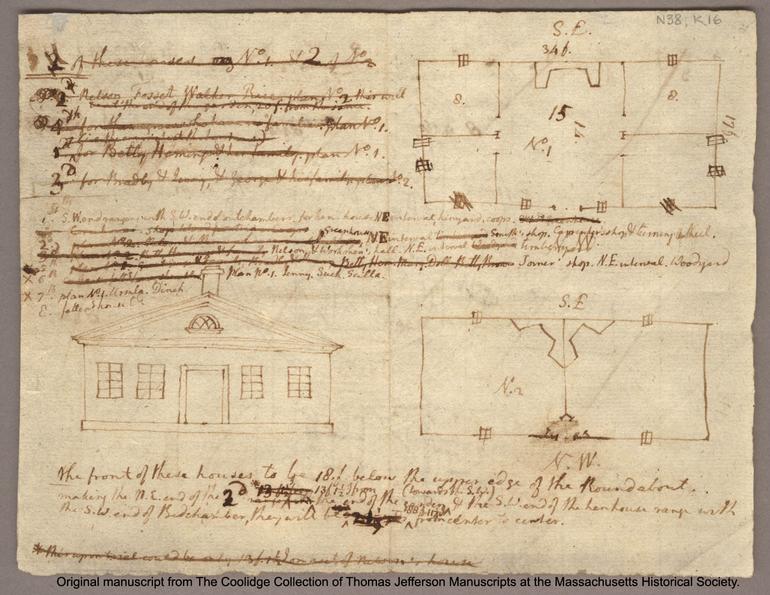
It is this variety that keeps me excited throughout the workday. And it also points out the irony of this project. Jefferson is absolutely at the center of our little scholarly kingdom (er, I mean republic). The project is defined by documents that emanated from his pen or passed through his hands. Yet, for me its greatest value is the light it casts on the various people, objects, ideas, and events with which TJ engaged. Perhaps that merely reflects my training during a period that prized decentering and debunking the “great white men.” I’ll own up to that. But it also seems to me that the vastness of documentary projects such as ours precludes (or at least should) the kind of narrative coherence that a tight analysis requires. What such editions achieve is not a biography in documents. Rather, they foster multifaceted, sometimes chaotic, portraits of the social milieus in which the primary subjects and their peers acted.

For students of Jefferson (detractors, boosters, and others) the Papers project remains an unparalleled resource. Yet anyone interested in some small corner of the early republic can profitably consult its volumes. And the same might be said for documentary projects of all stripes. Don’t think of them as limited by their primary subjects, however rich and contentious.

Friday, July 17, 2009

A Woman in Berlin

From NPR:

"Silence Broken On Red Army Rapes In Germany"
by Eric Westervelt

This week, the American premiere of the German film A Woman in Berlin brings new attention to an issue long considered a taboo in Germany: the mass rape of women by Soviet Red Army soldiers after the fall of Hitler's Third Reich. The movie is based on the real diary of an anonymous Berlin woman. Historians believe some 2 million German women were raped after Soviet and Allied forces defeated Hitler's army in the spring of 1945....

Dr. Phillip Kuwert, a senior physician at the University of Greifswald's department of psychotherapy and psychiatry, estimates that about 200,000 children were conceived by native German women raped by Russian soldiers.
>>>

Thursday, July 16, 2009

Richardson's Rules of Order, Part VIc: Tips for Writing Research Papers for a College History Course

Heather Cox Richardson

Writing the Paper:

You’re ready to write your paper. You have a thesis: “Custer led his men to a slaughter because he was determined to regain the favor of his Commander-in-Chief, President Grant.” Write that thesis on a sticky note and put it over your workspace, to guarantee that everything you put in the paper supports that thesis. When you get tangled up in your writing, and can’t decide what to put in, that paper will be the judge. Does whatever you’re writing advance your thesis? If not, it stays out.

Plot your paper out. If it’s a ten page paper, you can plan on using a half a page at both the beginning and the end for your introduction and your conclusion. So you have, essentially, about nine pages to make your argument. In your mind, divide those pages up into sections of relatively similar length. You have about four sections of two pages each, or three of three, to make your argument. (Section numbers and lengths will vary depending on the length of the paper and the nature of your material). For your Custer paper, you’ll need to explain to a reader what happened at Little Big Horn and then make your argument, which really doesn’t leave you much room. What are your most important points that prove your thesis? They should be the subjects of your different sections. Within those sections, each paragraph should support the section argument, which in turn supports the thesis. Make sure you have a plan, and that you stick to your section limits. This is sort of an outline using space rather than headings (although outlines are still useful). Your “section breaks” are not literally different pieces of a ten-page paper (which would leave it looking a bit like a long poem!), but are places where you will change to a different aspect of your presentation. Do not make the common mistake of just starting to write, hoping you end up somewhere. Do it this way, and you will almost certainly use most of your space on your first point, and end up being forced either to rewrite or to rethink the paper, neither of which you want to do at this stage.

Sit down to write, but leave your “writing hat” on the rack. The most common error students make is to assume that they won’t sound smart unless they use complicated sentence structures and long, scholarly words. If you generally talk like that, go for it. Your writing will sound quite natural. But if you normally talk like the rest of us, don’t try to sound like a nineteenth-century professor of rhetoric. Just tell us, in your own words, what you’ve discovered. You can correct grammar and structure later, although if you write naturally there will not be as much to correct as if you try to work with words and structures you don’t know well. My rule is the dinner table test. If you could not read the paper at the dinner table without your friends cracking up, it’s not written in a believable way.

If you find yourself stuck staring at a blank screen (or paper), stop writing a “paper” and write your material as a letter or an email to a friend, usually someone older who is interested in history but who doesn’t know much about your topic. (Don’t worry, you don’t have to send it!) You will find the story falls into order fairly easily. Humans are naturally storytellers, putting material in where the listener needs to know it, so mimicking a conversation in an email or letter often is a big step toward getting material down for your paper.

You cannot write a good paper in one sitting, but you want to continue the flow from one writing session to another. One way to do this is to leave the paper just when you know exactly what you’re going to write next, and are eager to do it. That way, when you sit down to it again, you’ll start right in and move forward easily, rather than staring at the screen (or paper) wondering what on earth to write next.

If you can’t face writing a certain piece of the paper, or can’t recall exactly what you want to say there, it’s okay to mark that section with a note to yourself to come back later. Use something a search will pick up easily: a “XX” or “TK” (which doesn’t show up naturally in English). Then go back later and do it.

Never, though, write funny/angry comments in a document—either yours or a friend’s—thinking that the writer will certainly find them all and delete them before handing it in. Those comments do, sometimes, slip by, and the embarrassment of explaining them and recalling the essay is excruciating (for the professor as well as the student!). Better to make a lifetime rule that you will never mess with any document that will go to a third party. (You don’t want to do it in your career, either).

BACK UP YOUR WORK DAILY AT LEAST. HOURLY IS BETTER!!! Keep a copy of each day’s work in two different locations. Get a flash drive, use your school’s server, use your own machine, use the Apple back up system, buy space with a commercial server (about $5 a month or less). BUT DO NOT THINK YOU WON’T LOSE THINGS!!!! If you learn nothing else from this tip sheet, learn this! YOU MUST BACK UP YOUR WORK!!!! IT IS INEVITABLE THAT DISASTER WILL STRIKE EVERYONE AT SOME POINT HAS THAT UNFORTUNATE EXPERIENCE!!! BACK UP YOUR WORK!!!!

As you write, enter in your endnote information in correct form. In Word, you do this by pulling down the “insert” menu, and clicking on “reference.” Then click “endnote” and, under “options,” click the 1, 2, 3, format. When you move text around later, the endnotes will move with the text, and you won’t have to worry about lost citations.

You should have a draft of the paper at least a week before it’s due. Now it’s time to leave it alone while someone else looks at it. Hand it to an interested bystander—a roommate, someone at the writing center, an instructor—and take their comments seriously. They may not tell you how to fix something, but when they comment “I don’t get this,” it means you need to rework something.

Give yourself a few days away from the essay, checking a few last sources if you need to, but ignoring it, otherwise. Check to make sure you have paper and toner for printing; buy it if you don’t. After a few days, reread the essay CAREFULLY—I reread out loud, which means I catch many errors—and note changes you want to make. Combine them with the comments of your reader(s). Revise the essay.

Do not forget the “who cares” question, but don’t make the common mistake of overreaching. It’s unlikely your ten-page paper will force us to rethink all of American military history. Don’t be ridiculously general either. “Custer’s failure was important because understanding the West is critical to understanding our nation’s history,” doesn’t tell a reader much. It may be that you don’t need to address the “who cares” specifically. It might be apparent through your explication of your thesis. But if you need to put it in, make sure it passes the dinner table test.

Wednesday, July 15, 2009

Obit: Kenneth M. Stampp, 96

From the Washington Post:

"KENNETH M. STAMPP, 96: Celebrated Historian Altered Understanding of Slavery"
Adam Bernstein
Tuesday, July 14, 2009

Kenneth M. Stampp, 96, a historian who helped transform the study of slavery in the United States by exposing plantation owners as practical businessmen, not romantics defending a noble heritage, died of heart ailments July 10 at a hospital in Oakland, Calif. He had vascular dementia.

His death was confirmed by the University of California at Berkeley, where he taught from 1946 until retiring in 1983.

Dr. Stampp denied having the burgeoning civil rights movement in mind when he researched and wrote The Peculiar Institution (1956), which powerfully challenged the way slavery was presented in history texts. But the impact of the book was undeniably linked to the changing era in which it appeared.

Leon Litwack, a Pulitzer Prize-winning historian who studied under Dr. Stampp and called him "one of the most important historians" of his generation, said that as late as t
he 1940s, many eminent historians of the South depicted slavery as a largely benign system. >>>

Monday, July 13, 2009

History Battles: Hitler Tree in Poland

Randall Stephens

Der Spiegel recently reported on an oak seedling planted in Nazi-occupied Jaslo, Poland in 1942. Seldom does a tree spark a controversy about memory and history. But... Almost seven decades after the planting, writes a journalist in the paper, "the tree is the subject of heated debate as the city mayor, previously unaware of its history, calls for it to be felled":

Getting permission to chop down a tree for the building of an intersection is not unusual. What is slightly rarer is the discovery that that tree was bequeathed to the city by the most famous dictator of the last century. An oak tree that had been growing in the Polish city of Jaslo for almost 70 years now faces the chop as its links with Hitler are revealed. . . .

The campaign to save the oak is led by 80-year-old Kazimierz Polak, who witnessed it being planted firsthand. He is organising a petition to challenge plans to fell the tree, which he watched being brought into the city in a box wrapped in the swastika flag in 1942. The oak, originally from Hitler's birthplace of Braunau am Inn in Austria, was given to the city on the occasion of the Führer's birthday and was part of attempts to 'Germanize' the town. >>>

Friday, July 10, 2009

The Moon Landing at 40

Randall Stephens

With the 40th anniversary of the Apollo 11 moon mission just around the corner--the landing was on July 20--it's a good time to reflect on what that meant and still means. In 1969/70, some rhapsodized about the power of human innovation and the horizon of exploration. With tongue firmly planted in cheek, playwright Arthur Miller wrote in the July 21 edition of the New York Times:

There are two schools of thought about the moon landing. One heralds it as the start of a new Age of Discovery like the period that began in 1492. The other regards it as a distraction from social problems. Few, though, feel anything but pride in the men who step over the astral frontier; even the crabbers are secretly envious of them.

I think it's a great thing for all of us. After the moon we undoubtedly will put men on other planets further and further away from Earth. The climax, which I doubt anyone alive will witness, will come when a scientific expedition finally lands on 125th Street or the North Side of Waterbury, Connecticut.

On the run in Algiers, Eldridge Cleaver, Information Minister of the Black Panther party, unleashed a torrent of criticism. On July 20 he told New York Times reporters that the moon landing program was a "misuse of public funds." Cleaver didn't see "what benefit mankind will have from two astronauts landing on the moon while people are being murdered in Vietnam," and starving in the U.S. Politicians like Nixon, "number one pig," were to blame

Others, like Norman Mailer--razor-tongue gonzo journalist, premature curmudgeon, and egomaniac--used the moon landing to rant against America's banal technophilia. He wrote in Of a Fire on the Moon: "Armstrong and Aldrin were to do an EVA that night. EVA stood for Extra Vehicle Activity, and that was presumably a way to describe the most curious steps ever taken. It is one thing to murder the language of Shakespeare - another to be unaware how rich was the
victim. Future murders stood in the shadow of the acronyms. It was as if on the largest stage ever created, before an audience of half the earth, a man of modest appearance would walk to the centre, smile tentatively at the footlights, and read a page from a data card. The audience would groan and Beckett and Warhol give their sweet smiles."*

Now to the present... In the Guardian Christopher Riley has written "The Moon Walkers: Twelve Men Who Have Visited Another World." Maybe his piece indicates that the landing is no longer a sounding board for politics?

The 12 members of the most exclusive club in human history had many things in common.

All came from a highly technical background and all but one studied aeronautical or astronautical engineering. Growing up, many had been Boy Scouts and even more were active members of their University fraternities. They all went on to study for further degrees – many at military test pilot schools – and almost all of them saw active service in cold war skies, often flying nuclear weapons behind enemy lines.

Popular Mechanics features a collection of essays on all things 40th-anniversary-moon-landing related. Highlights include: "Is America's Space Administration Over the Hill? Next-Gen NASA"; "Giant Leaps: Apollo 11 Alums Reflect 40 Years Later at MIT Conference"; and "Exploring the Moon: Apollo 11, The Untold Story."

For an excellent documentary on the moon landing and space race, see Race to the Moon (PBS, 2005).

Wednesday, July 8, 2009

Richardson's Rules of Order, Part VIb: Tips for Writing Research Papers for a College History Course

Heather Cox Richardson

Research (and this is primarily for American history, especially for students working on nineteenth-century topics):

There are two ways to find a topic for a research paper. The first is to follow up on something that has interested you in a class or a reading. What do you feel isn’t well explained in the books you’ve read? Is there a topic there worth digging around in? Does it resolve itself quickly when you check Wikipedia and a few books? Or is there something we really haven’t thought through in a way that you think makes sense? By the way, there are precious few topics in history that can’t bear a reexamination, so don’t worry that you can’t think of something to research.

The other way to find a topic is to immerse yourself in primary sources and see if a different story emerges than the one we usually tell. There are a number of places you can start to see a new story in history. Your college, university, or public library website can link you directly to Proquest's historical New York Times and the historical Boston Globe. If you’re interested in a particular topic or a particular year this is a good place to go to see what people at the time were saying. The Making of America website at Cornell University and the University of Michigan have huge collections of nineteenth-century books and journals as well as The Official Records of the War of the Rebellion; you can search them for specific topics. Don’t forget Google Books, either—that has an extensive pre-1923 collection—which can give you much information you wouldn’t have thought to look for. If you hit “full view” books, you’ll get those books that are in the public domain, and which you can read on-line in their entirety. The X-roads project at the University of Virginia also has a wide range of material.

The Digital Collections at Harvard have a wide selection of material on-line, including a good collection on the economic lives of American women, another on marriage and family, and another on immigration. The Native American Documents Project at California State University, San Marcos, has good material on Indian history. The American Memory site at the Library of Congress holds much, but it is appallingly organized, so be careful to keep track of where you’ve been—you might not find it again. It’s good on the American West and on African Americans. There are a number of excellent specialty collections at different libraries (Stanford has a collection of dime novels; the Denver Public Library has one on Western photographs), so look around.

The American Presidency Project at the University of California, Santa Barbara is invaluable for studying presidents because it has official documents of recent presidents; it also has the text of every State of the Union address—which is a great short trip through the highlights of a particular year, since the secretaries of each department write their own sections—and every Inaugural Address. It also has the political platforms of every major political party for each presidential campaign. The Presidential Recordings Program from the Miller Center at the University of Virginia contains recordings of all the White House tapes, as well as transcripts of them. The website A New Nation Votes, based on the Philip J. Lampi collection at the American Antiquarian Society, holds the election returns for every local, state, and national election from 1787 to 1825.

These are good places to start. Read around for awhile and see what interests you. Don’t take notes yet—just keep a brief record of what you find and where you find it. The reason I suggest you start with internet sources is that they are easily searchable and working with them first will cut down your time looking for a topic. Give yourself time to find something you really like and want to know about. There’s not really much point in spending weeks researching something you hate. It’s also unlikely you’ll produce anything anyone wants to read if you hate what you’re doing.

Once you’ve fallen in love with something, the fun really begins. Now you can track down the leads you find in the secondary sources you look up in the library (don’t make the grave error of thinking you can use the internet only—almost every research paper will need to be informed by the secondary works other historians have written, and will need other primary source books and manuscripts that are unavailable on-line). Follow the trail in front of you. Go to the library. Dabble in old newspapers. Go to local libraries or local archives. Use manuscript collections. If you find yourself admiring the work of a certain (living) scholar and wish you could ask him or her for advice, do it. Drop him or her an email. S/he’ll almost certainly answer with helpful information, and if not, who cares?

Let yourself enjoy the process. It may be that your topic changes as you conduct your research. That’s fine. As your research advances, a question will emerge.

That question is the heart of your essay. Your TOPIC might be The Battle at Little Bighorn, but your QUESTION might be: “Why did Custer bring his men into such an untenable military situation?” Many students make the mistake of confusing a topic and a question. Now your research is very directed, and you should take good notes on your sources. ALWAYS put everything you quote directly into quotation marks, and write down the full and correct citation for each source IN YOUR NOTES! (Just memorize correct citation form, it’s easier than reorganizing everything later. The form, including correct punctuation, is: Author, Title (Place of publication: Publisher, Date), pp. XX.) Make notes, too, of questions your research raises. Why was Ulysses S. Grant mad at Custer? Was there a larger struggle going on over Indian policy? Was the army in danger of losing its funding? Was Custer jealous of other commanders? These will be questions your reader will also want to have answered, so keep a list of them somewhere.

As your research advances, you will be able to answer your question (as a student did very successfully a few years ago, suggesting historians had gotten the story wrong until her research). You might have come to believe, from your research, that Custer was upset that he had recently lost President Grant’s favor and was determined to regain his former prominence (as some historians have said). Why do you think that? What information have you dismissed as less convincing than that explanation? Why do you dismiss it? It is fine, by the way, to have concluded that an existing explanation is correct, but you need to be able to demonstrate that you have considered alternative explanations and are siding with a specific one for solid reasons.

By the time your research is done, you should also have an answer to that all-important question: Who cares? Why should we care about Custer’s motivations at Little Big Horn? Well, perhaps they show that generals have to be very careful to assess a junior officer’s mental state before giving unsupervised command. Maybe they suggest that presidents shouldn’t come from the military. Maybe they suggest any number of things that will stay with a reader and inform the way s/he thinks in the future. You may not have to spell this out in the paper—it might be obvious from the way you develop the essay—but make sure you know the answer yourself before you start writing.

Tuesday, July 7, 2009

Praise for Recent Themes in the History of Africa and the Atlantic World

Randall Stephens

In 1963, writes
Sandra Amponsah in the African Studies Quarterly, Hugh Trevor-Roper thought African history had little to recommend it as a field. “Perhaps in the future there will be some African history to teach," he sniffed. "But at present there is none, or very little: there is only the history of Europe in Africa." Amponsah writes that "Now we can all call ourselves Africanists or Atlanticists, or so it appears, as the history of Africa and Atlantic world have become the subjects of interest among scholars of the Caribbean, North and South America, Africa, and Western Europe." Recent Themes in the History of Africa and the Atlantic World, edited by Donald A. Yerxa, shows just how far things have come since Trevor-Roper overlooked a continent.

Amponsah calls the essays in Recent Themes "thoroughly researched" and "presented in a lively argument and counter-argument" style. The collection contains the work of "outstanding African, Atlantic, and world historians," and the entries touch "on several issues that contribute to a better understanding of Africa’s elusive past." Recent Themes in the History of Africa and the Atlantic World pulls together articles and forums that have appeared in Historically Speaking over the years:

“Beyond Blacks, Bondage, and Blame: Why a Multi-Centric World History Needs Africa: A Forum"
Joseph C. Miller

“The Way of Africa, ‘The Way I Am,’ and the Hermeneutic Circle”
Ricardo Duchesne

“Africa in World History and Historiography”
Patrick Manning

“Comment on Miller”
William H. McNeill


“Finding Africa in World History”
David Northrup

“The Borders of African and World History”
Jonathan T. Reynolds

“What Are World Histories?”
Michael Salman

“Another World”
Ajay Skaria

“Africa in a Multi-Centric World History: Beyond Witches and Warlords”
John K. Thornton

“Multi-Centrism in History: How and Why Perspectives Matter”
Joseph C. Miller

“African Encounters”
David Northrup

“Only Connect: The Rise and Rise (and Fall?) of Atlantic History”
Trevor Burnard

“Does Equiano Still Matter? A Forum”
Vincent Carretta

“Construction of Identity, Olaudah Equiano or Gustavus Vassa?”
Paul E. Lovejoy

“Goodbye, Equiano, the African”
Trevor Burnard

“Beyond Equiano”
Jon Sensbach

“Response to Lovejoy, Burnard, and Sensbach”
Vincent Carretta

Amponsah concludes her review by acknowledging, that "Although originally intended as a course companion for students of African and African Diasporic history, world history, and Atlantic history, this book will undoubtedly appeal to the intellectual response of scholars in various academic areas, particularly those interested in race and identity formation. It also holds a real treasure in historical analysis by providing in a single volume not only arguments and counter-arguments, but also opportunity for the proponents of the arguments to respond to the counter-arguments."

See other published and forthcoming titles in the Historians in Conversation series:

Thursday, July 2, 2009

National Park Service, the New American Revolution Center, and Bruce Cole

Randall Stephens

Wilfred McClay has alerted us to a new National Park Service initiative under Bruce Cole's leadership (more below). The Historical Society is proud to announce the appointment of Cole to its Board of Governors. Cole, who served as chairman of the National Endowment for the Humanities from 2001 to 2008, presently serves as the president and chief executive officer of The American Revolution Center. During his tenure at the NEH, he launched a number of programs to improve the teaching of history and the humanities, including We the People and Picturing America. Cole is distinguished professor emeritus of comparative literature at Indiana University.

The National Park Service has issued the following news release just in time for the fourth!

AMERICAN REVOLUTION CENTER WORKS WITH NATIONAL PARK SERVICE TO RELOCATE TO HISTORIC PHILADELPHIA

PHILADELPHIA – July 1, 2009 – Secretary of the Interior Ken Salazar and the American Revolution Center (ARC) today announced that the National Park Service (NPS) has reached a historic agreement to develop a national museum dedicated to the American Revolution. The National Park Service signed a land-exchange agreement with ARC to establish this museum at Independence National Historical Park.

“This is wonderful news for both the National Park Service and the American Revolution Center,” said Secretary of the Interior Ken Salazar. “Visitors to our Nation’s birthplace will now be able to enjoy a world-class museum dedicated to the story of the American Revolution within the shadow of Independence Hall.”


The new American Revolution Center will be located at 3rd and Chestnut Streets in downtown Philadelphia, within the 55-acre park. In exchange for the site, the National Park Service will receive a 78-acre parcel of private land owned by the Center within the boundary of Valley Forge National Historical Park.


“The American Revolution Center is a critical project for our Nation, and I am extremely pleased with this latest development,” said H.F. “Gerry” Lenfest, Chairman of the Board of Directors of ARC. "We have expended extraordinary time and resources to locate the Center in Valley Forge, and I believe that our vision there could have been achieved. We now believe that it is in our best interest to begin a new chapter for ARC, and I cannot think of a more appropriate setting than at Independence National Historical Park in Philadelphia.”


At Independence National Historical Park, the National Park Service manages several sites associated with the American Revolution, including the Liberty Bell Center, the National Constitution Center and Independence Hall. ARC will work together with these and other institutions around the country and the world to further the understanding of the American Revolution.


The American Revolution Center will be the first national museum to commemorate the entire story of the American Revolution. The museum will display its distinguished collection of objects, artifacts and manuscripts from the American Revolution era and will offer educational programming, lectures, symposia, and interactive learning for teachers, students, and the general public.


“I applaud the mission of The American Revolution Center and fully support the decision to relocate,” said Governor Edward G. Rendell. “I am thrilled that Gerry Lenfest, Dr. Bruce Cole and ARC’s Board have selected Philadelphia, Pennsylvania for the new home of this national museum and I believe it will be a terrific complement to Independence National Historical Park area.”


“The National Park Service has long supported the concept of The American Revolution
Center,” said Dan Wenk, acting NPS Director. “What better place than Philadelphia, the ‘cradle of liberty’ for a museum about the American Revolution.”

“This is a promising time for The American Revolution Center,” said Dr. Bruce Cole, ARC’s new president and chief executive officer. “We are committed to the creation of a living memorial to the American Revolution. We look forward to developing a museum to commemorate the legacy of the American Revolution in our Nation’s birthplace.”

Representatives from The American Revolution Center and the National Park Service will work jointly on appraisals, title searches, surveys, and other matters to move the land exchange process forward as quickly as possible.


About The American Revolution Center:

The American Revolution Center (ARC) will establish the first national museum to commemorate the entire story of the American Revolution. The Museum will display its distinguished collection of objects, artifacts and manuscripts from the American Revolution era and will offer programming, lectures, symposia, and interactive learning for teachers, students, and the general public.