Thursday, April 30, 2009

Religious Responses to Epidemic Disease

Randall Stephens

According to the New York Times: "Health officials continue to report mild cases of swine flu throughout the United States and worldwide. The number of deaths in Mexico that officials suspect to have been caused by the flu is 159." The NYT also features a map that tracks cases by region. Schools and private companies have laid out plans of action. Churches and mosques are urging the faithful to reconsider "several traditional observances," according to the Raleigh News & Observer. "At St. Mel Parish in Fair Oaks, Calif., congregants will be asked not to shake hands during the exchange of peace or hold hands when the community recites the Lord's Prayer. The church will not offer the Communion cup during Mass."

For some historical perspective on this coverage--and perhaps to counter the shrieking, doomsday coverage of swine flu--I post here a link to a forum we ran in Historically Speaking several months ago. In the intro to “Religious Responses to Epidemic Disease: A Roundtable,” Donald Yerxa writes:

Thanks to the seminal work of William McNeill and Alfred Crosby, historians pay much more attention to the impact disease has had in history. Historians, however, have been slower to consider the nature and variety of religious responses to epidemic disease. To help readers think about this relatively neglected topic, we invited Andrew Cunningham to comment in general terms about religion and widespread disease in the West. We also asked David Arnold and Howard Phillips to explore two specific cases outside of Europe—one from India, the other from South Africa. Then we commissioned Duane Osheim to use these essays to comment on the overall topic of religion and epidemic disease in history.

Wednesday, April 29, 2009

Richardson's Rules of Order, Part IIIc: Appropriate Behavior in College Classrooms

Heather Cox Richardson

Heather Cox Richardson follows up earlier posts with more advice to undergrad history majors. See previous posts below for more Richardson's Rules of Order.

Emails:

Address your professors formally—“Dear Professor Liu,”—unless they tell you to do otherwise. Keep your messages short, unless the professor has indicated that s/he is willing to have longer discussions over email (I am, by the way). While email messages are more relaxed than other forms of communication, don’t use “Yo,” or baby talk, IM abbreviations, or inappropriate slang. The informality of email doesn’t mean you should write to your instructor as if s/he was a roommate.

It is not appropriate for your parents to make requests on your behalf over email.

Everyone writes messages in anger or frustration that should never be sent. If you have written such a message, store it in your “drafts” folder for at least a day before you hit the “send” button. Then reread it and reconsider whether or not it is appropriate. You will save yourself considerable embarrassment.

If a professor emails you about something, answer.

Complaints:

Do not sit quietly all semester in conditions that make it impossible for you to learn. If you cannot hear when you sit in the front of the classroom, tell the professor. If the room is too dark for you to take notes, speak up. If there is someone in the class of whom you are afraid or with whom you cannot work on a team for personal reasons, tell the professor. If you cannot understand the TA’s accent, tell the professor. All of these situations can be remedied. Do not stop coming to class and then try to justify a failing grade at the end of the semester by complaining of poor conditions.

If your problem with the class is more substantive, consider first whether there is anything you can do to remedy it. Are you unable to finish the reading? Ask yourself first whether or not the amount of reading is appropriate. For a college history course 100-400 pages a week is reasonable. If the professor is assigning 2,000 pages per week, there is a problem with the course. But if s\he is assigning fewer than 300 pages, the problem is yours. Do you need to budget more time to read? That’s your problem. Perhaps, though, what you need is more guidance about how to read for a history class. In that case, go to the teacher and lay out the problem: “I can’t seem to make it through the reading and I know it’s not an inappropriately large amount. Can you help me figure out how to get through it more efficiently?”

Do not try to tell the professor that you know how to teach the class better than s/he does. “I’ve never heard of a class that assigns 300 pages a week!” is going to get you nowhere. Similarly, complaints that “this course goes too fast,” or “you cover too much material,” are only going to work if it is the first time the professor has taught the class. If it has been taught before and gotten positive reviews, it’s unlikely that your complaint is going to sound like anything other than whining. That being said, if you are an obviously good student who is involved in the class, and you tell a professor that a specific point wasn’t clear or was rushed, s/he will probably thank you for the feedback and remedy the problem.

Do not try to make your point by claiming that students in another section of the class don’t have to do such work, unless it is absolutely certain that a TA is acting in ways of which the professor has no knowledge, simply canceling class and telling the students s/he’ll give them all “A”s if they keep quiet, for example; or showing an established pattern of discriminatory statements in class. Professors supervise their TAs, and most have an excellent sense of what is going on in a section. “My roommate is in another section and her TA gave out all the exam questions!” isn’t going to fly without hard evidence.

See other Richardson's Rules of Order

Monday, April 27, 2009

The Vital “Irrelevance” of Early Modern History

Lisa Clark Diller

I’ve been reflecting lately on my fate as someone who studies early modern history. For me personally, being an early modernist means I get to study a world with few strict borders, really big personalities, and lots of mystery. For my students, apparently, enjoyment of this era is primarily connected to obsessive attendance at Renaissance Fairs. The longer I teach, the more my undergraduates’ insistent connection of everything we study with the present day weighs on my class time, my reading, and even my research into the modern period.*

However, I’m increasingly convinced that those of us who study the pre-modern world play a crucial role within our departments and the broader profession. Part of the nature of “modernity” is that we know where history is going. The world is always becoming more mechanized, specialized, literate, committed to democracy, always on the way to the nation-states we are now divided into. Our situation in the modern period means we’re consistently looking in the past for how we got to be how we are now, and it limits our imagination.

Those of us who study the pre-modern world, if we’re careful, get to bring a few more possibilities to the table. First, we frequently have fewer texts, and often less information about our subjects. This does not mean we can’t tell true stories about our past, but that the evidence for those stories requires slightly different skills than is often asked of historians who study the modern world. The people and situations we study are allowed to retain some of their shadowy characteristics. Second, those men and women before and outside the triumph of the Enlightenment did not “know” where the world was going yet. Their writings are less driven by the paradigm of progress and national identity. Their world was more steeped in mystery and they also remain a bit mysterious to us.

So the early modern historian can bring a bit of drama to the table—my sources did not know about the framework of the modern world, so I can also try to suspend knowledge, if I choose. They often leave their evidence in the form of stories, which allows me to retain my commitment to storytelling as part of the art of history. My subjects’ knowledge was contingent, and so is mine. This is also true for those who study the modern world, but perhaps early modernists’ are forced to be more aware of it.

We early modernists are important to our more numerous colleagues who study the relatively recent past because our attitudes and practices reinforce the historians’ commitment to drama, mystery, and asking creative questions of difficult sources. But we are also important because our knowledge is so often “useless.” As we collectively wring our hands over the commodification of knowledge and the future of the history professor, it is those of us who study the pre-modern world who have developed skills in explaining what we study in such a way that it seems “relevant” to the obsessively presentist mind. You need us around. Besides, who else is the world going to turn to when it becomes clear that previously frivolous fields of study such as early modern piracy in the Indian Ocean aren’t so silly and extraneous after all?

*I use “modern” here to mean roughly the nineteenth and twentieth centuries. We can argue about that later, if anyone is interested.

Lisa Clark Diller is assistant professor of history at Southern Adventist University. She earned her Ph.D. in Modern British History at the University of Chicago in 2003. Diller is especially interested in the origins of religious toleration in 17th-century England.

Saturday, April 25, 2009

April Issue of Historically Speaking on Project Muse

The April issue of Historically Speaking is up on Project Muse. Access is available by individual purchase or through college and university libraries. This issue includes interviews with Donald Worster, David Hackett Fischer, and Laurel Thatcher Ulrich; a review essay; two assessments of civil rights history; and a variety of articles.

Historically Speaking, Volume 10, Number 2, April 2009
Table of Contents

Massacre in Munich: The Olympic Terror Attacks of 1972 in Historical Perspective
David Clay Large

We Have Seen the Enemy and It Is Not David McCullough
Edward Gray

The Importance of Studying Ordinary Lives: An Interview with Laurel Thatcher Ulrich
Conducted by Randall J. Stephens

Why Dryasdust? Historians in Fiction
Beverley Southgate

The Ends of the Earth and the “Heroic Age” of Polar Exploration: A Review Essay
Katrin Schultheiss

Champlain’s Dream: An Interview with David Hackett Fischer
Conducted by Donald A. Yerxa

Fighting Bad History with Good, or, Why Historians Must Get on the Web Now
Marshall Poe

Adieu to Lebanon
Fred S. Naiden and Kenneth W. Harl

JOHN MUIR'S PASSION

John Muir and the Religion of Nature
Donald Worster

John Muir’s Passion for Nature: An Interview with Donald Worster
Conducted by Donald A. Yerxa

CIVIL RIGHTS HISTORIOGRAPHY: TWO PERSPECTIVES

Reconsidering the “Long Civil Rights Movement”
Eric Arnesen

The Lost Decade of Civil Rights
David L. Chappell

Letters

Thursday, April 23, 2009

What Can Historians Learn from Biologists

David Meskill

Can historians learn anything from biologists? Jared Diamond’s 1997 book Guns, Germs, and Steel sparked a flurry of interest among at least some historians, who published a special forum in the American Historical Review and held panels at the annual AHA meetings. A more common response to Diamond, however, if I go by numerous conversations with historians, has been disapproval tinged with an almost visceral rejection. I surmise that this disdain derives from the book’s underlying biological premise: as with other species, Diamond argues, humans’ fates have been determined by the environment and the availability of natural resources. It may also have to do with Diamond’s emphasis on the long term and his relative lack of interest in individuals and events. None of these things - the biological roots of human behavior, environmental determinism, the disregard for particularities – historians can abide. In fact, most historians have probably not taken a stance one way or the other in regard to Diamond’s book – or to the growing number of intellectual encroachments by natural scientists onto terrain usually reserved for historians. Whether due to parochialism or indifference, we historians remain, as Daniel Lord Smail has put it, in the “grip of sacred history.” We still conceive of history as starting with civilization and written records some 5,500 years ago in Sumer.

The relatively generous attention paid to Diamond actually confirms the extent of the problem: Guns, Germs, and Steel was a gripping, popular (but not unserious) read. If it hadn’t been a best-seller, it almost certainly would not have earned the AHA’s attention. Less visible, but in many cases even more important, works by natural scientists usually go unnoticed by historians. Since the 1980s, for example, several schools of biologists and anthropologists have been developing ambitious theories of “coevolution.” These approaches treat human culture as an evolutionary system in its own right and investigate its properties and its interactions with its genetic counterpart. They thereby hope to develop comprehensive, indeed potentially revolutionary theories of human behavior, something one might think would be of interest to historians. Yet a JSTOR search reveals that none of these books received even one review in a historical journal.

They deserve better. The following is a review of one of such project: Robert Boyd and Peter Richerson’s 1985 book Culture and the Evolutionary Process. (The others are Luigi Cavalli-Sforza and Marcus Feldman’s Cultural Transmission and Evolution: A Quantitative Approach [1981] and William Durham’s Coevolution [1991].)

Culture, as Boyd and Richerson (B & R) define it, includes all episodes of social learning of ideas and behaviors, whether by teaching or imitation. B& R provide considerable evidence that social learning of this type – and not individual learning or rationality, as neo-classical economics and rational choice approaches assume – plays a predominant role in human behavior. They point to the numerous cases of “cultural inertia,” in which people don’t respond to new circumstances, even for generations (see, for example, David Hackett Fischer’s excellent book, Albion’s Seed, on the persistence of different English folkways in America), and to psychologists’ plentiful evidence that people operate by various, often inaccurate, rules of thumb.

According to B & R, culture shares with genetic inheritance the three crucial ingredients necessary for an evolutionary system: variation, inheritance, and selection. I.e. people have different ideas and act in a variety of ways; they pass along these cultural traits to “cultural offspring,” who usually include their biological offspring, but can also include friends, students, etc.; finally, some cultural traits get passed on more often than others (for reasons to be discussed below). B & R therefore call their model a “dual inheritance” theory.

Crucially, the two inheritance systems, while similar, are not identical. Cultural evolution allows for “acquired variation.” It is Lamarckian. In genetic evolution the behavior of an individual has no effect on the genes she/he passes on. With culture, however, an individual can learn something on her/his own or otherwise pick and choose from her/his cultural heritage. What she/he passes on to cultural offspring has been changed. Additionally, in cultural evolution there can be many “parents,” not just the two of biological reproduction.

B & R distinguish between several different “forces” giving cultural evolution its directions. The first two, which belong together, they call “guided variation” and “direct bias.” Guided variation involves the interaction of individual learning, or innovation, and cultural evolution by social learning. Despite having culturally inherited certain ideas or behaviors, individuals are also capable of assessing their surroundings and options and developing a new response, one they did not inherit. For example, a medieval farmer stumbles upon a different way to plow his fields. If he can ascertain that this is an improvement over traditional methods – something that may not be easy to evaluate - he is then likely to pass on this new variant to his cultural offspring, in this case primarily his sons but perhaps also neighbors. Direct bias, on the other hand, is less innovative: the person does not invent a new response, but adopts one of the various options she has inherited from various cultural parents. However, a certain predisposition may favor – directly bias – one kind of cultural alternative over the others. In the cases of both guided variation and direct bias, criteria are needed to make individual judgments. And these criteria, B & R argue, must come from our genes, i.e. from biological natural selection. For this reason, they refer to these two forces as socio-biological. That is, cultural inheritance will track and reinforce biological inheritance.

With the other forces – which, B & R argue, are likely to be more important than guided variation or direct bias - this is not necessarily the case. The socio-biological forces depend on individual learning or discrimination: even in the case of direct bias, the individual has to make judgments about the available options, which bias to apply, and how to do so. But gathering such information has costs, which opens the door to other, less costly “forces” affecting social learning. Two of these are “indirect bias” and “frequency bias.” With the first, one individual identifies another whom he deems successful – an older brother, a village headman, a movie star - and copies many behaviors from him. Overall, this process is less costly because the first individual is not trying to assess which behaviors of the cultural parent have caused the latter’s success; he simply copies many or all of them. However, in some instances, B & R argue, costly “runaway” processes can ensue: people go to great lengths to dress like rock stars they admire, efforts that could never be justified in terms of clothes’ evolutionary selective power. The process is akin to the evolution of the peacock’s tail, in which an arms race over sexual attraction may impair the creatures’ survival. Frequency bias means that people simply copy the most frequent cultural variant, which will often prove to be a simple, efficient strategy.

A final force is natural selection, not of genes, in this case, but of cultural variants. This arises because genetic and cultural evolution are asymmetrical. We inherit our genes from our mother and father and the same two individuals are often important for imbuing us with our ideas and behaviors. However, we often inherit cultural variants from many other sources as well (siblings, teachers, friends, religious leaders, public figures). These non-parental sources will become relatively more important as we age. If we only inherited culture from our parents, B & R argue, we might expect that those ideas and behaviors would track or conform to the biological impulses we inherited from them: for example, we would imbibe the idea that having large families is a good thing. However, the existence of asymmetrical strands of cultural inheritance means that ideas and values can spread that may run counter to our biological imperative (and hence to what our biological parents on their own would teach us). Thus, teachers and other professionals may spread the message that professional success - something they themselves have achieved, and which requires sacrifices of the time and energy necessary for physical reproduction – is of great value. A Darwinian competition would then ensue – between biological parents and teachers over whose ideas and values would spread faster. B & R make a convincing case that this kind of asymmetric inheritance and the resulting natural selection of cultural variants probably lie at the root of the current, extraordinary demographic revolution. People, especially in affluent countries, are having fewer and fewer babies. Biology and biological Darwinism would predict just the opposite: as resources increase – as they have for humans over the last century or more, especially in industrialized countries – birth rates should steadily increase. In these cases, B & R say, the cultural variant “enjoy your own life, be successful professionally, don’t acquire these noisy, troublesome little creatures” has undermined the biological imperative to reproduce as much as possible.

Because of these final three forces – indirect bias, frequency bias, and natural selection of culture – cultural evolution will often come into tension with the dictates of biological evolution. They help to explain the internal conflicts that individuals experience much the way Freud described the struggles between id and superego. They also distinguish B & R’s approach from a strictly socio-biological one and from William Durham’s 1991 Coevolution, which foresees greater – though still not complete - congruence between biology and culture.

Finally, B & R ask how cultural evolution itself could have arisen in the first place? This is especially acute given cultural evolution’s frequent (biologically) maladaptive consequences. The generic answer is that as long as culture is overall biologically adaptive, its benefits outweigh its considerable costs. More specifically, culture may be expected to arise under particular environmental circumstances. If the environment remains constant for long periods, the best strategy is to hard-wire behavior in genes. This eliminates the costs associated with learning, either of the individual or social kind. If, on the other hand, the environment changes significantly quite frequently, then not only is genetic hardwiring the wrong strategy. Social learning, with its inertia, is as well. Under these circumstances, individual learning is the best option. Social learning – which allows for limited individual learning and variation – is best when the environment remains fairly constant but changes to some degree. In later work, B & R suggest that this was precisely the environment during the ice ages starting 2.5 million years ago and lasting until 12,000 years ago.

Culture and the Evolutionary Process is a challenging work. B & R rely frequently on mathematical models, which will not always be easy to follow unless one already has considerable facility with such methods. However, the authors always take the trouble to walk the reader through the main steps and, most important of all, the conclusions of the models. They also offer tangible examples from history and other social sciences to illustrate their points. The book should be required reading for anybody interested in “big” or “deep” history. Even at smaller time scales, the book offers a very stimulating framework for analysis, especially for thinking about broad patterns of social and cultural development. So, can historians learn anything from biologists? Yes – if they are willing.

David Meskill received his Ph.D. in Modern European History from Harvard University in 2003. He will be Assistant Professor of History at Dowling College in fall 2009. He blogs regularly at http://davidmeskill.blogspot.com/

Wednesday, April 22, 2009

Joyce Malcolm Lecture at Bentley University, 4/24/09

The Historical Society and the Department of History at Bentley University invite you to join Joyce Malcolm (George Mason U.) for a discussion of her new book Peter’s War: A New England Slave Boy and the American Revolution.

Friday, April 24, 3pm
Morrison Hall 300
Bentley University


This event is free and open to the public. Refreshments served.

An excerpt of the book can be found here.

Questions? Email cbeneke@bentley.edu

The Boston Globe interviewed Malcolm on Peter’s War:

We associate slavery so strongly with the Southern plantation that we forget its presence in Massachusetts. In "Peter's War: A New England Slave Boy and the American Revolution," former Bentley University historian Joyce Lee Malcolm tells the story of a 1 1/2-year-old "neagro servant boy" sold to a Lincoln couple in 1765. Apparently raised as a member of the family, Peter joined the Patriot army at age 12, and fought at the battles of Bunker Hill, Saratoga, and Yorktown. He received his freedom in return for his service, took the last name of Sharon, and lived out his days in his hometown. Slavery was outlawed here by a court ruling in 1783. With little to go on besides the bill of sale, which she found in the Lincoln Public Library, Malcolm reconstructed Sharon's life against the drama of his times. She spoke by phone from Arlington, Va., where she teaches constitutional history at George Mason University School of Law. >>>read on

Monday, April 20, 2009

Roman Holiday

Barry Strauss

According to ancient tradition, the city of Rome had a birthday. It was founded on April 21 in what, according to the most common version, was the year 753 B.C. We don’t have to trust the story in order to use the date as a reason to ponder ancient Rome’s legacy.

If we ask, as Monty Python did, “what have the Romans ever done for us?” we might be surprised at the answer. Truth to tell, we might be surprised at the question. Rome is better known these days as the center of the Catholic Church and the capital of Italy than as one of the twin fountainheads of the West (the other, of course, is Greece). Yet we needn’t probe too deeply in order to find that conviction.

Americans, for example, haven’t gotten over their pride at (or fear of) being the new Rome. Despite numerous obituaries, Latin is alive and well as a subject of study in schools and universities. Nor can the story of Christian origins be told outside the Roman context. Meanwhile, both Islamic and Jewish histories assign a major role to Rome or its successor state, the Byzantine Empire (also known as Rome and, rightly so, since the “Byzantines” called themselves Romans). Rome still matters.

With that in mind, here is an exercise in civic literacy: two sets of questions about the legacy of ancient Rome. The first set consists of traditional problems while the second features new scholarly approaches. They cover a wide range of subjects, but, I fear, not wide enough to hide my own limitations. To begin with:

1. What was the constitution of the Roman Republic? Was it a democracy, oligarchy or so-called mixed regime? Why did the American Founders lean so heavily on the Roman Republic as a model? Did they understand the reality of the Republic or were they misinformed?
2. How (and why) did Rome, a small city-state in Central Italy, conquer an empire that covered the shores of the Mediterranean and stretched from Britain to Iraq? Why were the legions so successful? Did Rome’s empire bring the blessings of peace (the famous pax Romana) or did the Roman historian Tacitus get it right when he had one of Rome’s enemies say of Rome “They make a desert and call it peace” (Agricola 98).
3. Why did Rome’s republican government collapse and why was it replaced by a monarchy?
4. To what extent was Rome an original culture? To what extent did it merely absorb, codify and preserve the culture of Greece?
5. To what extent was Rome a slave society? How can we admire a slave society today?
6. At its height, the city of Rome was the largest and most powerful city in the world, with a population of over a million people. What was life there like?
7. Why and how did Rome change from paganism to Christianity?
8. Why did the Roman Empire in the West decline and fall? Why did it survive in the East as the Byzantine Empire? Is “decline and fall” the right way to think of the fate of the Roman Empire in the West or is “transformation and change” a better model?

Here is the second set of questions:

9. What new evidence and new methodologies are uncovering the ancient environment and ecology? Was environmental pollution a problem in the Roman era?
10. How is the evidence of material culture revealing the lives of Roman women, including working women? How is it adding to the history of the Roman family? Roman childhood?
11. How are archaeology and anthropology opening a window into the medical dimension of Roman life? How advanced were Roman science, technology, and engineering?
12. How can we explain the brutal phenomenon of gladiatorial games? What new evidence do we have of a gladiator’s life?
13. What new evidence and models are there for the ancient economy? How did it support the Empire’s large population? For that matter, what advances in demography allow us to chart that population?
14. How is new research filling in the picture of the lives of the Italian peoples whom Rome conquered: e.g., Bruttians, Celts, Etruscans, Greeks, Lucanians, Samnites? Likewise, how is new research illustrating the lives of the peoples outside of Italy whom Rome conquered or whom Rome fought and failed to conquer: e.g., Carthaginians, Celts, Germans, Greeks, Jews, Persians, Thracians? What special contribution to Roman history does the extraordinarily well-preserved evidence of Roman Egypt make?
15. What new insights emerge from a comparison of the Roman Empire with Han Dynasty China? What new evidence has been found of Roman trade in goods and ideas with such countries as India, China, Arabia, and Kush?
16. How is new research describing the experience of Roman battle?
These questions offer a glimpse of the subject, not an overview. But birthday parties only start the new year.

Barry Strauss teaches ancient history at Cornell University. His most recent book is The Spartacus War (Simon & Schuster, 2009). He blogs at http://www.barrystrauss.com/blog/.

Saturday, April 18, 2009

The Historical Society's 2010 Conference

Historical Inquiry in the New Century
June 2010, George Washington University, Washington, DC


Since its inception over a decade ago, the Historical Society has been committed to fostering critical engagement and dialogue among historians in and out of the academy. With the theme of “Historical Inquiry in the New Century,” the 2010 THS conference seeks to take stock of where the profession currently stands.

Under this broad rubric, we invite participants to address a wide range of questions and issues, including: What are the current historiographical debates? Where do particular fields currently stand? What's changed for the good—or the worse—in specific areas? What have been the clearest criticisms of the profession? What are the truly "big questions" historians face, and are we adequately grappling with them? How do THS members want to see history written? What, in fact, are our aims/goals for the history that we write? What are the audiences for the history we write? Who's reading us? What impact, if any, do we have on larger, non-scholarly debates? To what extent have academic historians snapped out of the rigid concepts and pedantic writing that has long marked our profession?

In an age that sees itself as moving beyond modernity, the ground has shifted under the various grand narratives of its European origins. The 2010 THS conference hopes to cast a critical eye on traditional and revisionist chapters in that narrative, such as the Middle Ages, the Enlightenment, or the Industrial Revolution. At the same time, we hope to promote ongoing efforts to frame the histories of Africa, Asia, and the Islamic world in terms of categories not shaped by European narratives. We expect that historians working with many different kinds of sources and representing all fields and perspectives will be party to these discussions. We also envision this conference as a conversation about what makes history a discipline. Since historians cannot rely on a single method to fit all situations, we expect to take a close look at different approaches to the past. We are interested as well in the challenges created by the nature of available sources, and by the issues that arise when one borrows theoretical approaches from other disciplines. In addition to historiographical and state-of-the-field papers, of course, we also invite papers on specific research areas in such diverse fields as military, religious, business, political, world, and intellectual history.

We hope that this seventh national meeting will serve as a point of departure for a clear-sighted analysis of the likely future of historical studies in the new century.

Please submit individual paper proposals or panel proposals to Eric Arnesen, THS 2010 Program Chair, at arnesen[at]uic.edu or Eric Arnesen, The George Washington University, Columbian College of Arts & Sciences, Department of History, 801 22nd St NW, Phillips 335, Washington, DC, 20052.

Thursday, April 16, 2009

Goodness, Gracious, Great Balls of Fire and Brimstone

Cross post from Religion in American History.

Randall Stephens

Jerry Lee Lewis to Sam Phillips on the perils of rock and roll, Sun Records Studio, Memphis Tennessee, 1957

Jerry Lee Lewis: H-E-L-L . . . that’s right. It says “MAKE MERRY with the JOY OF GOD, only.” But when it comes to worldly music, rock and roll, anythin’ like that, you’re in the world, and you haven’t come from out of the world, and you’re still a sinner. And you’re a sinner. You’re a sinner unless you be saved and born again, and be made as a little child, and walk before God, and be holy. And brother, I mean you got to be so pure, and no sin shall enter there. No SIN! Cause it says “no sin.” It don’t say just a little bit. It says “no sin shall enter there.” Brother, not one little bit. You got to walk and TALK with God to go to heaven. . . .

Sam Phillips: Now Look, Jerry . . .

Lewis: Mr. Phillips, I don’t care . . . it ain’t what you believe, It’s what’s written in the BIBLE! . . . .

Phillips: Nah, gosh, it’s not what you believe it’s how do you interpret the Bible?

I’ll stop right there. It’s just so much more fun to hear this on youtube. A transcription can’t capture the accents and folk wisdom entailed, ya hear? I don’t even think Mark Twain could render the conversation justly. Hat tip to Joe Lucas (Historically Speaking) for making me aware of this fly-on-the-wall treasure. (How many other famous pop icons discussed hermeneutics with their producers?!?)

Hearing the above, I thought about work I’ve done, albeit very little, on rock, pop music and holiness-pentecostalism. At the suggestion of Bland Whitley while in grad school, I read an essay on famous pentecostal musicians (Stephen R. “Pentecostalism and Popular Culture in the South: A Study of Four Musicians,” Journal of Popular Culture 16 [Winter 1982]: 68-80.) Few have looked at pentecostal rock and rollers and country singers as Tucker did all those years ago. The evidence from interviews with performers, autobiographies, and secondary work is pretty stunning.

Elvis Presley, like “The Killer,” attended an Assemblies of God church. Johnny Cash spent some harrowing Sundays in a fired-up Church of God. Tammy Wynette did, too. There are other links between black pentecostalism and B.B. King and Little Richard. The latter’s autobiography will blow your hair back. All that to say that the connection between sanctified religion, gospel quartets, shouting preachers, and rock is not a mere coincidence.

Here’s are a couple questions I’m interested in, and this speaks to the above audio clip: If, as the Louvin Brothers reminded the faithful in 1960, “Satan is real, working in spirit . . .” then how does one square the devil’s music with holy living? That dilemma worried Jerry Lee, and, to a lesser extent, Elvis. How much of the vibrancy and ecstasy of early rock was a result of a religious tension? Maybe much more than most realize.

I said a little bit about this in the last chapter of my book. It’s worth quoting David Wilkerson (of Cross and Switchblade fame) who wrote about Lucifer’s rock trickery in a 1959 issue of an Assemblies of God magazine. For every Youth for Christ rally “Satan is now staging a rock and roll rally!” he said. Even worse, “Satan has used rock and roll to imitate the work of God at Pentecost! In these last days Satan has come down to baptize with an unholy ghost and unholy fire!” Rock shows looked like upside-down pentecostal revivals: “the shaking, the prostration” of the saints “are imitated by this unholy baptism—as far even to speaking in vile tongues!”

Tuesday, April 14, 2009

THS past president Eric Arnesen reviewed Beryl Satte's new book in Saturday's Chicago Tribune.


For much of the 20th Century, Chicago has maintained a reputation as one of the nation's most segregated cities, its African-American population consigned to the Black Belt on the South Side and then to particular neighborhoods on the West Side. Once viewed as a promised land by Southern blacks, Chicago's multiple barriers to black residential expansion dashed countless hopes.

A professor of history at Rutgers-Newark and a native of Chicago and its environs, Beryl Satter skillfully and creatively weaves the story of her own family into a powerful narrative of neighborhood decline, economic exploitation and individual and community activism. The result is a moving and eloquent account of the forces black Chicagoans were up against, and the efforts of reformers, black and white, to combat them. Hers is a complicated story that is extremely well told. Read on>>>

Monday, April 13, 2009

Richardson's Rules of Order, Part IIIb: Appropriate Behavior in College Classrooms

Heather Cox Richardson offers up more advice to undergrad history majors. See previous posts below for more from her Richardson's Rules of Order.

Electronics
:

Turn off your phone.

You may use a laptop in class, but other students beg you to sit in the last two rows if you expect to check your email, surf the web, or play games. If you sit in front of them, their eyes are drawn to your screen and they miss out on class. If you are taking notes, though, or occasionally looking up something class-related on-line, you may sit anywhere.

Never record or photograph a teacher or another student in class without express permission.

Assume that anything you put on the web is going to be found and read by everyone in your university and by future employers as well. Be careful what you make public. That photo of you and your roommate in Florida over spring break might seem hilarious now, but s/he may not be very happy about it when it kills his or her job offer from IBM. Similarly, on-line comments about other students, the class, or the professor will almost certainly become public knowledge, so make sure you’ve thought over whether or not you want your comments to be public before you decide to post anything on-line.

Appropriate Learning Behavior:

It is your job to learn the material covered in the course. Come to class and do the assignments on time. Few students actually do these two very simple things. Those who do will tell you that you virtually cannot fail a class in which you have accomplished these two basic requirements. To get the most out of a class, though, think about the material. Put effort into it. Let it give you new ideas and open up new fields.

Most college-level teachers want to teach, and are willing and sometimes even eager to help you. If you don’t understand something, ask. Go to office hours or see if the syllabus states how the professor prefers to be contacted. If it doesn’t say, drop the professor an email or a phone call asking what is the best way to reach him or her.

If you find a class particularly interesting, you can go to a professor’s office hours simply to say hello and to chat. You do not have to have a question or a problem. Most teachers will be very happy to see an interested student who doesn’t actually want anything from them.

Do not ask your professor to do your work. Do not ask for lecture notes because you missed class, do not ask for the answer to questions that are answered in the textbook, do not ask for information listed on the syllabus. Check class materials first before you bother the professor. Do ask for clarifications of material in lecture, or for suggestions for future reading.

Do ask teachers if you can hand in a draft of a paper, but don’t then simply make the changes the teacher suggests and expect that the paper will earn an “A”. It is your job to continue working on the paper, and to continue to improve it. Do not try to use your teacher as an editor.

If, at the beginning of a semester, you can foresee a scheduling problem later on, most teachers will allow you to arrange for an extension or an alternative assignment beforehand. Do not skip an exam or an assignment due date and tell the teacher later that you had something else to do. To excuse a missing assignment under such circumstances, the teacher will need an official note from a health-care provider, a dean, or another official source.

Do not have your parents call a professor to collect your assignments, or to complain about the class and/or grading. College teachers cannot discuss your performance with your parents.

If you make an appointment to meet a professor, keep it. If something unforeseen happens to make it impossible to keep the appointment, telephone or email immediately to cancel. Many professors (and I am one) have been stood up by students so many times that they will not come to campus for a single appointment.

See also, Richardson's Rules of Order, Part III: Appropriate Behavior in College Classrooms
Richardson's Rules of Order, Part II: Tips for Taking Notes in a College History Course and Richardson's Rules of Order, Part I: Why Study History?

Friday, April 10, 2009

The Last Historians, Seriously

Chris Beneke

My friend Benjamin Carp, a highly regarded historian of the American Revolution, has offered a good-natured response to “The Last Historians?”—my post from last week. It’s comforting to know that scholars as sensible as Carp and his fellow Common-Place blogger, and renowned early national U.S. historian, Jeffrey Pasley are less worried than I am. Apocalyptic warnings about the imminent, digital-driven demise of the traditional university were obviously premature a decade ago, and they are probably premature today. Yet, of all people, historians should appreciate that technological revolutions can sometimes take decades to make their full social impact. Moreover, there are some alarming trends converging on the modern university—an expensive cost structure, high levels of indebtedness among U.S. families, the globalization of college competition, unfavorable demographic patterns, and a host of distance learning innovations—that even a non-futurist might recognize as looming threats to our existence. In fact, you don’t have to hold a degree in economics to see that the tuition bubble of the last two-and-a-half decades looks remarkably similar to the housing bubble. Universities, and especially humanities scholars within universities, need to think hard about how we can develop both better and cheaper forms of higher education. Otherwise the end times (or some comparably grim tribulations) might really be quite near for those of us at institutions with endowments less than the gross domestic product of entire nations.

Now to Carp’s specific criticisms. Do I believe that an iTunes lecture series will substitute for the experience of working closely with Carp or Pasley in a seminar or as advisees? Of course not. But is a student in a typical lecture class of one hundred going to learn significantly more than she would with online course content, a great lecturer video series, and a part-time facilitator? Even if the answer to that question is “yes” and the live lecture course represents a more effective approach to teaching and learning, we still have to ask whether the marginal difference is worth a couple of thousand bucks to the students and their families. We also have to appreciate that our calculus may differ significantly from the calculus made by people outside the academy. You could protest that the university is not a corporation and should not be run like one. And I’d agree. The rub here is that perfectly rational mothers, fathers, and anxious teens often measure the worth of an education the same way that they measure the worth of other goods. And we, as academics, will either provide more educational, cultural, and economic value for their dollar than the alternatives, or we will fail.

What can be done about this value problem? To begin, I would suggest that historians make a stronger case for smaller classes with research-active faculty and that they design courses with more student-faculty interaction built into them. I would also suggest research-active historians consider writing fewer books and articles (and blog posts, for that matter) so that they can devote enough time and intellectual energy to teaching, advising, and programming, thereb making the experience worth the extra money their students are paying to be around living, breathing professional historians.

Regarding Ben’s brief against altering PhD and tenure requirements, I may have gotten ahead of myself in this case. It is nonetheless clear that we are producing too many PhDs with Research I credentials who end up as adjunct lecturers working for $5000/course and no benefits. It’s also clear that we’re publishing a lot of scholarship, especially in the form of books, that gets neither read nor cited (the latter, of course, not always requiring the former). Would the field of history suffer if we produced twenty percent fewer monographs? I doubt it. My sense is that few historians can keep up with all of the work generated in their field of specialization, let alone the profession. Nor do their college libraries have enough money to buy all of the books in a particular sub-specialty from university presses that barely have enough resources to produce them. The point I’m making here is not new. But the convergence of dismal trends (see paragraph one above) does make it newly urgent. I am more and more convinced of the value of research to good teaching. But I don’t believe that we should continue increasing scholarly output just so that we can add lines to our resumes and percentages to our salaries. The educational value of research needs to be repeatedly demonstrated. Teaching and research really do need to complement each other.

At least a year before the recession began and the financial crisis struck, my friends and family members had started to badger me about the high cost of a college education. Was a four-year undergraduate degree really worth $200,000 they’d ask? I’d try to explain. I’d tell them about the generous financial aid packages, the luxurious student facilities, and the economic benefits of a bachelors degree—as well as the great education our students were receiving. They seldom bought it. To non-academics, our self-rationalizations are looking more and more like a bill of goods. As historians, the task of justifying our existence has never been easy. We know implicitly that we’re in the business of educating rather than job training. We know that our research can enrich our teaching. Now we may finally have to prove it.

Wednesday, April 8, 2009

Loving Your Library in the Digital Age

Over at Common-place Benjamin Carp has posted a thoughtful response to something I posted here several days back that I called Goodbye Library? (BTW, Common-place is a remarkable on-line publication dedicated to "exploring and exchanging ideas about early American history and culture." It's well worth bookmarking and checking regularly.) Carp has kindly allowed us to repost his original here:

Loving Your Library in the Digital Age
Benjamin Carp

There have been some good posts over at the new Historical Society blog–I want to respond to Chris Beneke’s, in particular, some time soon. (I’d like to try and keep our readers abreast of some of the other relevant blogs out there that touch on the early American history world–maybe I’ll do a feature on them and see if any of my suggestions inspire Jeff to update the ol’ blogroll.)

For now I’d like to respond to Randall Stephens’s post, “Goodbye Library?” with a defense of brick and mortar, shelving and circ-desks. (Although when the digital revolution comes, I’ll be cheering when they line the microfilm readers up against the wall.)

This year I’m working on a book on the Boston Tea Party, and I’ve had a lot of chances to reflect on how I gain access to sources. For a topic like this, it’s absolutely amazing how much I can read without ever leaving my study: all the Boston newspapers from 1773 are in America’s Historical Newspapers. Most of the known pamphlets, broadsides, and books are on Early American Imprints. (Thanks, AAS!) Over on the other side of the pond, a lot of the relevant British material is at ECCO, although British newspapers can sometimes be harder to track down. Furthermore, even once you start needing nineteenth-century serials, or Benjamin Bussey Thatcher’s Traits of the Tea Party (which Alfred F. Young used extensively for The Shoemaker and the Tea Party), or the Reports of the Record Commissioners of the City of Boston (which include the Boston Town Records and Selectmen’s Minutes), much of that stuff has been scanned on Google Books. Many of the major academic journals are available through such resources as Project Muse, JSTOR, etc., although the gaps here are sometimes huge, and immensely frustrating. As clunky or misleading or incomplete as these electronic resources can sometimes be, if you need to double-check a fact or a footnote without leaving your study, they’re massively convenient.

And yet, as catchy as it sounds to wave “Goodbye, Library!” I don’t think any of us (including Stephens) are ready to leave them yet. I’ve had the honor to have library cards at some great libraries: Hewlett-Woodmere Public Library, Yale University Libraries (particularly Sterling Memorial Library and the Beinecke Library), University of Virginia Libraries (particularly Alderman Library), Columbia University Libraries (particularly Butler and Avery, and I like Barnard’s, too), and Tisch Library at Tufts (which is smaller than the research libraries, but scrappy and surprisingly comprehensive for its size, and there’s a great view from the roof). And while two of those library systems (CU and Yale) are woefully exclusive when it comes to access and borrowing, the rest of them aren’t (last time I checked), at least where local residents are concerned. Here are some of the major reasons why, even at a research university with access to multiple electronic databases, I’ll always feel that libraries are a crucial part of my work and life.

  1. Rare or unique archival materials. Sometimes I’ll find out, miserably, that a manuscript collection is housed far away in some crazy, inaccessible place. And given the shrinking of travel budgets and the high cost of fuel, plus the usual time constraints, it really is tempting sometimes to hope that they’ll just put it all online someday and I can save myself the trouble. Except for a few things: using scanned manuscripts (or crack-brained OCR) online is a nightmare–tough to search, tougher to browse, and a pain to read. The only thing going for these scanned manuscripts is that they preserve the originals from our oily fingers. Plus, some collections are really intelligently organized, and you miss out when you don’t consult the collection in person. Also, sometimes we really do enjoy the excuse to travel (even if you’re just an early American historian and London is as exotic as it gets).
  2. Browseable stacks. As beautiful as the New York Public Library, the British Library, and the Library of Congress are, none will ever be my favorite library to use. Why? I’m a stack rat, through and through, and these libraries force you to call up most of their materials. For me, nothing will ever compare to the serendipitous effect of scanning through the stacks and coming upon a book you never knew you needed–you can replicate this to some extent by clicking on the “Subject” of a book you already know in an electronic library catalog, but those categories are never perfect, whereas you can spend all day traipsing through the E’s and F’s (or the B’s and H’s and N’s and P’s…), seeing where your mind takes you.
  3. Knowledgeable, experienced librarians. They really do know stuff we don’t, and most of the ones I’ve met really take joy in helping out scholars, students, budding young readers, etc. I really wish my students spent more time talking to these folks than I suspect they do.
  4. The buzz of studious patrons. Libraries are places of quiet contemplation and/or (now with the rise of in-house coffee shops) active conversation. The frisson of other people working helps me work in turn. I’ve never been much of a coffee shop writer (I feel like I’m renting the table, hot liquids and laptops don’t mix, the caffeine high will eventually crash, and the vibe just isn’t the same), and although I usually do most writing in a home office, I’m always pleasantly surprised at how much I can accomplish in a library.
  5. All the usual reasons to love libraries. They believe in the promotion of literacy, equity of access, and intellectual freedom. They are refuges for people who live the life of the mind, gateways for those in search of knowledge, and public spaces vital to healthy communities. The internet and home computers allow each of us to work and play in our own little boxes, not too differently from televisions, video games, and private book collections. Libraries celebrate the spirit of coming together to share in the pursuit of knowledge.

In short, I appreciate electronic resources as much as the next person–I’m no luddite–but if you’re a history person and you don’t love libraries, you’re probably in the wrong field.

Tuesday, April 7, 2009

Richardson's Rules of Order, Part III: Appropriate Behavior in College Classrooms

Heather Cox Richardson

There is a difference between high school and college learning. In high school, you do most of your learning in class, and have homework largely to help you master the classroom material. In college, you are supposed to do most of your learning outside of the classroom, with lectures and readings designed to encourage your own explorations.

General:

Use your early years in college to open up new horizons. Take classes in fields about which you know little, and really try to care as much for the material as the teacher does. You won’t fall in love with every subject, but you may very well find yourself developing new interests that stay with you for a lifetime. (To this day, I read science news thanks to a college professor who conveyed his love of anthropology in such a way that I could see why it was cool, even if I didn’t particularly want to do it for a living). By the end of your second year in college you should be thinking of a career path. Research the skills that are necessary for the career(s) in which you’re interested. Take courses that will give you those skills. Get to know the teachers. Look into internships. Don’t wait until it’s too late to discover you need to have a certain background to enter the profession you’ve chosen.

Once in the classroom, remember that your teacher takes his or her subject very seriously. College professors care so much about their subject that they have chosen to spend their lives studying it. Similarly, most of the students in the class will have a strong interest in the material. Even if you can’t see what’s so exciting about Shakespeare, don’t insult those who care about his work by rude behavior implying the course is a waste of time. Do not read newspapers in class, chat with your neighbors, do homework for another class, or sleep. If any of that activity is imperative during the time class meets, don’t come to class.

Do not pack up your belongings or start for the door before the class actually ends. It disrupts the class by throwing off the teacher’s conclusion and making other students unable to hear. If you know you will have to leave early, sit at the back of the room on the end of an aisle.

Address your professors formally unless they tell you to do otherwise. At most schools, this will mean “Dr.,” or “Professor.” “Mr.” or “Ms.” is reserved for people who do not have a doctorate. If you choose to use “Mrs.,” be very sure you have your teacher’s name correct, for a married name is often different than the last name a female teacher uses.

See also, Richardson's Rules of Order, Part II: Tips for Taking Notes in a College History Course and Richardson's Rules of Order, Part I: Why Study History?

Monday, April 6, 2009

Jared Farmer's On Zion's Mount Wins Parkman Prize

Last week Harvard University Press announced that Jared Farmer's book has won the Francis Parkman Prize. Well deserved indeed.

Jared Farmer has been honored with the Francis Parkman Prize by The Society of American Historians for his 2008 book On Zion's Mount: Mormons, Indians, and the American Landscape, which details how Mormon settlers in Utah endowed their new homeland with a spiritual geography—how they made themselves "native" in a strange land—and how their effort to confer meaning on their new dwelling place came at the expense of the Utes they displaced, people whom, ironically enough, they considered their "spiritual kin." Farmer, Assistant Professor of History at The State University of New York at Stony Brook, shows how this pattern, this imbuing of the American landscape with "Indian" lore that hadn't existed until Euro-American settlers showed up, was repeated time and time again across the United States, and how the legacy of these cultural acts remains with us today.

In January 2009 Farmer's essay, "Displaced from Zion: Mormons and Indians in the 19th Century," appeared in Historically Speaking.

Friday, April 3, 2009

Goodbye Library?

Randall Stephens

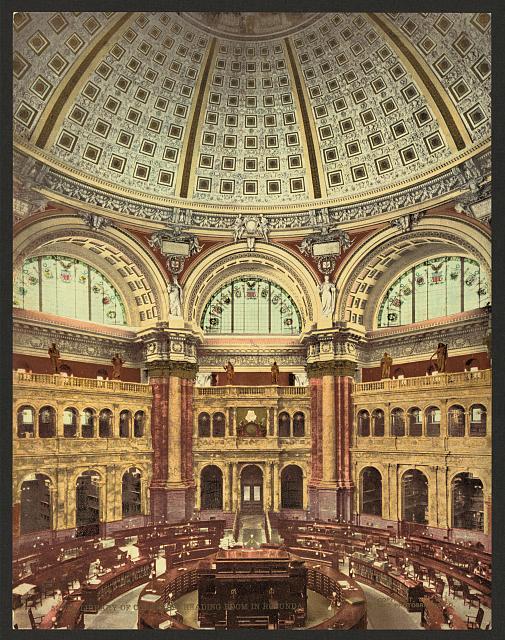
Can we imagine a day when history students and their teachers/professors no longer need to step foot in a library? With so many resources available on-line—newspapers, diaries, academic journals, medieval manuscripts, books… ad infinitum—does that now change the role of actual libraries? Students can access so much on the Web that they can craft very good research papers without ever leaving their dorm rooms. I’m a real fan of actual browsing within the four walls of a library, and there are certain things about a physical space and the people who populate it that can never be replaced. I pose this question more as something to consider rather than as some kind of manifesto/prophecy.
Yet…

Here are just a few of the terrific sites that contain virtual mountains of digitized material:

Perseus Digital Library
“Our larger mission is to make the full record of humanity - linguistic sources, physical artifacts, historical spaces - as intellectually accessible as possible to every human being, regardless of linguistic or cultural background. . . . Perseus has a particular focus upon the Greco-Roman world and upon classical Greek and Latin, but the larger mission provides the distant, but fixed star by which we have charted our path for over two decades.”

The British Library Catalog of Illuminated Manuscripts
“Use this website to find and view descriptions and images of medieval and Renaissance manuscripts in the British Library, one of the richest collections in the world.”

Google Books
Using the full view feature, browsers have access to countless books in multiple languages published from the 16th century to 1922.

Chronicling America: Historic American Newspapers
“This site allows you to search and view newspaper pages from 1880-1910 and find information about American newspapers published between 1690-present.”

America’s Historical Newspapers
“This growing collection of fully searchable historical American and Hispanic American newspapers is the most extensive resource of its kind. With nearly 2,000 titles from all 50 states, America’s Historical Newspapers provides an unparalleled record of the topics, people, issues and events that have shaped America for nearly three centuries.”

America's Historical Books, Broadsides and More
“Comprehensive and authoritative collections of books, pamphlets, broadsides and pieces of ephemera printed between 1639 and 1900…”

Project Muse
“Project MUSE offers full text, affordable access to current content from prestigious humanities and social sciences journals.”

The Library of Congress: American Memory Project
“American Memory provides free and open access through the Internet to written and spoken words, sound recordings, still and moving images, prints, maps, and sheet music that document the American experience.”

Making of America
“Making of America (MoA) is a digital library of primary sources in American social history from the antebellum period through reconstruction. The collection is particularly strong in the subject areas of education, psychology, American history, sociology, religion, and science and technology. The collection currently contains approximately 10,000 books and 50,000 journal articles with 19th century imprints.”

Wednesday, April 1, 2009

Race, Politics, & Religion in American History

Randall Stephens

"Devout Racism: A Review Essay"
Christian Century, March 11, 2009

God and Race in American Politics: A Short History
by Mark A. Noll (Princeton University Press, 2008)

The Origins of Proslavery Christianity: White and Black Evangelicals in Colonial and Antebellum Virginia
by Charles F. Irons (University of North Carolina Press, 2008)

In the early 1900s an Englishman made his way across the American South. William Archer ventured by train and on horseback, observing the region's peculiar folkways. He met with leading men, Booker T. Washington and W. E. B. Du Bois among them, and visited historic sites and thriving New South cities. For Archer the South was at once quaint, backward, hopeful, beautiful and grotesque. Relations between blacks and whites preoccupied him. In that regard, he was like so many other nonsouthern authors of Dixie travel literature—William Bartram, Henry Benjamin Whipple, Frederick Law Olmstead, V. S. Naipaul. But timing is everything.

Archer journeyed through the countryside not long after many southern states rewrote their constitutions, systematically excluding blacks from the electorate. Southern law enforcement officers could easily arrest blacks for vagrancy or some other trumped-up charge. The penalty for the accused: working hard labor in a gruesome prison camp, a fate that one historian calls "worse than slavery." In these years vigilante justice instilled fear in the hearts of millions as the lynching of black southerners reached an all-time high.

Archer didn't doubt that southerners, black and white, were intensely devout. The region was one of the most "sincerely religious" places he had ever visited. Yet, he sarcastically observed, most white southern Christians "would scarce be at ease in heaven unless they enter it, like a southern railway station, through a gate marked 'for whites.'"

The illogic of Jim Crow justice still haunts America. The longstanding presence of racism in the church is hardly believable to some, a brutal fact to others. Looking at the sweep of American history, it's impossible to dissociate deep-seated racism from America's Christian churches.

Two recent books examine race and American Christianity. The authors ably trace how Americans—enslaved and free, northern and southern—have struggled with religion and race over the ages. Mark Noll's insightful God and Race in American Politics is a sweeping account of the subject from the 1820s to the early 21st century. In contrast, Charles Irons focuses on the fierce debates about slavery and Christianity that dominated the attention of Virginians from the late 18th century to the eve of the Civil War in his carefully researched and well-written The Origins of Proslavery Christianity. Read on>>>