Showing posts with label Daniel Rodgers. Show all posts

Wednesday, June 13, 2012

Economics in the Age of Fracture

Dan Allosso

I’ve started re-reading Daniel T. Rodgers’ Age of Fracture.  I glanced at it in the final run-up to my PhD comps, but it didn’t make much of an impression.  Then Jane Kamensky mentioned it during her closing talk at the Historical Society’s recent conference, and I thought I ought to pick it up again.

This closer reading led me to a couple of thoughts.  First, that there’s probably a whole lot more in many of those books we powered through in grad school; it’s probably worth revisiting some of them and digesting them slowly.  Second, what doesn’t seem relevant when you’re under the gun and trying to absorb the historiography of a field may be really useful when you’re thinking about teaching or writing – especially for the public.

I’ve only scratched the surface of Age of Fracture so far, but it strikes me as a very interesting attempt to argue a complicated point for a more-or-less general audience.  This fascinates me, since I think historians really need to help us all understand how we got to where we are today.  I hope to pick up some ideas about how to do this, especially about where the boundary is between assertion and explication: how much of an argument you can carry with an authoritative voice and how much you need to demonstrate with evidence and analysis.  At one point, for example, Rodgers says, “What precipitates breaks and interruptions in social argument are not raw changes in social experience, which never translate automatically into mind. What matters are the processes by which the flux and tensions of experience are shaped into mental frames and pictures that, in the end, come to seem themselves natural and inevitable: ingrained in the very logic of things” (Kindle Locations 125-127).  This is an interesting claim; very close to the idea I just found in Giambattista Vico’s New Science (another book I picked up as a result of the conference), “Every epoch,” Vico wrote, “is dominated by a ‘spirit’, a genius, of its own. Novelty, like beauty, recommends certain faults which, after fashion changes, become glaringly apparent. Writers, wishing to reap a profit from their studies, follow the trend of their time” (quoted in Anthony Grafton’s Introduction).  It’s a provocative idea, and it obviously has a lineage – but is it true?  And can it be used to explain social change over time?
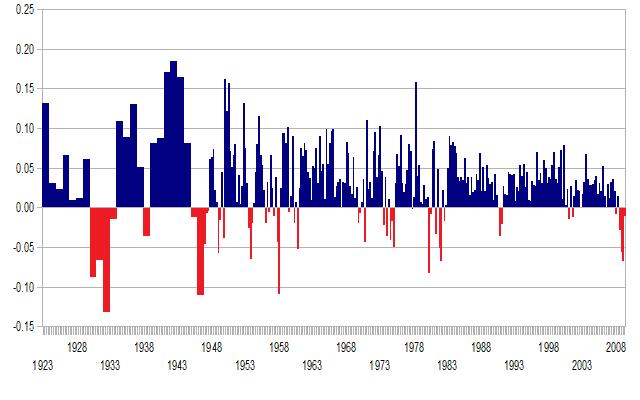
GDP Growth, 1923-2008, (Source: wikimedia).
Another thing Rodgers does, in the early pages of Age of Fracture, is to provide a schematic for a “historiography” of the field of Economics.  Beginning with Alfred Marshall (Principles of Economics, 1890), Rodgers traces the development of economic thinking (and college economic teaching) through Paul Samuelson (Economics, 1948), and then into the variety of competing interpretations resulting from the failure of macro-economic prediction in the 1970s and 80s.  Along the way, Rodgers mentions many of the relevant texts in this development: popular texts such as Milton Friedman’s Capitalism and Freedom and F. A. Hayek’s Road to Serfdom as well as academic titles like Ronald Coase’s “The Problem of Social Cost” and Richard Posner’s Economic Analysis of Law.  It would be interesting to organize a syllabus around these titles, and read them one after another.  In addition to tracing the development of economic theory, the themes of such a class might be to examine whether theory or contingency really moved society, and more importantly to test the point made above by Rodgers and Vico: to see if the explanations offered by economists in their historical moments contain “faults which, after fashion changes, become glaringly apparent.”

Tuesday, October 11, 2011

Running on Empty: Back to the Seventies

Randall Stephens

At least since Bruce Schulman published his The Seventies: The Great Shift In American Culture, Society, and Politics in 2002, historians have been reflecting on that pivotal decade and how it altered the course of recent American history. Maybe it's a sign of the historiographical times that Jefferson R. Cowie's Stayin' Alive: The 1970s and the Last Days of the Working Class won the prestigious Parkman Prize in 2011.

Historians like Daniel T. Rodgers (Age of Fracture) and Judith Stein (Pivotal Decade: How the United States Traded Factories for Finance in the Seventies) also weighed in on the era in 2011. And new explorations of religion and politics in the postwar years are changing what we think about the "recent" rise of the Religious Right (see Dan Williams' God's Own Party: The Making of the Christian Right and Darren Dochuk's From Bible Belt to Sunbelt: Plain-Folk Religion, Grassroots Politics, and the Rise of Evangelical Conservatism).

Is this the scholarly analogue of what The Onion hilariously described back in 1997?: "U.S. Dept. Of Retro Warns: 'We May Be Running Out Of Past'". Unlikely. But, still, the past keeps catching up with us. The seventies--with all it's tragic pathos, decline, hirsute decadence, and acres of polyester--just pulls us in. The decade is certainly a draw for those observes who like to emphasize the heartbreaking, grim side of life. Maybe in these desperate economic times we also see ourselves reflected back in that bleak era.

Josh Rothman makes that point in the Boston Globe this Sunday. He also cites out very own Journal of the Historical Society.

When we talk about today's economic crisis, we tend to think about the 1930s and the Great Depression. Increasingly, though, economic historians are focusing on another decade -- the 1970s. It was during the seventies, conventionally dismissed as an aesthetically challenged interegnum between the revolutionary sixties and the Reaganite eighties, that the seeds of our current crisis were planted. The argument was advanced last year, primarily in Pivotal Decade: How the United States Traded Factories for Finance in the Seventies, by Judith Stein, a historian at CUNY. Now it's gaining momentum, with a roundtable of historians and economists responding to the book in this month's issue of The Journal of the Historical Society. As the historian Daniel Rodgers puts it, "In the economic history of the first half of the twentieth century, the crucial decade was the 1930s. For the second half of the twentieth century," there is a "growing consensus" that "the pivotal decade was the 1970s."

I couldn't agree more. In a modern US course several years ago my students and I explored the cultural and political dimensions of the seventies hangover by reading
Andreas Killen's captivating, yet underappreciated 1973 Nervous Breakdown: Watergate, Warhol, and the Birth of Post-Sixties America. (I take special pride in being born in such an awful year.)

John Lennon, not long before his death at the hands of a deranged man, told an interviewer: "Wasn't the 70s a drag, you know? Here we are. Well, let's try and make the 80s good, you know?" Yet the Me Decade would linger on and on. So writes Killen in his intro paragraph:

Will the seventies never end? The question asked recently by a pundit in the New York Times is a valid one. The sevenries are, indeed, the decade that refuses to end--despite the fact that, for a long time, they barely counred as a decade, so completely were they obscured by the long shadows cast by both the sixties and the eighties and by the noisy clamor of their respective partisans. While the former were claimed by the Left and the latter by the Right, the seventies remained the foundling of recent American history, claimed by no one. Despite the current wave of seventies nostalgia and revisionism, these years still need to be liberated from the two decades that bracket them. More than simply the aftermath to the one and the prelude to the other, this decade should be considered on its own terms, as a distinct cultural moment, a moment of rupture and discontinuity in American history but also of tremendous creativity.

Tuesday, April 12, 2011

Forum on Daniel Rodgers's Age of Fracture in April Issue of Historically Speaking

Randall Stephens

Over at the U.S. Intellectual History blog there's been a lively discussion and debate generated by Daniel Rodgers's new book Age of Fracture. We add a little to that here with a selection from the forum on the book in the new issue of Historically Speaking. (View the full April 2011 issue on Project Muse. Use your college, university, or library connection for full access.)

AMERICA IN AN AGE OF FRACTURE: A FORUM

Historians and other observers of postwar America note the dramatic social and political changes underway since the 1960s. It was, as Daniel Rodgers puts it, an age marked by discontinuity, shifting party allegiances, and social fracture. An intellectual and cultural historian, Daniel Rodgers is Henry Charles Lea Professor of History and director of the Shelby Cullom Davis Center for Historical Studies at Princeton University. He is the author of four books, including: The Work Ethic in Industrial America, 1850-1920 (University of Chicago Press, 1978), winner of the Organization of American Historians’ Frederick Jackson Turner Prize; Contested Truths: Keywords in American Politics (Basic Books, 1987); and Atlantic Crossings: Social Politics in a Progressive Age (Harvard University Press, 1998), which won the American Historical Association’s Beer Prize and the Organization of American Historians’s Hawley Prize. His latest book, The Age of Fracture (The Belknap Press of Harvard University Press, 2011), argues that in the 1970s Americans began to think of the country in terms of choice-making individuals rather than as a society shaped by classes, interests, and norms. Historically Speaking asked Bruce Schulman, Melani McAlister, Michael Kimmage, and Donald Critchlow to comment on Rodgers’s short essay about this shift in American thought. Their comments are followed by Rodgers’s response. (Citations of Rodgers’s book are in parentheses.)

Daniel Rodgers, "Age of Fracture," Historically Speaking (April 2011)

The history of the United States in the last quarter of the 20th century seems to constitute, at first glance, a maze of paradoxes. It was the age of Reagan, conservative partisans said at the time: a moment of deep political reversal. Peggy Noonan, one of the most gifted of Reagan’s speechwriters, joined the White House staff to be present at “the Reagan revolution.”1 Political managers dreamed of a realignment election that would change the very frame of partisan politics, and political scientists pored over election results to see if they could discern that one had occurred. A sense of the world as shifting rapidly beneath one’s feet was widespread, but, for all of Reagan’s symbolic prominence, the notion of a clear political watershed turned out to be an illusion.

Party allegiances shifted dramatically in the last quarter of the century, particularly among white southern voters; a new and highly energized conservative political movement came into being; but the realignment election that would give the Republican Party a permanent majority failed to occur. Closely fought elections, divided governance, and an increasingly divided electorate have marked the last three decades’ politics, not a new consensus. Even Reagan himself, Noonan wistfully admitted, “wasn’t a revolutionary; he wasn’t a missile drawn to the heat of a new idea.”2 The battles over taxes and regulation that Reagan’s election precipitated represented no revolutionary break with history. Even the “culture wars” and their partisan mobilization of religious loyalties replayed long-standing strains in 20th-century American politics.

A stronger argument for discontinuity can be made for the structures of the late 20th-century economy. The global economic crisis of the 1970s with which the era began, buffeted by oil price shocks and inflation, was a prelude to wide-ranging transformations in the domestic and global economies. Squeezed by new cost pressures, compromises between labor and management unraveled. Union membership spiraled precipitously downward. Manufacture went global in search of cheaper labor. Finance capitalism emerged out of the crisis stronger than ever before, fueled by new and more exotic investment instruments and new investor ambitions for corporate restructuring. The derogatory “age of greed” label reflects a simplistic reading of the moral tone of the era, but the phrase had its structural basis, as David Harvey and others have argued, in the collapse of the Fordist economy of the middle years of the century.3

And yet the age of materialism, global markets, ascendant financial capitalism, new political ambitions, and an intensely politicized punditry was also, and in many ways more fundamentally, a period of deep transformations in social thought. It was here, on the terrain in which Noonan thought her hero Reagan to have been least adept, that the discontinuities of the era were most pronounced. A whole vocabulary of concepts that had once seemed the common sense of social thought weakened and new languages took their place. The age of Reagan, the “age of greed,” was simultaneously, and more importantly, an age of transformation in ideas.

“A war of ideas,” conservatives often called it, but it was much less structured by partisan polarities than has often been understood. Ideas flowed quickly into politics through more aggressively partisan think tanks and more aggressively partisan funders of books and university research. But ideas simultaneously slipped across the political blocs, often incongruously and unpredictably. Deregulation was a radical project before it became a conservative one. The first practical school voucher proposals were the work of liberal social scientists. Libertarian ideas infiltrated social thought, leaving a trail across both Left and Right. >>> read on

See also the four comments and Rodgers's response:

Bruce Schulman, "Daniel Rodgers's (New) Consensus History"

Melani McAlister, "Popular Media in an Age of Fracture"

Michael Kimmage, "A Response to Age of Fracture"

Donald T. Critchlow, "On a Darkling Plain"

Daniel Rodgers, "A New Consensus?"