Monday, January 31, 2011

Lincoln, Eisenhower, and Lies

Heather Cox Richardson

Why is so much press coverage going to the news that an amateur researcher altered the date on a pardon issued by President Lincoln? Retired psychiatrist Thomas Lowry, who, together with his wife, has spent his retirement studying Civil War materials in the National Archives, apparently changed the date on the original piece of paper from April 14, 1864, to April 14, 1865. If the latter date had been true, the pardon of a soldier would have been one of Lincoln’s last acts before his assassination.

Defacing a historic document is certainly appalling. But this particular change has had very little effect on our understanding of either the president or the war. The true date has always been in Roy P. Basler’s The Collected Works of Abraham Lincoln, which remains the standard book of Lincoln documents for scholars. And, really, how important is this one scribbled note, anyway, in the scheme of Lincoln’s life or the Civil War?

I can’t help but contrast the flurry over this story with the relative silence over the truly astounding news that Stephen Ambrose had made up—MADE UP!—his famous interviews with Dwight Eisenhower. Ambrose’s biography was considered definitive, and held the field for decades, because no other historian could compete with his apparent deep knowledge of the man, gleaned through numerous private interviews he claimed he had had with President Eisenhower. Those interviews, it turns out, almost certainly never happened. Our entire understanding of the Eisenhower years—relatively important years, one might argue, since they cover 1890 to 1969—has been warped through Ambrose’s imaginings. This seems to me the biggest news story involving history in the past year.

So why did the press largely ignore it? And why are newspapers picking up the Lincoln story, when such a huge story went untouched?

Is it that Lincoln himself is always a draw for readers? (Although Eisenhower is getting far more news coverage this year than he has in the past three decades.)

Is it that the unknown Dr. Lowry is an easier target than the well-known Ambrose family?

Is it, perhaps, that the Eisenhower lie was just too big, and too embarrassing, for anyone to take on?

My fear is that, while all of these might be true, the latter is the most important reason. And what does that say about the parameters of public debate? The little things—the numeral changed by an unimportant figure on a relatively unimportant document—can be attacked. But the really, really big things—a fabricated life of a major figure by a famous historian—must be ignored.

Not a great way to conduct business.

Friday, January 28, 2011

Stonewall, the Mafia, History, and Teaching

Heather Cox Richardson

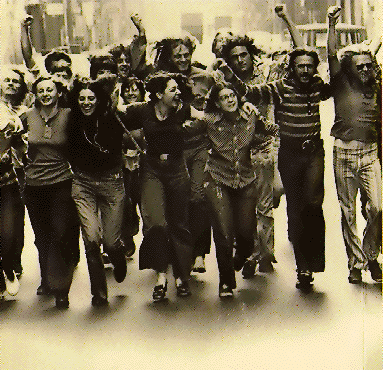
A week or so ago, a group of high school sophomores asked me what the Stonewall Riots were. I could give the basic survey answer: 1969, New York, the spark for the gay liberation movement. The basics. But my young friends wanted to know more. What, exactly, happened, and why?

We went to the internet to poke around. And there, on some basic website, we found a throwaway line that went something like: “although the Stonewall Inn was owned by the Mafia . . .”

This was certainly news to me, so I wrote to ask Jennifer Fronc, author of New York Undercover, about it. She studies moral policing in communities and law, so I figured she might know why the Mafia owned a gay bar. She did. She answered:

The Stonewall Inn, and most gay bars in NYC at the time, were, in fact, owned by the Mafia (or at least petty criminals of Italian-American descent). The reason that they owned them was purely as a business venture--not out of some sense of civil rights or justice. The New York State Liquor Authority had very strict codes about dress and conduct in public houses, and you could easily lose your liquor license if your patrons did not abide by those codes. So, in the case of gay bars, the codes that affected the patrons were no same-sex kissing, touching, or dancing, and your patrons were required to wear 5 articles of clothing that corresponded with their biological sex (this was targeting drag queens but ended up nailing dykes much harder). So, what started happening is the cops would raid gay bars and frisk/strip search the patrons to make sure they were wearing the right clothes. Bar owners couldn't afford to pay off the police or get back their licenses after raids like this, so the mafia stepped in and started running the gay bars and paying off the local cops….

The Stonewall Inn was a frequent target of those raids, and there are 2 theories as to why they rioted that night, which was like any other: 1. they were just fed up and 2. the memorial service for Judy Garland had been earlier that night, and the men were drunker than usual. Although it was allegedly a tough dyke who threw the first punch at the cops.

For contemporary newspaper clippings, she sent me to an online exhibit at Columbia University:

This is, itself, one of those great connections in history (like Elvis and Nixon) that make it possible to survive January in New England. But it also raises for me two other issues.

First, it indicates the importance of a renewed historiographical interest in societal systems. In this case, the New York code dictating dress in public had huge implications for gay culture, suggesting that we must understand the legal codes in order to understand what happened at Stonewall. That code also clearly had big economic repercussions for business owners, suggesting that we cannot understand discrimination without looking closely at the economic systems with which it is intertwined.

There is a strong tendency among historians of America to see legal history, economic history, political history, and the study of similar systems as old-fashioned and reactionary, but it seems to me the very opposite is true. We can’t understand most aspects of social history completely without these systems factored in.

Second, the fact these high school students came to a neighbor who teaches history for information on Stonewall speaks to this blog’s on-going discussion of teaching. They asked me about Stonewall because they have a teacher who always has the answer to everything. They figured out in the first two days that she was often wrong, and their education has taken a fascinating turn. Rather than being turned off to history, the students have made it a game to learn everything better than she knows it. (The Stonewall question apparently came up when she tried to tell them that the “Stonewall Riots” had something to do with Stonewall Jackson.) Had she assigned them an essay on Stonewall, they likely would have grumbled and done as little as possible. But since they were doing it for themselves, they took their own time to find answers, and they didn’t stop with the job half done.

While making things up to drive students to try to embarrass us is hardly a model for how to teach, it does suggest that our job is less to have all the answers than to have enough answers just to whet curiosity, and then to make sure our students know how to keep learning. This, curiously enough, is the conclusion of a new study on learning conducted at the University of California.

[Thanks to Jennifer Fronc for her information, and for letting me post from her email.]

Thursday, January 27, 2011

American Exceptionalism

Bruce Mazlish

Today's post comes from Bruce Mazlish, professor emeritus of history at MIT. A distinguished historian, he is the author or editor of a variety of books and articles, including: The Global History Reader (Routledge, 2005), ed. by Mazlish and Akira Iriye; The New Global History (Routledge, 2006); and The Uncertain Sciences (Yale, 1998; paper Transaction Press, 2007) .

All peoples think of themselves as special, their way of life as exceptional. The USA certainly thinks of itself as exceptional, elevating the claim to a national shibboleth. This claim guides the country in its thinking and behavior in international affairs. Though all are exceptional, America sees itself as more exceptional than others. The implications of this conviction are profound and fundamental. Inquiry into this belief system, given the power, economic and military of the country, appears necessary.1

Its roots are deep and tangled. In Ian Tyrrell's definition, "The idea of the United States as a unique and indeed superior civilization outside the normal historically determined path of human history lies at the heart of American exceptionalism."2 With this provisional definition, we can proceed to examine the origins of the experience and its phases.

Apparently, one of the earliest formulations comes from a Marxist analysis claiming that America is exceptional in not having a true class system. Hence socialism does not flourish in America as it does elsewhere. This was a theory advanced by Werner Sombart, a Marxist influenced historian. However, before Sombart, Alexis de Tocqueville had used the term "exceptional" in his Democracy in America. One aspect of America for him was that as a nation it had been born in the light of day i.e., its origins not lost in the forests of the past but visible to contemporary observers. Even before the Frenchman's classic analysis, a general European view of the continent stressed both the unparalleled possibility of abundance in the New World as well as its dark barbarianism, seeing them as exceptional. The encounter with the Indians seemed to be unique (very different from that in South America).

The original colonists of New England had faith that the New World was liberated from the dead hand of the past and no longer subject to the strictures of what we would now call historical determinism. It had a special mission, to spread its creed of freedom to the rest of the world (a latent contradiction to exceptionalism?) In the process, the carriers of this creed were experiencing a rebirth. In the view of Richard Slotkin, this belief had a dark side. "The first colonists," he writes, "saw in America an opportunity to regenerate their fortunes, their spirits, and the power of their church and nation; but the means to that regeneration ultimately became the means of violence, and the myth of regeneration through violence became the structuring metaphor of the American experience."3

In his article on American exceptionalism, Seymour Martin Lipset quotes G.K. Chesterton to the effect that "America is the only nation in the world that is founded on a creed."4 That creed was to be a light to the world; the nation had a divine mission to spread the blessings of freedom and liberty to the rest of the world (even by violence, if necessary).

Clearly, the concept is a fundamental part of the American belief system. Its implications are extremely important. I want to argue that we must see the concept historically, as a dynamic part of the American experience. In doing so, we can discern two major phases. The first is a more or less benign expression. It has led the US into seeking to support freedom of dissent and human rights in many parts of the world. Alas, the country has been hypocritical in the way it does this. All too often, it says one thing and does another. For example, it proclaims freedom and democracy and then supports autocratic countries such as Saudi Arabia. It behaves occasionally according to a double standard. Opposing torture elsewhere, it has practiced it within its own borders. This becomes increasingly clear as we look at more recent history.

I want to suggest that there are variants on American exceptionalism: benign and malignant. The benign is most marked in the 18th and 19th centuries as America sought to fulfill Winthrop's prophesy of its being a city on a hill that would serve as a light for the rest of mankind. With all its deep-rooted faults at home—slavery being the “blackest”—ranging from its treatment of the Indians to its continental and then overseas imperialism, America, symbolized by the Statue of Liberty on Ellis Island, the port through which so many of its immigrants arrived, seemed to beckon all peoples to the freedom and liberty of the country. Abroad, it strove to spread its message as widely as possible.

Though proclaiming the Monroe Doctrine, thus announcing its dominion over both the North and South continents, along with its existing appropriation of the name "America" for itself, the nation exhibited a mix of isolationism and participation in international affairs. The benign aspect would appear especially after WW II, when America was in the foremost rank of those seeking to establish institutions and codes that would seek to punish not only war crimes but also crimes against humanity. The UN, with America providing a home for it in New York City, in 1948 issued a Declaration of Human Rights. A few years earlier in the Nuremberg trials the US was among the foremost in seeking justice on an international scale. The Yugoslav and Rwanda trials following confirmed this trend, culminating in the International Criminal Court. Elsewhere I have called this a "Judicial Revolution."5 Here was reached the sticking point for the US. It became increasingly clear, especially in the Bush administration, that America was not prepared to be held to the same justice and laws that it had so prominently helped establish.

Now emerged the malignant side of American exceptionalism. It served as one of the banners under which the US felt that it was exempt from conforming to international law except where and when it suited its own purposes. President Obama rightly takes exception to this assertion—America is a nation like all others, and subject to the same laws of history and judgment—and has been roundly criticized by Tea Party members for this statement of equality. Frequently invoked in the present, Republicans Sarah Palin and Mike Huckabee are reported as "denouncing Obama for denying 'American exceptionalism.'"6

There are many founding myths in America. In its malignant form, that of American exceptionalism is one of the most potently damaging, to America itself and to the world. It is time that it is dug up by the roots and placed in the trash bin. We can do this easily on the computer; it is time that we matched this action in our minds as well.

___________

1. The literature on "American exceptionalism" is extremely full. Rather than trying to list various titles, I refer the reader to that rubric in Google, where numerous examples are given.

2. Ian Tyrrell, "American Exceptionalism and Uneven Global Integration: Resistance to the Global Society," in The Paradox of a Global USA, ed. by Bruce Mazlish, Nayan Chanda, and Kenneth Weisbrode (Stanford, 2007).

3. Richard Slotkin, Regeneration Through Violence: The Mythology of the American Frontier, 1600-1860 (Wesleyan, 1973), 5.

4. Quoted in Seymour Martin Lipset, "American Exceptionalism," Washington Post, 1991.

5 . See Bruce Mazlish, The Idea of Humanity in a Global Era (Palgrave, 2009), especially Chapter 4.

6. Quoted in Thomas Friedman, "From WikiChina," New York Times, November 30, 2010.

Wednesday, January 26, 2011

Reading Primary Sources: Bank Notes

Dan Allosso

We don’t think much about our money. We may worry about how much of it we need; but we’re not concerned about what it looks like or where it came from. Rarely do we remember that this is a modern phenomenon. Until the Civil War, Americans were very aware of the origin and relative safety of their money.

The best money in early nineteenth-century America was gold, but there was a limit to how much of it you could conveniently carry. And there wasn’t enough of it to go around, especially in towns and villages far from financial centers like New York and Philadelphia. So local people exchanged promissory notes that were basically IOUs stating, for example, that Miller Jones owed Farmer Smith $50 for his wheat harvest, payable sixty days after Smith delivered the bushels of grain to the mill. If Farmer Smith needed to pay someone else sooner than sixty days, he had several options. He could write his own promissory notes (if people trusted him), endorse the Miller Jones’s note to a third party (if people trusted Miller Jones), or take Jones’s note to the bank for cash. The banker would exchange the note for cash, at a “discount” representing interest for the sixty days he would have to hold Jones’s note before he could redeem it. The “cash” the banker would give Farmer Smith could include gold coins if Smith insisted on it, but if the banker had his way it would be—and this is where it gets interesting—bank notes.

Bank notes were initially just like promissory notes, except that they were issued by the bank. They were usually written to a named recipient for a specific amount. But they were much more easy to endorse to a second party, because in most cases everyone knew and trusted the bank. Over time, banks were able not only to write a lot of these types of notes, but to begin writing general notes for smaller denominations, that were immediately payable to anyone “on sight.” Of course the details of how this developed varied from place to place, but these small denomination sight notes became “circulating currency,” or what we think of as money.

When banks gained the ability to issue their own notes, they basically began creating money. In many states, there were laws requiring the bankers to invest in a state insurance fund, or to deposit securities (government bonds or mortgages) with the state comptroller in order to issue notes, but very rarely was there a substantial specie requirement. In other words, the money these state banks printed was usually backed by something other than piles of gold in the vaults of the banks, because there were no piles of gold.

Confidence in the banker issuing a note was crucial to the note’s acceptance. This confidence was naturally greater in states that had a “safety fund” or that required securities to back note issues. Everyone knew that there was never enough gold at the bank to pay all the notes. The expectation was rather that there would be enough to conduct regular business, and pay the notes brought in for redemption on any given day, rather than all the notes outstanding. This differential between everyday redemptions and all the notes outstanding was all-important: this was how the bank literally made money.

The money-making ability of the local bank was not only profitable for the banker, but was essential to the community. Without the money printed by local banks, farmers and millers would have had a much more difficult time doing their business. Especially in remote areas, which was where most of the farm products destined for city dinner tables were grown. Most of the “real money” (that is, gold) was hoarded in the big eastern cities, or after Andrew Jackson’s 1837 Specie Circular was used to buy land at the frontier Land Offices. Very little was available in the settled farmlands that made up the middle of the country. Local banks provided the cash and credit that allowed farmers to plant, tend, and harvest their crops, at a time when 90 percent of Americans were farmers.

All this changed during the Civil War. The Lincoln administration first issued their own notes, called Greenbacks because they were printed with green ink, to help pay for the war. Between 1863 and 1865, Lincoln’s Treasury Secretary, Salmon Chase, led a campaign to centralize control of American banking by creating a system of national banks and by taxing the notes of local banks, to make them too expensive to use relative to the new national notes. Chase and his supporters claimed that local banks were unsafe, and that the extreme variety of notes floating around in the economy (it has been claimed there were over 9,000 different types in circulation in the early 1860s) provided too much opportunity for counterfeiters. While both of these arguments were valid up to a point, Chase’s solution wasn’t the only possible response. Our current system of national currency was not inevitable; by nationalizing the power to make money, Chase added a nearly immeasurable new source of revenue for the central government. This aspect of the change to national notes has gone largely unrecognized, and we now treat our national currency as a completely natural and inevitable part of our national economy--except in a few places like far western Massachusetts, where local people have taken advantage of changes and loopholes in the banking laws, to once again begin making their own money.

Tuesday, January 25, 2011

Rarely is the Question Asked: Is Our Professors Teaching? Part III

Randall Stephens

Guess what? Many college students do not learn analytical and writing skills during the four years they spend in college. Students don't study. Courses are not demanding. Collaborative learning does not work like professors think or hope it does. . .

Or, so argues a new book, Academically Adrift: Limited Learning on College Campuses (University of Chicago Press), by Richard Arum and Josipa Roksa. More and more students--more likely parents--are throwing down the cash for college. But the authors ask: "are undergraduates really learning anything once they get there?"

Last week the Chronicle highlighted Academically Adrift and the authors' controversial findings. (David Glenn, "New Book Lays Failure to Learn on Colleges' Doorsteps," Chronicle, January 18, 2011.) Arum and Roksa tracked 2,000 students at 24 four-year colleges. Thirty-six percent of these students who took the Collegiate Learning Assessment essay test showed no significant improvement from their freshman to senior year.

Arum and Roksa certainly have their critics. The study asked too few questions about collaborative learning, say some. Others say that the study, limited in scope, should not challenge the whole undergraduate enterprise.

But, overall, the findings should give us pause. "Mr. Arum and Ms. Roksa don't see any simple remedies for the problems they have identified," writes David Glenn in the Chronicle. "They discovered more variation in CLA-score gains within institutions than across institutions, and they say there are no simple lessons to draw about effective and ineffective colleges." Still, Glenn points out that business and education programs in Texas colleges require that students "take only a small number of writing-intensive courses." The path of least resistance.

Are students today less likely to major in history when the workload is high and the perceived payoff is so low? ("So I'm going to spend all this time reading primary and secondary works just so I can be unemployed after four years of reading, writing, and reading some more?") Five years ago Robert Townsend noted in Perspectives that: "Information from the latest Department of Education (DoE) report (pertaining to the years 1997–98 to 2001–02) suggests that in the competition for students, history lost ground while the total number of undergraduate students at colleges and universities grew quite quickly." I haven't see more recent data, but I can't help but think that there are fewer majors today then there were 20 years ago.

Perhaps history departments could do a better job of emphasizing the portable skills students learn in the major. Why not stress in clear terms that history trains students to think critically and to write clearly? I have my students read Peter Stearns excellent essay, "Why Study History," for this very reason. They learn that history students gain: "The Ability to Assess Evidence. . . . The Ability to Assess Conflicting Interpretations. . . . Experience in Assessing Past Examples of Change." Stearns ably shows that "Work in history also improves basic writing and speaking skills and is directly relevant to many of the analytical requirements in the public and private sectors, where the capacity to identify, assess, and explain trends is essential." I've also had students read Heather's excellent post on this subject from our blog. She noted: "History is the study of how and why things happen. What creates change in human society? What stops it? Why do people act in certain ways? Are there patterns in human behavior? What makes a society successful? . . . . When you study history, you’re not just studying the history of, for example, colonial America. You’ll learn a great deal about the specifics of colonial America in such a class, of course, but you’ll also learn about the role of economics in the establishment of human societies and about how class and racial divisions can either weaken the stability of a government or be used to shore it up."

Sounds like a cure for the "I-learned-little-in-four-years-of-college" blues.

Monday, January 24, 2011

An Interview with Jacqueline Riding on Mid-Georgian Britain

Randall Stephens

Jacqueline Riding is a historian and consultant who is completing her PhD in 18th-century British art and culture. She served as the curator at the Theatre Museum, the Guards Museum, the Tate, the Palace of Westminster, and was founding Director of the Handel House Museum in London. Her Mid-Georgian Britain, “the latest addition to the growing Living Histories series, charts the growth of the empire and looks at the growing importance of London as a capital city where the rich and poor rubbed shoulders. Jacqueline Riding creates a vivid portrait of the daily reality of life for a middle-class family in this age of growing affluence.”* Ever wonder what life was like in an 18th-century city? How did people eat, work, and play? What did they think about the world around them? Riding's concise, immensely entertaining book gives a snapshot of an amazing, vanished world.

Randall Stephens: Your book, Mid-Georgian Britain is a readable, fascinating account of life in the 18th century. Did your own work as a curator and scholar of art and culture influence how you composed the book?

Jacqueline Riding: Thank you very much. The basic chapter structure and length were set out by the publishers, although I did change a few of the headings. For example I think “Charity and Citizenship” is a key theme of the period and I have done a lot of work on the Foundling Hospital (my PhD is on an artist, Joseph Highmore, who donated a history painting to the charity). So I changed the chapter heading accordingly. The tight word length meant I had to be disciplined and the text feels pithy and quite fast-paced, which I like. It was important to stop worrying that so much inevitably gets left out. Even so, some of the themes were out of my comfort zone (dental pelicans anyone?!). So I learned something new too. Word length permitting, I was keen to show contrasts and find unusual facts or opinions rather than trot out the usual Georgian suspects. Having said that I could not resist Dr. Johnson. I think my background in curatorship means I think of an historical period in 3D—a case in point was recreating Handel’s house in Mayfair. I believe it is important not to be confined by a particular academic discipline, to study an historical period in the round. One of the benefits of being an art historian is that you know your way around a picture library, so I was very eager to get really good quality images. Ultimately, if I gave an interesting snap shot of the period, which encourages people to look further and even visit some of the locations mentioned, then I've done my job.

Stephens: Could you say something about how the London of the early 21st century differs from the London of, say, the 1750s?

Riding: Well, if they thought it was big in the mid-eighteenth century, they should see it now . . .

Stephens: Throughout Mid-Georgian Britain you quote a host of contemporary authors. Do you have a favorite character/author from that period?

Riding: It would have to be William Hogarth. He’s quite simply a hero, a real London bruiser with a heart made of putty.

Stephens: You include sections in the book on “Love and Sex, Marriage and Family,” “Home and Neighbourhood,” “Work,” “Food and Drink,” and more. What did you find most interesting to research and write about?

Riding: As I say, most of the headings were provided by the publisher although “Love and Sex . . .” was one of my modifications—partly so I had the excuse to illustrate the syphilitic skull and condom. When you are asked to rattle through a thirty-year period covering as many bases as possible you start to realize how little you know or at least how relatively limited your expertise is. No one is an expert on “the eighteenth century”—it’s just not possible. Humbling but true.

Stephens: Are you working on any projects now that you can tell us about?

Riding: I am indeed. For anyone interested in mid-Georgian art and charity I have an article in Art History Journal titled “The mere relation of the suffering of others’: Joseph Highmore, History Painting and Charity.” I have an article coming out in April’s History Today on Charles Edward Stuart and I am also writing a narrative history on the Jacobite Rebellion of 1745 for Bloomsbury Publishing (eta 2013).

Saturday, January 22, 2011

Morris L. Cohen Student Essay Competition

.
The Legal History and Rare Books Section (LH&RB) of the American Association of Law Libraries, in cooperation with Cengage Learning, announces the third annual Morris L. Cohen Student Essay Competition.

The competition is named in honor of Morris L. Cohen, late Professor Emeritus of Law at Yale Law School. Professor Cohen was a leading scholar in the fields of legal research, rare books, and historical bibliography.

The purpose of the competition is to encourage scholarship in the areas of legal history, rare law books, and legal archives, and to acquaint students with the American Association of Law Libraries (AALL) and law librarianship.

Eligibility

Students currently enrolled in accredited graduate programs in library science, law, history, or related fields are eligible to enter the competition. Both full- and part-time students are eligible. Membership in AALL is not required.

Requirements

Essays may be on any topic related to legal history, rare law books, or legal archives. The entry form and instructions are available at the LH&RB website: http://www.aallnet.org/sis/lhrb/

Entries must be submitted by 11:59 p.m., March 15, 2011. The winner will be announced by April 15.

Awards

The winner will receive a $500.00 prize from Cengage Learning and up to $1,000 for expenses associated with attendance at the AALL Annual Meeting.

The runner-up will have the opportunity to publish the second-place essay in LH&RB’s online scholarly journal Unbound: An Annual Review of Legal History and Rare Books.

Please direct questions to Robert Mead at libram@nmcourts.gov or Sarah Yates at yates006@tc.umn.edu.

Friday, January 21, 2011

Learning from the History We Don’t Study

Joel Wolfe

Today's post on what we can learn from other fields comes from Joel Wolfe, professor of history at the University of Massachusetts Amherst. Wolfe "studies the impact of modernity, industrialism, and trade on Latin American societies and their politics. His primary focus is modern Brazil. He is the author most recently of Autos and Progress: The Brazilian Search for Modernity (Oxford 2010). He also published Working Women, Working Men: São Paulo and the Rise of Brazil's Industrial Working Class, 1900-1955 (Duke 1993). His articles have appeared in the Latin American Research Review, Hispanic American Historical, Radical History Review, Review, Luso-Brazilian Review, and Revista Brasileira de História. He is at present working on a book tentatively titled, '100 Years of Trade in Latin America.'"

And now for something completely different. . . .

To those of us of a certain age, hearing those words meant we were about to see something absurdly funny. This isn’t so much funny as it is completely different from what’s been on this blog. Unlike most of the folks who post here, I’m a historian of Latin America. What exactly constitutes “Latin America” will be the topic of a future post, but only if people like this one.

What interests me today is our collective ignorance about the things we don’t study. I recently read Gordon Wood’s magisterial Empire of Liberty, and I had to balance the awe in which I hold Wood’s work with my panicked sense of ignorance about key aspects of American history. How deep is my ignorance? I’m just now starting Daniel Walker Howe’s What Hath God Wrought and I have James McPherson’s Battle Cry of Freedom on the shelf in the “on deck circle.”

A friend and colleague expressed a similar sort of ignorance about the country that I study. She told me she had recently seen a map of South America and was truly stunned by Brazil’s enormousness. I agreed. It is big. She continued to express her extreme surprise, her complete perplexidade. So, I did something only a historian would do. I sent her a map. It shows that every country of Europe fits comfortably within Brazil’s borders. (Click to enlarge.) Neat, huh?

Brazil’s great size is important for a lot of reasons that should interest U.S. historians. Brazil, for example, has been expansionist at the expense of many of its neighbors. Indeed, Brazilians are comfortable with some aspects of U.S. notions of manifest destiny because they see themselves in a similar light. Brazil is literally the opposite of Mexico, the region’s second largest and second most populous nation, in this regard because Mexican history has been marked by invasion and annexation that led to the loss of more than half its territory to the United States.

Latin America’s geography has shaped these nations in ways much more significant than their relationship to the United States. Mexican history has long involved attempts by the center (Mexico City) to gain control over the periphery, including the northern states in the nineteenth century, Yucatán in the nineteenth and twentieth centuries, and Chiapas more recently. Brazil, on the other hand, has been trying to move off the coast to know, claim, and control its interior spaces. The 1960 opening of Brasília, its modernist capital in the interior, is only the most obvious manifestation of a history that includes wars against far-away millenarian communities (Canudos and the Contestado) and endless schemes to control the vast Amazon from an ill-fated attempt to build a telegraph line through the jungle to Fordlândia and Belterra (Henry Ford’s modernist interventions in the jungle) to doomed settlement schemes advanced by the nation’s military dictators in the 1970s and 80s.

We can never know everything in our own fields, let alone even the basics of others. Returning to some of the activities that drew so many of us into history as children, such as playing with globes and studying maps, can help us begin to know other countries and fields. Maps are great tools for thinking about a country’s size, what region or regions it helps constitute, and how it relates to other parts of the globe. Thinking about maps, space, and place should remind us of how geography is central in history and it can help us start to bring our disparate fields a little closer together.

Thursday, January 20, 2011

Jack Miller Center-Historically Speaking Prize Essay Competition

Randall Stephens

We are happy to report the inaugural winners of the Jack Miller Center-Historically Speaking Prize Essay Competition. At a recent Jack Miller Center reception held in conjunction with American Historical Association’s annual meeting in Boston, Pamela Edwards, the Miller Center's director of academic initiatives, and Donald Yerxa, senior editor of Historically Speaking, announced the winners of the 2010 Miller Center Prizes (of $1000 each) for the best essays published in Historically Speaking in the areas of (1) intellectual history and the history of political thought and (2) military-diplomatic history.

Christopher Shannon, associate professor of history at Christendom College, won the intellectual history prize for his essay: "From Histories to Traditions: A New Paradigm of Pluralism in the Study of the Past" (January 2011). Peter Paret of the Institute for Advanced Study in Princeton won the military-diplomatic prize for his essay "Two Historians on Defeat and War and Its Causes" (June 2010). The Society thanks the Miller Center for its support of historical scholarship in the service of improved public understanding. We are delighted with the partnership being forged between the Historical Society and the Jack Miller Center. It promises to be a very congenial and mutually beneficial collaboration.

Wednesday, January 19, 2011

Reading Primary Sources: Estate Inventories

Dan Allosso

One of the things that fascinates me about doing historical research, is that it doesn’t always involve long trips to exotic archives or well-known historical sites. For example, wills and estate inventories going all the way back to the earliest days of settlement are often kept in the county records office. Whether you are trying to find information on a particular family or individual, or looking for background material to help you rebuild the world your subjects lived in, probate documents can be a really interesting window into the material culture of the past, and into the attitudes and values of people long ago.

I went to the western Massachusetts town of Northampton a while back, to look at estate information for the town of Ashfield. Hampshire County encompassed the area which is now Franklin County until 1811, so I went to Northampton expecting to find Ashfield documents up to that time. In fact, I found several later than 1811, suggesting that people in the habit of going down to the Northampton Courthouse to conduct their business were not turned away. Sometime soon, I’ll make a similar trip to Greenfield, and see what they have in their files.

Wills are public records, so you don’t have to provide any credentials to look at them—but I don’t imagine they get a lot of use. In Northampton, there’s an old-fashioned card catalog where you can find the names you want to ask for, and a simple form you hand to the records clerk. The January 3, 1811 will and April 10, 1811 inventory of Joseph Clark is typical of what I found. Most of the old documents are folded into palm-sized packages, often bound with string. The inventory, taken by Clark’s executor Japhet Chapin, lists everything of value that Clark owned. First and most important, of course, are “Fifty acres of land including the buildings valued at $800.” Everything else Clark owned was worth about $159, including six cups and saucers valued at 12 cents, a vest worth 42 cents, and seven sheep and two lambs whose $13.50 value suggests they may have been newly introduced Spanish Merinos.

In his will, which Clark executed four months before his death, he first specifies “I would have all my just debt paid.” Next, Clark orders the division of his remaining assets. He specifies cash settlements to be paid “within one year after my decease” to his five daughters; fifty-five dollars to each of the unmarried, and five dollars to the married woman, who had probably received the fifty when she wed. He gives fifty dollars to his son Otis, and “to my dearly beloved wife” Clark orders “she should have a comfortable maintenance out of my estate so long as she remains my widow then the income of one third of my estate during her natural life.”

Clark’s widow’s income and maintenance would come out of the balance of his $959 estate after the $275 in cash bequests and whatever went to pay his debts. This balance was to be split equally between his two remaining sons, Joseph and Loring, who would presumably either work the farm together, split it into reasonably equal halves, or find a way for one to buy out the other’s equity. There was a practical limit to how small a farm could be and remain viable; if all fifty acres were “improved” cropland, they may just have been able to split the property. On the other hand, one or both of the brothers may already have owned other property, before their father’s death.

The will and inventory raises several questions that can help direct my further investigation. I can check the town’s Vital Records book (there’s one for every town in Massachusetts, covering births, deaths, and marriages up to 1850), to determine the ages of the family members in 1811. Town “valuations” (tax lists) will tell me what land the sons may have owned already, if they lived in town, and possibly whether either of them had cash on hand to meet the “within one year” requirement of the cash bequests. Since Clark left no cash and I believe he had no large sums owed him (I don’t know for sure, but I assume there are none because the two notes he held were crossed out at the bottom of the inventory list, suggesting they had been settled), the brothers would have needed to raise over three hundred dollars relatively quickly, to satisfy their siblings’ and provide for their mother.

In addition to these particulars of the Clark family, the documents tell me several things about Ashfield, that I can check against historians’ understanding of similar places at this time, to get a better sense of the town. Clark writes affectionately of his wife and leaves her not only a widow’s maintenance, but a third of the income of his estate, suggesting that he valued her contribution to the family's fortunes. The inventory is witnessed by Ebenezer Smith Jr., son of the Baptist minister and grandson of the town’s first settler, suggesting Clark (who was a member of the Congregational Society) was on good terms with neighbors outside his denomination. The will itself is witnessed by Polly Chapin and Margaret Wood, who signed their own names, suggesting that among Clark’s friends, both men and women were relatively well educated. It would be interesting to know exactly where the farm was, what type of land it was on, and how many buildings were on it; since the $800 valuation makes up the majority of Clark’s estate and seems a little high for the times. Finally, the list of items Clark owned is very valuable, not only for the relative values of the items, but as an inventory of the items that surrounded him during his life. The combination of indoor and outdoor tools, the three cows and three heifers, four dining chairs and four pewter plates, all help set the scene and give us clues about Clark’s life. They also suggest ways he may have been connected to extended family and neighbors. Ten “cyder barrels” but no press: so who pressed his apples? No plow and team: did one of his sons have one? One axe: how much of Clark’s land was cleared? This will and inventory give a fascinating glimpse into both the physical and social world in which Joseph Clark lived and died in 1811.

Tuesday, January 18, 2011

"A little wine for thy stomach's sake": Wine History Roundup

Randall Stephens

Marc Kaufman, "Ancient Winemaking Operation Unearthed," Washington Post, January 11, 2011

Now actual proof of early vintners comes from a cave near a remote Armenian village, which, perhaps not coincidentally, is within 60 miles of Mount Ararat. Scientists have unearthed a surprisingly advanced winemaking operation, surrounded by storage jars, and say it dates back 6,000 years, making it the earliest known site in the world for wine-making with grapes, by far.>>>

Stephen Meuse, "But Was It Plonk?" Boston Globe, January 13, 2011

The earliest known winery has been discovered in an Armenian cave complex. An international team investigating the site has identified a treading platform for crushing grapes, a vat for storing wine, a drinking cup and bowls believed to be more than 6000 years old.>>>

Wynne Parry, "In Vino Veritas: Wine Cups Tell History of Athenian Life," MSNBC, January 12, 2011

Over centuries, the ancient Athenian cocktail parties went full circle, from a practice reserved for the elite to one open to everyone and then, by the fourth century B.C., back to a luxurious display of consumption most could not afford. The wine cups used during these gatherings, called symposia, reflect this story, according to Kathleen Lynch, a University of Cincinnati professor of classics.>>>

Talia Baiocchi, "Vintage America: A Brief History of Wine in America," eater.com, January 3, 2011

But America's wine history reaches much further back than the 1970s and covers much more ground than the West Coast. In many places, the remnants of 500 years of wine growing and consumption are still evident. Ohio still grows Catawba, the native grape that was the centerpiece of Nicholas Longworth's first commercial winery in the United States in the 1830s; Virginia's Roanoke Island is still home to a 400-year-old Scuppernong vine trained by the Englishmen that washed up there in the late 1500s; and Texas, whose winemaking history dates back to the mid 1600s, may just be the next great American wine producing state.>>>

Jeremy Bowen, "Lebanon's Vines on the Frontline," BBC, January 12, 2011

Compared with the world's wine superpowers, Lebanon's wine production is tiny but its history goes back to the Phoenician civilisation in the ancient world. In Baalbek, in the Bekaa Valley, the Romans left a temple to Bacchus, the god of wine, which still stands.>>>

Thomas Jefferson to M. de Neuville, December 13, 1818, in Memoir, Correspondence, and Miscellanies: From the Papers of Thomas Jefferson, ed. Thomas Jefferson Randolph (Charlottesville, 1829), 312.

I rejoice, as a moralist, at the prospect of a reduction of the duties on wine, by our national legislature. It is an error to view a tax on that liquor as merely a tax on the rich. It is a prohibition of its use to the middling class of our citizens, and a condemnation of them to the poison of whiskey, which is desolating their houses. No nation is drunken where wine is cheap; and none sober, where the dearness of wine substitutes ardent spirits as the common beverage. It is, in truth, the only antidote to the bane of whiskey.>>>

Monday, January 17, 2011

January 2011 Issue of Historically Speaking Online

Randall Stephens

Browse the January issue of Historically Speaking on Project Muse from your college or university computer. Leo Ribuffo's lead essay in the issue gives "Twenty Suggestions for Studying the Right Now that Studying the Right Is Trendy." A little bit from that:

There is a boom in the study of the Right, broadly conceived. Subtitles of books that not so long ago would have ended with “and the persistence of capitalist hegemony” or “and the pervasiveness of status anxiety” now end with “and the rise of conservatism.”

This is the second such boom since World War II. The first discovery of American conservatism involved many of our favorite straw-man targets, including Richard Hofstadter, Daniel Bell, and Seymour Martin Lipset. Typically those scholars involved in the first discovery of the Right traced the story back at least to the Constitution. Typically, too, they paid close attention to government, economics, nationalism, foreign policy, and war at the expense of race and gender. Despite their
mistakes, the best of these self-consciously centrist historians and social scientists were very smart and worthy of serious engagement.

Moreover, the intellectual cohort of the first discoverers extended beyond the “vital center” (in Arthur Schlesinger, Jr.’s famous phrase) to include the radical sociologist C. Wright Mills and sometime conservative political scientist Clinton Rossiter. Most important were the rival grand narratives of American history offered by William Appleman Williams in The Contours of American History (1961) and Schlesinger everywhere. When I make this point to newly minted experts involved in the second discovery of the Right, the usual response, accompanied by a blank look, is something like: “I don’t know what you mean. I’m writing a thick description of fifty Birchers in Binghamton.”


The first discovery of the Right petered out during the High Sixties. There was nonetheless an in-between cohort of about forty historians, most now in our sixties, who did terrific work. Names will be provided on request—except for one scholar who deserves to be singled out for praise: George Nash. . . .

Hofstadter’s catch phrase “paranoid style” should be buried in a deep hole with nuclear waste. When coined in the mid-1960s this phrase encapsulated a comprehensive social-psychological theory of politics in which rational people defended—as they always should defend—the sensible center against status-anxious outsiders and temperamental oddballs on the right and left “extremes.” The conceptual validity of this politically self-serving formula has been debunked countless times, not least because it was glibly used to discredit radical critics of the Cold War and accompanying hot wars. But to Hofstadter’s credit, “paranoid style” was part of his creative effort to use psychology to interpret political behavior. Nowadays “paranoid style” has sunk to the level of a pure and simple epithet employed whenever radicals, liberals, and progressives panic.>>>

Historically Speaking (January 2011)

Twenty Suggestions for Studying the Right Now that Studying the Right Is Trendy
Leo P. Ribuffo

What Makes Civilization?: An Interview with David Wengrow
Donald A. Yerxa

Questioning the Assumptions of Academic History: A Forum

From Histories to Traditions: A New Paradigm of Pluralism in the Study of the Past
Christopher Shannon

Response to Christopher Shannon
Daniel Wickberg

Liberal History and Historical Style After Virtue
Mark Weiner

Comment on Christopher Shannon
Elisabeth Lasch-Quinn

From Histories to Traditions: A Response
Christopher Shannon

The Golden Age of the 'Abbasid Empire
Muslim City Life during the Era of the Great Caliphs
Amira Bennison

An Interview with Amira Bennison
Donald A. Yerxa

For a Classroom Craving Certainties, a Theory of Importance
Ralph Menning

China, the West, and Pearl Buck: An Interview with Hilary Spurling
Randall J. Stephens

Deconstructing the Discourses of Roman Imperialism
David J. Mattingly

Is Mahan Dead?
John T. Kuehn

Religion and the Founding of the United States: An Interview with Thomas Kidd
Randall J. Stephens

Antecedents of Neoconservative Foreign Policy
Paul Gottfried

Friday, January 14, 2011

Rarely is the Question Asked: Is Our Professors Teaching? Part II

Heather Cox Richardson

Randall asked a good question in his post wondering whether or not college and university professors are encouraged to improve their teaching. He has inspired me to blog about teaching issues in a more systematic way than I have before.

Today the topic that is consuming me is assessment. This is not a new obsession, either on my part or on that of the profession. We’ve talked about assessment for years. . . but what have we learned?

What, exactly, do we want our students to learn in our classes? Long ago, I figured out I should design my courses backward, identifying one key theme and several key developments that were students’ “takeaway” from a course. That seems to have worked (and I’ll write more on it in future).

But I’m still trying to figure out how to use assessments, especially exams, more intelligently that I do now. My brother, himself an educator who specializes in assessments, recently showed me this video (below), which—aside from being entertaining—tears apart the idea that traditional midterms and finals do anything useful in today’s world.

Shortly after watching the video, I happened to talk separately with two professors who use collaborative assignments and collaborative, open-book, take-home exams. They do this to emphasize that students should be learning the real-world skills of research and cooperation just as much—or more—than they learn facts. As one said,
facts in today’s world are at anyone’s fingertips . . . but people must know how to find them, and to use them intelligently. This is a skill we can teach more deliberately than we currently do.

These two people are from different universities and are in different fields, but both thought their experiment had generally worked well. One pointed out—as the video does—that the real world is not about isolation and memorization; it’s about cooperation to achieve a good result.

The other said she had had doubts about the exercise because she had worried that all the students would get an “A.” Then she realized that it would, in fact, be excellent news if all her students had mastered the skills she thought were important. When she actually gave the take-home, collaborative assignment, though, she was surprised—and chagrined—to discover the same grade spread she had always seen on traditional exams. She also saw that some of her student groups had no idea how to answer some very basic questions, and that she would have to go back over the idea that history was not just dates, but was about significance and change.

And that is maybe the most important lesson. The collaborative exam revealed that there were major concepts that a number of students simply weren’t getting. So she can now go back and reiterate them.

I’m still mulling this over, but I do think I’ll experiment with collaborative assessment techniques. Historians have some advantages doing this that teachers in other fields don’t. We can ask students to identify the significance of certain events, to write essays, and to analyze problems. With the huge amount of good—and bad—information on the web in our field, though, we could also ask students to research a topic, then judge their ability to distinguish between legitimate and illegitimate sources (something that might have helped Joy Masoff when she was writing her Virginia history textbook).

As I’ve been thinking this over, a third colleague has inadvertently weighed in on it. He discovered students had cheated on a take-home exam, working together and then slightly changing each essay to make them look original. At least an assigned collaboration would eliminate the problem of unapproved collaboration!

Thursday, January 13, 2011

Reading Primary Sources: Indentures

Dan Allosso

One of the most exciting and interesting things we do as historians is look at old documents. Exciting because we get to use all our “detective” instincts, and we’re never sure what we’re going to find. Interesting because along with the data we’re looking for, there’s often a lot more. Sometimes this additional information takes the form of a surprise that completely changes our idea of what happened; more often, it broadens and enriches our understanding of the setting, the people involved, and the times they lived in.

I recently had an opportunity to look at nineteenth-century land deeds, or “Indentures” in upstate New York. My goal was to establish when the people I was studying had arrived in the region. I went to the county records office and got permission to use their computerized database of indentures. This saved me the trouble of pulling a dozen old books off the shelves, since deeds were recorded in the order they were executed, so you need to find them in the index and then go to the appropriate “Liber” and page.

As I expected, the pile of documents I was able to find and print for a nominal fee, told me a lot about when my subjects had arrived in the area, but also a lot more that I hadn’t expected. For example, I found an 1842 record of an agreement between one of my subjects, Roswell Ranney, and Spencer Hildreth and Elijah Bement, “and Julia his wife.” Ranney bought a 106.25-acre parcel of land from these two men, “for the sum of Ten Dollars to them in hand,” as well as “payment & satisfaction of twelve hundred and fifty dollars being a part of a mortgage heretofore executed by Samuel H. And Henry Baggerly and their Wives to the New York Life Insurance and Trust Company for twenty seven hundred dollars.” The location and dimensions of this land were described in great detail, which allows me to not only plot it on a map and know where Ranney lived, but suggests that an acre of prime farmland in Phelps was worth about $12 in 1842, if this sale was at the market price.

But I don’t know that for sure, yet. Because, reading on, I find that there had been a previous mortgage, dating from 1838, between George Ranney, Roswell’s brother, and the late Russell Bement, whose exact relationship to Elijah I don’t yet know. George and Russell, I already knew, both came to Phelps around 1833 from the same town in Massachusetts. George Ranney died about six months after this indenture was recorded, so this land sale may have been part of an attempt to put his affairs in order. But now, to understand the sequence of events, I’d like to know why the Baggerly brothers had a mortgage with New York Life. Actually, until I saw this indenture, I wasn’t aware that the New York City company was involved in real estate lending in this small upstate village—so that’s definitely worth finding out more about.

In a footnote to the indenture, the county official appended a note witnessing the signatures and stating that in a private interview, Elijah Bement’s wife Julia “acknowledged that she executed the within deed freely and without any fear or compulsion of her said husband therefore let it be recorded.” It’s an interesting glimpse at the changing status of wives in 1842 New York, that although she clearly does not have the rights of the men, society is concerned about Julia’s willing participation in this sale.

Wednesday, January 12, 2011

Writing History and the Crisis in Punditry

Heather Cox Richardson

Participating in the discussion over the media’s role in the tragedy in Tucson, Rolling Stone’s Matt Taibbi makes the point that media figures get their market share by offering their audience a certain kind of emotional charge, reassuring them that they are better than “the other.”

Where entertainers will go for inspiration now that that dog-whistle kind of performance is suspect, he doesn’t have a firm idea.

It seems to me that historians have, at this point, a great opening to jump into the public conversation. My friend and literary agent, Lisa Adams, is always reminding me that readers want to feel smarter after they invest time reading something. If, indeed, there is a market for making people feel superior, why can’t we invest our energies in making people feel smarter with good facts and argument, presented accessibly?

There is an unfortunate tendency among academics to suggest that anything written for a popular audience must be “dumbed down.” This is wrong. On the contrary, pieces written for non-academics must be smarter than anything we consume within the academy. Untrained historians will not accept a book that uses theory as shorthand in place of an explanation for how something actually happened (but they will happily accept theoretical constructs if they are proven). They will not endure poor writing, or incomplete explanations. Indeed, rather than dumbing down our arguments, it seems to me that writing for a non-academic audience often forces academic historians to give up the jargon and shortcuts that allow them to advance arguments their facts don’t prove.

At a time when there is a vacuum in the public arena waiting to be filled by writers who can offer a new kind of intellectual rush, historians have a unique opportunity to step up to the plate.

And it might just be good for us.

Tuesday, January 11, 2011

Poltical Assassination and Motivation

Randall Stephens

On November 23, 1963 the New York Times announced "Leftist Accused: Figure in a Pro-Castro Group is Charged--Policeman Slain." Will Fritz, head of the Homicide Bureau, Dallas Police Department, linked Lee Harvey Oswald to the left-wing "Fair Play for Cuba Committee." Such connections proved more complicated than originally imagined. Oswald lied and was, by any account, a shiftless loser. Journalists and commentators grasped for a motive in the chaotic hours and days after President Kennedy's assassination. Texas, and Dallas in particular, was a hotbed of anti-Kennedy feeling and theories of a right-wing plot circulated widely. (Replace Texas then with Arizona now and some striking similarities in public discussion are apparent. Tea Partiers and John Birchers . . . anti-immigration and anti-communism . . .)

There was, in fact, enough hard-right political terrorism in the South to make such views seem credible enough. The Klan harassed and threatened civil rights workers and dynamited churches and schools. Pundits called Birmingham "Bombingham." In rare cases, gunmen assassinated black leaders and activists. The murder of Martin Luther King, Jr., in April 1968 created a political firestorm and produced innumerable theories as Kennedy's murder had less than five years before. After King's death in Memphis riots erupted across the country's cities and conspiracy theories of Klan involvement and a government assassin gripped the imagination of Americans roiled by the events of a turbulent year. Writing in Life magazine in June 1968 Paul O'Neil observed, "No real criminal organization conspired with [James Earl] Ray," King's alleged killer. Ray was, in O'Neil's words, like Robert Kennedy's assassin, Sirhan Sirhan, prone to bizarre fantasies and unreal self conceptions.

Medical professionals, journalists, and the general public have often questioned an assassin's sanity. And the current debate over the political motivations of Gabrielle Giffords' mentally unstable shooter parallel related events in history.

Was Leon Czolgosz, who shot and killed President McKinley nearly 110 years ago, insane? The American establishment, observes Eric Rauchway in Murdering McKinley: The Making of Theodore Roosevelt's America (New York: Hill and Wang, 2003), could not "admit that a low criminal had accomplished so much, and so from the start they insisted he was insane, and his action an accident of a callous fate" (x).

What of America's most infamous assassin? "One is naturally tempted to ask whether John Wilkes Booth, son of the 'Mad Tragedian,' might have been found insane under existing laws," writes Michael W. Kauffman in American Brutus: John Wilkes Booth and the Lincoln Conspiracies (New York: Random House, 2005), 353. Wilkes's brother thought madness ran through the male portion of the family. But, in this case, notions of melancholy and madness were closely linked. And diagnosing someone from the the remove of nearly 150 years would certainly be difficult.

Historians often ask why people do the things they do. Is it trickier to answer that question about current figures than about those from ages past? Figuring out the motivations of men and women from long ago, like judging why an unstable young Arizona man went on a shooting spree, can be a tough game. David Hackett Fischer explored motivation in his controversial, argumentative Historians' Fallacies: Toward a Logic of Historical Thought (New York: Harper and Row, 1970):

Historians have often used motivational explanations in their work. Almost always, they have used them badly. Problems of motive in academic historiography tend to be hopelessly mired in a sort of simple-minded moralizing which is equally objectionable from an ethical and an empirical point of view. Lord Rosebery once remarked that what the English people really wished to know about Napoleon was whether he was a good man. The same purpose often prevails among professional scholars who are unable to distinguish motivational psychology from moral philosophy, and even unwilling to admit that there can be a distinction at all. Moreover, many scholars tend to find flat, monistic answers to complex motivational problems, which further falsifies their interpretations (187).

But that won't keep Americans from wondering, speculating, and trying to make some sense out of seemingly senseless acts of violence, past or present.

Monday, January 10, 2011

Mr. Jefferson’s Army in the 21st Century?

Tom Army

Today's guest post comes from Tom Army, who received his B.A. from Wesleyan University (1976) and M.A.L.S. from Wesleyan University (1982). Army is doing graduate work at UMass Amherst on the "correlation between the North and South's different market economies and educational systems prior to the Civil War and the effectiveness of Union and Confederate engineering during the war."

On November 10, 2010 the New York Times ran an Op-Ed arguing that as the American military debates the role of the armed forces in future conflicts, planners should look to Thomas Jefferson and his “Army of Nation-Builders” as a compelling model. The author of the article, Dominic Tierney, an assistant professor of political science at Swarthmore College, cited the establishment of the military academy in 1802 by President Jefferson, and the role of West Point-trained engineers and topographical engineers in forging a new nation, Tierney pointed out correctly that these “West Point graduates left their scientific and engineering mark on America.” For the 21st century, Tierney continued, we need a “multipurpose army” to fight conventional and irregular wars and to develop the skills necessary to become effective nation-builders. Tierney wrote that American soldiers “who are helping Afghans build greenhouses, grow crops and better feed cattle are not losing their identity as warriors—they’re following in the footsteps of our earliest soldiers.”

Besides whether or not it is appropriate for the United States to be involved in the nation-building business, the problem with the Tierney thesis is that his use of the Jefferson model does not stand up to historical scrutiny. As army engineers of the 19th century built canals and dredged harbors, the infantry, cavalry, artillery, and supply branches were poorly trained and unprepared to meet the initial challenges of the Mexican War, the Civil War, the Spanish-American War, and World War I. Focusing on nation building undermined the army’s ability to fight.

Throughout the 19th century the regular army was hard pressed to meet the changing nature of warfare. For example, in April 1861 there was not an officer in either army who had led anything more than a regiment. After the war the military’s unpreparedness was a theme army reformers such as Emory Upton and Frederic Louis Huidekoper attempted to address. In 1915, Huidekoper, founder of the Army League of the United States, published The Military Unpreparedness of the United States: A History of American Land Forces from Colonial Times until June 1, 1915. After hostilities erupted between Mexican and American forces along our southern border, Huidekoper noted, “The attempts made to assemble one paltry division of Regular troops . . . afforded to the world the edifying spectacle of a great nation composed of one hundred million people virtually destitute of the means to make the few soldiers whom it could muster efficient as a fighting force.”

An important reason why the Regular Army was ill prepared to fight our 19th century wars was twofold. First, military engineers eventually became civilian engineers such as George McClellan, and they contributed technical skills to our burgeoning economy. To train these men at the public’s expense was justifiable. Second, we abandoned infantry and cavalry officers to western outposts guarding the frontier and fighting Native Americans because they were judged to have less value than the engineers. Americans celebrated the citizen-soldier and this military ideology dated back to Lexington and Concord. Standing armies were European and aristocratic by nature. Volunteers and militia who fought to defend freedom, liberty, and democratic virtue could defeat regulars.

Lawmakers and citizens throughout the 19th century expressed this cultural attitude. John A. Logan, a former Union Army general, wrote about his faith in an army of volunteers. Published one year after his death, The Volunteer Soldier of America (1887) attacked professional armies as, “undemocratic, un-American, and almost unnecessary; caste-ridden, cliquish, hidebound.” It was not until 1881 that Congress established the School of Application for Infantry and Cavalry at Fort Leavenworth, Kansas. In 1901 the Army War College was created and in 1903 a modern General Staff was organized.

The world today is very different from the 19th century and so is the army. Warfare has changed so dramatically that our armed forces must continue to plan for a multitude of contingencies, and planners need to debate, anticipate, and train for future conflicts. The military does not want to find itself in the same situation it found itself in Iraq and Afghanistan. It took us six years of fighting and dying before we figured out how to fight an insurgency. Finally, if we do consider nation building we can draw from the extensive civilian resources at our disposal. If nation building becomes part of our foreign policy and war aim, we need to teach others how to do it. Doing it for them is counterproductive. The lessons of the Vietnam War clearly speak to this issue. But that is a story for another time.