Friday, December 31, 2010

December 31st, 1759: Guinness Inceptum

Randall Stephens

On December 31st, 1759, Arthur Guinness signed a 9,000-year lease for the St. James Gate Brewery in Dublin. (Since then Guinness has been a staple of new years merry makers.) The lease has survived and is held in a vault at the Guinness HQ. The four-acre site had a brewhouse, a dozen horses, a stable, and a grist mill.

Much changed in years to come. The Handbook to the City of Dublin (1908) described some of the brewery's history up to about 1900:

The brewery, which is now that of Arthur Guinness, Son, & Co., Ltd., was probably founded early in the eighteenth century, and belonged to a certain Mr. Rainsford. From him it was purchased by Mr. Arthur Guinness in 1759. Up to the year 1825 the trade was almost entirely local. From 1825, however, the trade commenced to increase in Ireland and England, and about the year 1860 commenced the foreign trade, which has gradually spread to all quarters of the world.

The stout manufactured consists of four kinds, viz.: porter, which is chiefly used in Ireland for draught; extra stout, which is the article best known to the English public, but which is also largely used in Ireland; export stout, generally exported in wood; and foreign stout, which is specially brewed and stored for the requirements of the bottlers, chiefly in Dublin, Liverpool, and London, by whom it is exported.

The amount brewed is equivalent to 101,132,001 standard gallons a year, or 2 gallons per head of population in the United Kingdom; and the supply of raw materials requires the produce of 130,900 acres of barley and 1,000 acres of hops. . . .

As regards the materials—consisting solely of malt, hops, and water—the firm use Irish barley as far as possible, but a sufficient supply of Irish barley cannot be obtained, and, consequently, a considerable quantity has to be bought in Great Britain, and a small amount is imported from foreign countries. Like most brewers, the company make a large part of the malt they use, and the remainder required is made by various firms throughout the country, on commission, or is bought in the Irish, Scotch, and English markets. The hops are obtained from Kent and America. . . .

There are three different levels in the Brewery premises, all connected by a narrow-gauge railway. . . .

The number of new casks capable of being turned out is as many as 1,500 a week, and the life of each cask about ten years. Unlike other breweries, Messrs. Guinness have not adopted cask-making machinery, except for the purpose of sawing timber. The casks are practically entirely made by hand.

The firm owns 210 drays and floats, 171 horses, and 10 steamers, all in full use; and the principal railways in Ireland have connecting lines to the brewery. The steambarges take casks from the quay which extends along the Liffey, and bring them down to the Channel steamers anchored at the North Wall, as well as to numerous vessels waiting at the mouth of the Liffey.

For more on drink, new year's revelries, frolics, merriment, teetotalism, temperance, prohibition, and more, see:

Maureen Ogle, Ambitious Brew: The Story of American Beer (Harvest Books, 2007)

John Kobler, Ardent Spirits: The Rise And Fall Of Prohibition (De Capo, 1993).

Michael A. Lerner, Dry Manhattan: Prohibition in New York City (Harvard University Press, 2008)

Norman H. Clark, Deliver Us from Evil: An Interpretation of American Prohibition (W. W. Norton & Company, 1976)

Iain Gately, Drink: A Cultural History of Alcohol (Gotham, 2009)

Richard W. Unger, Beer in the Middle Ages and the Renaissance (University of Pennsylvania Press, 2004)

Judith M. Bennett, Ale, Beer, and Brewsters in England: Women's Work in a Changing World, 1300-1600 (Oxford University Press, 1999)

W.J. Rorabaugh, The Alcoholic Republic: An American Tradition (Oxford University Press, 1981)

Thomas R. Pegram, Battling Demon Rum: The Struggle for a Dry America, 1800-1933 (Ivan R. Dee, 1999)

Thursday, December 30, 2010

Rarely is the Question Asked: Is Our Professors Teaching?

Randall Stephens

Academics are, by nature, hand wringers. We worry about the decline in the humanities. We worry about grade inflation. We worry about the troubles of academic presses. Once in a while we worry about the state of teaching. Or, to paraphrase our former president, "rarely is the question asked: is our professors teaching"?

Quite often the appraisal of teaching is negative, though academics and non-academics offer different points of view. In the popular imagination, the old stereotypes persist, as Anthony Grafton points out, with tongue firmly in cheek:

We don’t teach undergraduates at all, even though we shamelessly charge them hundreds of dollars for an hour of our time. Mostly we leave them to the graduate students and adjuncts. Yet that may not be such a bad thing. For on the rare occasions when we do enter a classroom, we don’t offer students close encounters with powerful forms of knowledge, new or old. Rather, we make them master our “theories”—systems of interpretation as complicated and mechanical as sausage machines. However rich and varied the ingredients that go in the hopper, what comes out looks and tastes the same: philosophy and poetry, history and oratory, each is deconstructed and revealed to be Eurocentric, logocentric and all the other centrics an academic mind might concoct.*

Across the water, historian and filmmaker Tariq Ali and and Harvard historian and teledon Niall Ferguson speak to the BBC about what they see as the abysmal state of history teaching. (Hat tip to the AHA.) Students stop pursuing history in England at an early age, says Ferguson. And what history is taught is "too fragmentary." Ali agrees, saying that what is presented is, basically, "worthless," and hobbled by a chasing after so-called relevance. They both argue that the old anachronistic, triumphalist, island history of Britain, should be avoided, but students need a larger narrative. "It could hardly be worse than what is going on in schools today," concludes Ferguson.

How does history teaching fare in America's colleges and universities? Are teaching awards more than a feather in the cap? Do promotion and tenure committees value persistently good evaluations and commend teaching effectiveness in the same way that they reward scholarship? Do peers sit in on classes and make assessments? Do departments do anything when a professor continues to receive poor teaching evaluations one semester after another?

Nearly ten years ago Daniel Bernstein and Richard Edwards proposed that we need more peer review of teaching in the Chronicle. "[I]f educators are going to sustain the progress made, we will need to move toward a more rigorous and objective form of review," they wrote. "The goal of peer review has been to provide the same level of support, consultation, and evaluation for teaching that universities now provide for research." I can't imagine what the results of such efforts have been. Certainly, peer evaluation can turn into a messy, political business.

Does graduate training in history prepare men and women for classroom success? Budding historians spend far more time in graduate school working on research, parsing theory, and getting the historiography down. Less time is devoted to developing teaching skills and, at least as it was in my case, there is not much mentoring on teaching. (Most grad students I encountered came prewired with an interest in teaching. So, that was a plus.) Could graduate training be better oriented to prepare good history teachers? What would that look like?

Wednesday, December 29, 2010

Amateurs, Professionals, and Popular Histories

Dan Allosso

As I look at the historiographical “tree” I drew, it strikes me that the books on it have all been chosen by historians. I wonder what it would look like, if it included books that were especially important at imparting historical ideas to the general public?

The other day, Lisa responded to Chris’ post with a comment about appreciating older scholarship, and the “parents/grandparents” element of our intellectual lineage. I’ve been thinking about that, as I’ve been reading professional historiographies (John Higham, Peter Novick, Ian Tyrell) this week, along with assessments of the influence and popularity of books: Frank Luther Mott’s Golden Multitudes: The Story of Best Sellers in the United States (1947) and Cowley & Smith’s Books that Changed Our Minds (1939). Malcolm Cowley and Bernard Smith's book, dedicated to Charles Beard, consists of a series of essays on authors or books deemed especially influential by American intellectuals responding to a New Republic inquiry. While it does not provide first-hand information about the books that influenced regular people (or even women, since all the respondents were apparently male), many of the people they polled had written books that did influence large groups of Americans. Carl Becker, for instance, nominated William Graham Sumner's A Study of Mores, Manners, Customs and Morals (1907), “which impressed me with the relativity of custom and ideas,” and Hans Vaihinger's The Philosophy of 'As If ' (1911), which “confirmed me in the notion that social thinking is shaped by certain unexamined preconceptions current at the time.” (quoting Becker’s letter, 6) Beard said “Brooks Adams’s two books are thumping,” which the editors took to mean The Law of Civilization and Decay (1895) and Theory of Social Revolutions (1913). Both Becker and Beard recommended Benedetto Croce, History: Its Theory and Practice (1923).

Beard himself was the second-most widely recommended author, just behind Thorstein Veblen (really!); An Economic Interpretation of the Constitution and The Theory of the Leisure Class got an equal number of votes. Authors popular with the surveyed intellectuals for their body of work rather than a particular title included Sinclair Lewis, H. L. Mencken, George Bernard Shaw, and Ralph Waldo Emerson. Autobiographies included Henry Adams’, Theodore Dreiser’s, Joseph Freeman’s, Robert M. La Follette’s, and The Autobiography of Lincoln Steffens, which is called “the key book of the depression...[that] came at exactly the right moment.” (12)

Several of Cowley and Smith’s picks also appear in the lists of popular, “amateur” history I’m compiling from Higham, Novick, and Tyrell, which focuses more on the question of whether or not an author was academic, and how he (yes, 99% of the time, he) fit in the growth of the profession, but nevertheless offer some guidance regarding popularity. For example, former Senator and amateur historian Albert Beveridge’s Lincoln (1928) earned $51,000 in royalties in its first six months (Higham 75). H.G. Wells’ Outline of History (1920) was “issued by a hesitant publisher at an exorbitant price . . . it sold one and a half million copies--one copy for every twenty homes in the country--within twelve years.” (Higham 74) Although the multi-volume set is global in scope, it deals extensively with American history and perhaps contextualizes it in a way that resonated with readers. Volume Four begins with back-to-back photos of Lincoln at Antietam and Bismarck at Versailles. Novick compares sales of Wells’ Outline with J. Franklin Jameson’s American Revolution Considered as a Social Movement (1926), which sold less than a thousand, and John D. Hicks’ Populist Revolt (1931), which “took seventeen years to sell fifteen hundred copies.” (Novick 193) Allan Nevins, always interested in popular history, said that Mark Sullivan’s Our Times (1926) had “probably done more to interest people in American history than anything else written in our generation.” (Tyrell 49)

Cowley & Smith mention that Robert Lynd responded to their survey on the most influential books, with authors like Alfred Adler, John Dewey, William James, Veblen, Thomas Huxley, and with Samuel Butler’s Erewhon. These suggestions, the editors noted, were much different from the “books taken from the Middletown public library in 1935,” which Lynd described in Middletown (Chapter 17) and Middletown in Transition (Chapter 7). Those chapters probably deserve a closer look, alongside the titles I’ve pulled together on reader response theory and interpretive communities.

See also:

Waldo Frank, Our America

Van Wyck Brooks, America’s Coming of Age

Alfred North Whitehead, Science and the Modern World

Sigmund Freud, Interpretation of Dreams

Herbert Croly, Promise of American Life

Louis Brandeis, Other People’s Money

Joseph Krutch, The Modern Temper (said to be “very influential in the colleges,” 13)

V. I. Lenin, Imperialism

John Reed, Ten Days that Shook the World

Graham Wallas, The Great Society

John Strachey, The Coming Struggle for Power

Gustavus Myers, History of the Great American Fortunes

James Frazer, The Golden Bough

Tuesday, December 28, 2010

Bad Company and Good Prose

Heather Cox Richardson

Once again, I have been keeping bad company. This time my unsavory companion is Thurlow Weed, master wire-puller of nineteenth-century New York politics, and the mastermind of much that I find troubling in the deeply troubled years of the Civil War era.

Fortunately, Weed kept quite good company himself. . . at least after he died. Historian Glyndon Van Deusen produced a biography of Weed in 1947 from which I have learned more than I wanted to know about New York politics, but from which I have also gotten new ideas about the importance of engaging prose. Van Deusen’s book is remarkably readable. Here he is, for example, on the industrial world of the late nineteenth century:

The Civil War and the ensuing years saw the opening of a new era in American life. In the North, a great migration of farmers swept into the lands west of the Mississippi, transforming that region into the granary of the world. Industry assumed gigantic proportions. The smoke that belched from thousands of chimney stacks, the fires that glowed at night in the steel towns, symbolized opportunities that drew a motley crowd of dreamers and spoilers, builders and wreckers, into the industrial cockpit. Chambers of commerce increased and multiplied, side by side with
Murderers’ Alleys and Poverty Lanes. Sleek dwellers in brownstone fronts and gimcrack chateaux looked down their noses at their country cousins, and shuddered with distaste as they saw trade-unions take root and grow in the darkness and squalor of the tenement districts. The age of Big Business had arrived, with all its glory and all its shame. (317)

This paragraph carries the weight of setting up the postwar world in which Weed operated, and it does so pretty thoroughly, it seems to me. Van Deusen creates a memorable paragraph primarily through his use of striking nouns—granary, dreamers, spoilers, builders, wreckers, cockpit, Murderers’ Alleys, and so on—an unusual technique compared to the more common reliance on strong verbs. He uses strong verbs, too, of course. The sentence: “Sleek dwellers in brownstone fronts and gimcrack chateaux looked down their noses at their country cousins, and shuddered with distaste as they saw trade-unions take root and grow in the darkness and squalor of the tenement districts” uses both nouns and verbs effectively to create a portrait of the era.

Surprisingly, Van Deusen does not use color, smell, or specific images to convey his point. Perhaps those are techniques of a later generation of writers, but color, at least, would have fit well here.

This sort of sweeping paragraph is less popular nowadays than it was in 1947. Today’s editors seem to prefer an individual point of view rather than the sort of omniscience Van Deusen uses. Today’s cry is for “boots on the ground,” an individual set of eyes through which a reader can see.

While I’m all for the idea of carefully constructed individual points of view, abandoning this older style entirely seems to me a loss. For me, these bird’s-eye snapshots provide the backdrop in front of which the action takes place, kind of a scan of the area before focusing on the figures in the foreground.

Am I the only one who likes these old-fashioned broad-brush descriptions?

Monday, December 27, 2010

On Footnotes and Doing History

Lisa Clark Diller

I recently picked up Anthony Grafton’s The Footnote: A Curious History (Harvard University Press, 1999) in an attempt to find more coherent ways to talk to my students about citation and research. I have somehow never managed to read it before now, and I’m finding Grafton’s overt connection between what we are “doing” in history and how we document that work, to be extremely useful. As I think about what I need to do to prove to my reading audience that I know what I’m talking about, I have forgotten what a thin tissue evidence rests on—our assumptions regarding footnotes. The Footnote also contributes to the discussions we’ve been having on this site about conversations between generations of historians.

Grafton reminds us that “in documenting the thought and research that underpin the narrative above them, footnotes prove that it is a historically contingent product, dependent on the forms of research, opportunities, and states of particular questions that existed when the historian went to work” (23). The genealogies of scholarship so neatly mapped out by Dan Allosso last week can also be seen in the footnotes and bibliographies of individual works of scholarship. Who we think it important to cite, what range of sources were important (or available) at the time, and the family of historiographical ancestors we choose for ourselves all reveal our location in time and situate us on an ideological map.

Footnotes reveal our technical proficiency, but they do so within a particular context. While in grad school, I can remember discounting entire volumes of historical research because the footnotes were so “thin.” And one of my advisors at the University of Chicago would warn us to look with grave suspicion on any early modernist who cited too many printed sources. I’m less puritanical in my standards now. And Grafton has reminded me that: “No accumulation of footnotes can prove that every statement in the text rests on an unassailable mountain of attested facts. Footnotes exist, rather, to perform two other functions. First, they persuade: they convince the reader that the historian has done an acceptable amount of work . . . . Second, they indicate the chief sources that the historian has actually used” (22).

We sometimes still operate under the assumption that if we have all the “original sources” our argument will be solid. But what makes history interesting is all the various interpretations that we can develop from the same sources. It is part of why we revisit the same problems over and over again. Interpretation as well as sources give each of us our originality. This is decidedly not the same thing as saying that any interpretation of the documents is as good as another, but it is what keeps me from reading a scholarly tome and thinking that because the footnotes took up 37% of each page I read, no one need any longer do research on that subject. Grafton also reminded me to be careful in judging the scholarship of an earlier generation by the type or quantity of footnotes.

As I sweat through proper citation of digital works and decide how much to include or exclude from my own footnotes, I am glad to remember that this process isn’t simply about showing off my guild credentials. It’s also a way to “out” myself regarding my priorities and methods. The evidence I use won’t be considered equally sufficient for all time; but then again, I don’t expect to answer historical questions and decide their significance once and for all.

The footnote reminds me of the time-laden nature of my queries and verifications.

Friday, December 24, 2010

Yuletide Roundup

.
"Queen's Speech: history of the royal Christmas broadcast," Telegraph, December 24, 2010

The Queen's grandfather King George V delivered the first royal Christmas broadcast live on the radio from Sandringham more than 75 years ago.

He had reigned since 1910, but it was not until 1932 that he gave his first festive speech.

He was unsure about using the relatively untried medium of the wireless, but eventually agreed and read a message composed by author Rudyard Kipling.>>>

Adam Goodheart, "Ghosts of a Christmas Past," New York Times, December 23, 2010

The Yuletide season was an unquiet time throughout the nation on the brink of the Civil War – and not just among black Americans. Judging from period newspapers, Christmas 150 years ago was just as politicized as it is now, if not more so. With the nation splitting in half (South Carolina had seceded on Dec. 20), each side of the Mason-Dixon Line tried to claim the holiday as its own.>>>

"A look back at big Christmas snows in D.C.," Washington Post, December 24, 2010

The largest storm on Dec. 24 or 25 was one which ended, and dropped most of its snow on, Christmas Eve in 1966. This storm was among a select group in a case study done by Paul Kocin and Louis Uccellini for their book Northeast Snowstorms. The storm center tracked from central Texas and across the Southern United States along the southern edge of an Artic high pressure dipping into the northern tier.>>>

Suzy Khimm, "Deck the Halls With Partisan Warfare," Mother Jones, December 24, 2010

Though revived by the rise of Christian fundamentalists, the purported "war on Christmas" goes way back in American history. Industrialist Henry Ford, a notorious anti-Semite, blamed Jews for stifling Christmas carolers and school-based religious demonstrations, notes Time magazine. "The whole record of the Jewish opposition to Christmas...shows the venom and directness of [their] attack," Ford writes in 1921.>>>

"Durham University the history of Christmas carols," BBC, 23 December, 2010

Did you know that Christmas carols were not sung in churches until the 19th Century?

That is one of the many interesting facts about Christmas carols shared by expert Professor Jeremy Dibble from Durham University.

He recently appeared as an expert on the Songs of Praise 'Edwardian Christmas' programme on BBC One in December.

Jeremy believes that the carol-singing tradition is getting stronger.>>>

Thursday, December 23, 2010

Laughing at Us: Academic Novels

Randall Stephens

"Why is the academic novel my favorite genre?" asks American literary critic Elaine Showalter in Faculty Towers: The Academic Novel and Its Discontents (University of Pennsylvania Press, 2009). "Maybe it's just narcissistic pleasure. One theory about the rise of the novel argues that it developed because readers like to read about their own world, and indeed about themselves." Of the genre itself, Showalter writes that it "has arisen and flourished only since about 1950, when American universities were growing rapidly, first to absorb the returning veterans, and then to take in a larger and larger percentage of the baby-booming population" (Showalter, 1). In the academic novel one finds the "tribal rites" of the profession, the weird quirks of tweedy academics, and stories of professional dread. (I'm guessing it should be a boom time for academic novels, given all the Cassandras wailing about the decline of the humanities.) When Showalter was an undergad, such books filled "a novice's need to fit into the culture" (2).

I like academic novels mostly because they make me laugh.

I'm reading, for the first time, novelist Kingsley Amis's Luck Jim (1954), a university sendup about a hapless history lecturer. At his provincial English university, James Dixon, an utterly uncommitted medievalist, weaves a web of ridiculous deceptions, while preparing to deliver a lecture on "Merrie England." (Let's just say the lecture does not go well.) Fretting about his love life and his teaching prospects for the next year, Jim schemes to make things right. Yet, no matter how hard he tries, this déclassé son of working class parents just can't win.

The book fits into that classic English schadenfreude, black humor tradition, evident today in British TV shows like The Office and Worst Week of My Life.

A few fun history-related passages:

Jim rides in the car with his dry-as-dust, scatter-brained senior colleague, Welch, and frets over his work-in-progress article.

Dixon looked out of the window at the fields wheeling past, bright green after a wet April. It wasn't the double-exposure effect of the last half-minute's talk that had dumbfounded him, for such incidents formed the staple material of Welch colloquies; it was the prospect of reciting the title of the article he'd written. It was a perfect title, in that it crystallized the article's niggling mindlessness, its funereal parade of yawn-enforcing facts, the pseudo-light it threw upon non-problems. Dixon had read, or begun to read, dozens like it, but his own seemed worse than most in its air of being convinced of its own usefulness and significance. "In considering this strangely neglected topic," it began. This what neglected topic? This strangely what topic? This strangely neglected what? His
thinking all this without having defiled and set fire to the typescript only made him appear to himself only more of a hypocrite and fool (14-15).

Jim Prepares to proctor an exam and thinks about the hideousness of the Middle Ages.

The examinations were now in progress, and Dixon had nothing to do that morning but turn up at the Assembly Hall at twelve-thirty to collect some scripts. They would contain answers to questions he'd set about the Middle Ages. As he approached the Common Room he thought briefly about the Middle Ages. Those who professed themselves unable to
believe in the reality of human progress ought to cheer themselves up, as the students under examination had conceivably been cheered up, by a short study of the Middle Ages. The hydrogen bomb, the South African Government, Chiang Kaishek, Senator McCarthy himself, would then seem a light price to pay for no longer being in the Middle Ages. Had people ever been as nasty, as self-indulgent, as dull, as miserable, as cocksure, as bad at art, as dismally ludicrous, or as wrong as they'd been in the Middle Age - Margaret's way of referring to the Middle Ages? He grinned at this last thought, then stopped doing that on entering the Common Room . . . (87).

A real pleasure read. I'm now looking out for similar so-called campus novels. (Any suggestions? I've not read David Lodge, Vladimir Nabokov, or Zadie Smith's contributions to the genre.) The 2009 indie film Tenure, starring Luke Wilson, brings the genre back to the silver screen. (Watch it in full on Netflix.)

I'm still on the lookout for Ian McGuire's Incredible Bodies (2006). The Bloomsbury website describes McGuire's higher ed farce: "Coketown University, also known as the ‘plughole of England’, is where thirty-something Morris Gutman has achieved the mighty heights of temporary lecturer. . . . Now Morris is hoping to negotiate a permanent department job under the noses of smarter and better candidates by being obsequious, cheap and willing to do anything."

I can picture it clearly enough.

Wednesday, December 22, 2010

Elvis and the American Dream

Heather Cox Richardson

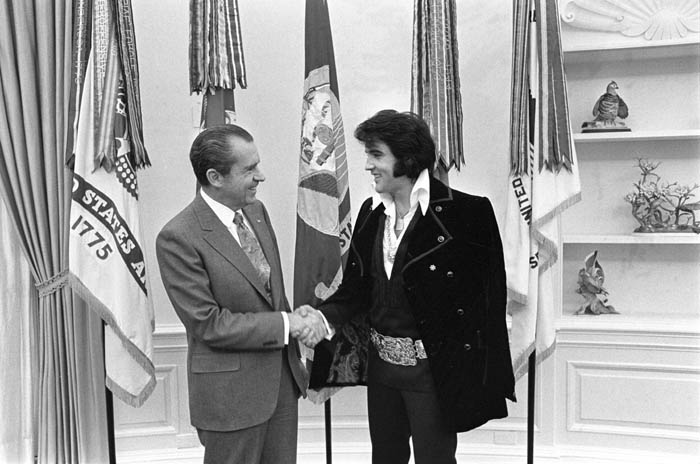
Forty years ago today, Elvis Presley showed up at the gates of the White House with two bodyguards and handed the guards a letter addressed to President Nixon. He said he knew the president was busy, but was hoping he could say a quick hello and present the president with a gift.

One can only imagine the flurry of astonished commentary in the White House when news arrived that Elvis wanted to drop in for a chat. An aide skimmed Elvis’s letter and sent a quick memo to Chief of Staff H. R. Haldeman. “The thrust of Presley’s letter is that he wants to become a ‘Federal agent at large’ to work against the drug problem. . . . Drug culture types, the hippie elements, the SDS, and the Black Panthers are people with whom he can communicate since he is not part of the establishment.” The aide warned that it would be a bad idea to push Elvis off on the Vice President, since “it will take very little of the President’s time and it can be extremely beneficial for the President to build some rapport with Presley.”

While the aide was right that Presley wanted a federal badge, the thrust of his letter was not that he could talk to members of the counterculture. The gist of his note was that, more than anything, he wanted legitimacy. Elvis wanted to achieve the American Dream—not to be rich and famous (although he certainly was), but to be respectable.

Elvis had been an enormously talented young man with pretty moderate ambitions, in part because his horizons were so limited that he couldn’t see beyond stability and respectability. He wanted to take care of his parents; he wanted a job and a nice house. When his career took off, he bought Graceland, and decorated it in the fanciest way he could imagine—not with fine antiques and expensive art, but with a wall of mirrors and a carpeted ceiling.

Elvis seemed to be the epitome of the American dream. And perhaps he was, but not in the way that concept is usually used. As Elvis’s career went upward, his control over his success sloped inversely downward. Elvis’s life made it clear that even a man with such superlative talent could never rise to security without an education and connections. He took his financial advice from his father, a man who went to jail for altering a $4 check. He took career advice from a manager who was taking 50% of his earnings by the time the singer died (the going rate was 10%) and who pushed him constantly to make more and more money. By 1970, Elvis’s talent had become a commodity over which he had little control. Rather than enabling him to achieve the American dream, his ability was destroying him. His grueling schedule had him increasingly dependent on prescription drugs, and his marriage was falling apart.

What Elvis wrote to Nixon was that he craved solid middle-class respectability. “I . . . admire you and have great respect for your office,” he wrote. Countercultural figures might call the president and his advisors “the establishment,” but “I call it American and I love it.” “I can and I will be of any service that I can to help the country out,” Elvis wrote. He and President Nixon had something in common, and the singer made sure to point it out: “I was nominated this coming year one of America’s Ten Most Outstanding Young Men,” “I believe that you, Sir, were one of the Top Ten Outstanding Men of America also.”

Well over a hundred of Elvis’s records had gone gold, platinum, or multi-platinum, but when Elvis met with President Nixon at 12:30, he felt obliged to explain to the president who he was. And he didn’t focus on his music; he focused on the law, respectability, family, government. The first thing the singer did was to show the president his collection of police badges. He gave President Nixon some Presley family photos and a commemorative WWII Colt 45, and warned him that the Beatles had been fomenting anti-Americanism.

Then, as the White House notes from the meeting relate:

“Presley indicated to the President in a very emotional manner that he was ‘on your side.’ Presley kept repeating that he wanted to be helpful, that he wanted to restore some respect for the flag which was being lost. He mentioned that he was just a poor boy from Tennessee who had gotten a lot from his country, which in some way he wanted repay. . . . At the conclusion of the meeting, Presley again told the President how much he supported him, and then, in a surprising, spontaneous gesture, put his left arm around the President and hugged him.”

Nixon’s people managed to get Presley a special badge from the Bureau of Narcotics and Dangerous Drugs. The badge was a symbol of what Elvis wanted, but it couldn’t give him the middle-class respectability that was at the center of his American dream. It couldn’t buy him the economic understanding that would enable him to rearrange his business affairs, or admission to a professional culture of lawyers and agents whose knowledge would protect him from his parasitic manager.

Ironically, it also couldn’t stop Elvis from dying of drugs only seven years later, sad proof that all the talent in the world could not produce success if it were not protected by education and connections.

Tuesday, December 21, 2010

Boston's Best Bookstore

Randall Stephens

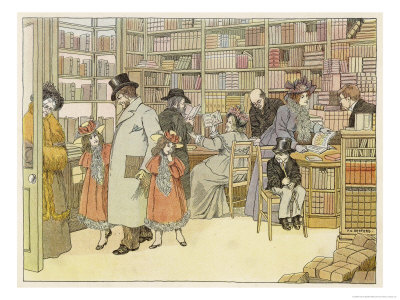
Coming to the 2011 AHA in Boston? Have a moment or two to spare? Check out the Brattle Book Shop, near the Downtown Crossing and Park Street T stops. The store is one of the oldest in the country and is brimming with books, old and new. Sections on 19th-century history, European studies, Asian history, New England history, religious history, African-American studies, ethnicity, political science, and on and on line what seem like miles of shelf space.

I’m particularly fond of the outdoor area, which contains thousands of books for as little as $1 to $5 each. (See the video I shot, embedded below.) That space is open all year round, only closing when it rains or snows. (After a long Boston walk with my border collie Beatrice, I’ll peruse titles until Bea begins to whimper out of sheer boredom.)

As Beatrice waits impatiently, I’ve been surprised by how many great history titles I’ve found outside. I’ve picked up books there by Allan Nevins, Oscar Handlin, Gordon Wood, Pauline Maier, Patricia Bonomi, and many more. Also, I’ve been happy to track down unusual 19th-century travel accounts, memoirs, primary source collections, and all manner of biographies.

Brattle Book Shop is real must-see for history bibliophiles!

I asked Ken Gloss, proprietor, about his store and what a history professor, grad student, or history enthusiast might find there.

Randall Stephens: What makes the Brattle Book Shop unique? What would you say are some of its most distinctive features?

Kenneth Gloss: The Brattle Book Shop can be traced back to the 1820s and it’s been in my family since 1949. It is a Dickensian-style store. The outside stands hold about 2,000+ books at $1, $3, and $5. We have two floors of general used books, and a third floor with rare books, 1st editions, leather-bound volumes, manuscripts, etc.

We go to estates throughout New England almost every day. It is like being Jim Hawkins on Treasure Island finding great books and libraries and then bringing them back to the shop.

You never know what is new to the shop on
any given day.

Stephens: What sort of clientele do you serve? Does the Brattle Book Shop have a typical customer?

Gloss: We have every type of customer you can imagine. We’ve got street people who buy from our $1 tables, collectors who spend large sums on rare letters, manuscripts, rare editions, and the customer who just wants a hard-to-find volume. They are young, old, male, female, regular, one-time, compulsive, and interesting. We have one customer who comes in every day and calls in sick when he cannot get in.

Stephens: Many historians that I know keep an eye out for that gem of a book. What sorts of books at Brattle would catch the eye of a historian on the lookout for a bargain or a rarity?

Gloss: We buy and put out books each day. Many of those are by amateur historians, professors, and writers. So you never know what will be on the shelves. That is what keeps people coming. There are also many, many bargains.

Monday, December 20, 2010

The New York Sun and other Newspapers at the Library of Congress

Heather Cox Richardson

Source material is springing up on the web so quickly that I find I miss important things. Still, how I missed this one is beyond me.

The Chronicling America project at the Library of Congress is putting American newspapers on-line. The collection so far has clearly been determined by something other than historical significance, but its quirks will be godsends for some historians. There are a host of papers from Arizona, for example, as well as Kentucky. Sadly, there are currently no newspapers from Maine—a pet peeve of mine, since Maine was a pretty crucial state for nineteenth-century politics, and the Kennebec Journal was an important newspaper that tends not to show up in libraries outside of Maine.

Anyway, some of these papers may not get much traffic, but there is at least one major draw. The project has put up much of the New York Sun. Edited by Charles A. Dana in the late nineteenth century, this paper was enormously important, but has been quite hard to find, at least on the East Coast.

The website is: http://chroniclingamerica.loc.gov/newspapers/

It’s worth a look.

Saturday, December 18, 2010

Visualizing Historiography

Dan Allosso

As a grad student preparing for Oral Exams, I spend a lot of time in a library carrel with piles of books. I’m trying to keep track of the connections between them, and simultaneously wondering how to think about historiography, for my particular project. Does it make more sense to trace the development of sub-disciplines like new social history? Or to group labor historians, regardless of the techniques they used? This question becomes even trickier, since the subject I’m exploring (American rural history) has much fuzzier edges than labor, or even than its own counterpart: urban history.

Nerd that I am, I naturally look to the computer for tools. I love Endnote, but it doesn’t really give me the note-taking and visual elements I want. So I’ve started using Tinderbox. It lets me extend the “post-it note on the plate-glass window” metaphor to extremes. But looking at the historiography visually has advantages.

I thought I’d draw American historiography as a tree (click image below to enlarge), so I’d be able to see how the different topics I’m tracing emerge like branches from a less differentiated body of earlier work. My reading list also includes a lot of iconic authors in the “trunk” area, but more single texts in the “leaves” area at the top. Time will tell, I suppose, which of the historians of the last three decades will emerge as “trunk” material. Or whether some of our current sub-disciplinary divisions will become permanent, leaving us without a single trunk at all.

The inclusion, placement, and arrangement of the authors and titles is completely arbitrary, of course, and represents my evolving ideas not only about how this material fits together, but about how it becomes meaningful to me. One of the interesting things I noticed, as I began building this list, was how much historiographies reflect the interests of their makers. The crowd of red on the left, for example, represents labor historians discussed in Francis G. Couvares, et. al., Interpretations of American History, which was one of my initial sources. I assume that, as I look at each of these authors, some will fall out of my tree. Similarly, as I continue reading environmental histories, I’ll be able to add more blue leaves to the tree, and make the appropriate connections between them.

The hidden advantage of Tinderbox is that all the content is XML, which means that it’s live and searchable. That means I can create agents that will sift all the pages behind these leaves, where I’ve attached my abstracts and reviews of these titles, ideas for my own writing, and even random notes. So it will be easy to see all the historians who’ve responded to Charles Beard or Frederick Jackson Turner, or all the books that discuss free banking or the agrarian myth.

The output side of this process is still a little sketchy in my mind. In the long run, I’d like to post something that would allow readers to navigate through the tree, and explore some of the material behind the leaves. But that’s several steps farther than I’ve gotten in exploring the software and refining my ideas. Thinking about output helps me grapple with the differences between learning this material myself, and communicating it to others--with taking what I’ve picked up on a personal journey through this material, and finding what’s relevant and interesting to other people.

Friday, December 17, 2010

50 Years of Counter-Counter-Subversion

Chris Beneke
.

Before the year ends, it may be worth noting that 2010 marks the fiftieth anniversary of a classic work in American history. In September 1960, a full tenure-cycle before the appearance of his classic tomes on slavery and abolitionism, David Brion Davis, published a modestly titled article in The Mississippi Valley Historical Review (today, The Journal of American History) called “Some Themes of Counter-Subversion: An Analysis of Anti-Masonic, Anti-Catholic, and Anti-Mormon Literature.” Perhaps overshadowed by the subsequent publication of Richard Hofstadter’s monumental The Paranoid Style in American Politics (1964), Davis’ little gem has been, and continues to be, profitably invoked by historians and non-historians alike.

A half century is a long-time for a publication with heavy interpretive implications to stay afloat in the roiling waters of American historiography. Most significant arguments from that long ago now rest under an ocean of dissertations and monographs. Occasionally they resurface—only to be unceremoniously dunked under again by a desperate graduate student. But “Some Themes” has remained buoyant even amid massive shifts of interpretive currents over the last five decades. Google Scholar alone counts 118 citations, many of them fairly recent.

Davis’ topic was antebellum hostility toward three outlier groups: Masons, Catholics, and Mormons, and he discovered conspicuous parallels in the structure of prejudice against them:

What distinguished the stereotypes of Mason, Catholic, and Mormon was the way in which they were seen to embody those traits that were precise antitheses of American ideals. The subversive group was essentially an inverted image of Jacksonian democracy and the cult of the common man; as such it not only challenged the dominant values but stimulated those suppressed needs and yearnings that are unfulfilled in a mobile, rootless, and individualistic society. It was therefore both frightening and fascinating. (208)

.

The themes of nativist literature suggest that its authors simplified problems of personal insecurity and adjustments to bewildering social change by trying to unite Americans of diverse political, religious, and economic interests against a common enemy. Just as revivalists sought to stimulate Christian fellowship by awakening men to the horrors of sin, so nativists used apocalyptic images to ignite human passions, destroy selfish indifference, and join patriots in a cohesive brotherhood. Such themes were only faintly secularized. (214)


My hunch is that Davis’ argument has avoided the twin perils of irrelevance and infamy because it presaged a discernible shift in the historiographical current. In particular, “Some Themes” provided early American historians with a handy, empirical point of access to the theory of The Other—the ubiquitous scholarly assumption that our understanding of self and community is always developed against imagined understandings of another (usually benighted and/or marginal) culture or people. In the five decades since, few ideas have exercised a more profound influence on historical interpretation. Davis’ article also captured the ideological spirit of the post-Red Scare academy, which has embraced the subversive and the counter-counter-subversive.

“Some Themes” had the additional virtue of not being overly burdened with clinical baggage. While Davis gestured toward mid-century concerns about identity formation and social anxiety, he was clearly more concerned with the cultural and political causes and manifestations of what is nowadays sometimes called “othering.” That too aligned his argument with late twentieth-century (at least post-1970s) historical study, which has never been comfortable with the essentialism of the psychological and philosophical foundations on which so much of it rests.

Thursday, December 16, 2010

Americanisms, Britishisms, and History

Randall Stephens

I approve Jefferson's word 'belittle' and hope it will be incorporated into our American DictionariesWe ought to have an American Dictionary: after which I should be willing to lay a tax of an eagle a volume upon all English Dictionaries that should ever be imported. -John Adams to Benjamin Rush, 1812

Jan Freeman recently wrote about British vs. American usage in the Boston Globe. "Just last month," she noted, "the Guardian’s David Marsh devoted his Mind Your Language blog to readers’ complaints about 'ugly Americanisms.' 'Recent examples include pony up, mojo, sledding, duke it out, brownstones and suck,' said one correspondent." I'd throw in dude as well.

Over at the Daily Mail, others complained about creeping Americanisms like "autopsy for post-mortem; burglarized instead of burgled; filling out forms instead of filling them in; fries for chips; chips for crisps; and food to go as opposed to take away." A tetchy lot, that.

It goes both ways, says Freeman. "Some Americans, it’s true, dislike some Britishisms — go missing and gobsmacked leap to mind—but few complainers, in my experience, object to (or even recognize) these terms as British. It’s their novelty or illogic or 'ugliness,' not their origin, that annoys."

I like Americanisms. I'll never say that so and so went "in hospital." I'll probably also never utter phrases like: "He’s doing my head in, he is"; "Know what I mean?"; or "Take a pew."

All this talk about British and American usage made me reach for my old worn copy of Americanisms: A Dictionary of Selected Americanisms on Historical Principles, edited by Mitford Mathews (Chicago, 1951, 1966). Language tells us something about the patchwork, polyglot quality of American history. America's peculiar words also shed light on westward expansion, national conflicts, political struggles, subcultures, and pastimes. (An interesting history class exercise might involve compiling a long list of words that are commonly used in the United States, which first appeared in dictionaries in the 19th century. Students could then track down the origins of the words.)

Mathews' dictionary includes Africanisms like "tabby," and a range of Native American and Mexican American words: tamale, incommunicado, schenectady, scuppaug . . .

Here's a collection of interesting entries.


Now I just have to figure out how to slip "skunkery" into a casual conversation with a Brit.

Wednesday, December 15, 2010

Myths of World War II: A Lecture

Donald Yerxa

Although some have questioned the health of the field of military history in today’s academy, there is no doubt that outstanding work is being done in military and naval history these days. A number of forums, essays, and interviews appearing in Historically Speaking over the past couple of years attest to this. And there has been outstanding work done especially on World War II.

I would like to alert readers of the blog to a major event in academic military history that will occur next month at the American Historical Association meeting in Boston. Gerhard L. Weinberg will give the Annual George C. Marshall Lecture on Military History (sponsored by the George C. Marshall Foundation and the Society for Military History) on Saturday, January 8, 2011, 5:00 PM-6:30 PM in Marriott Boston Copley Place’s Grand Ballroom Salon F. A reception will follow in nearby Grand Ballroom Salon E.

Weinberg, an emeritus professor of history at the University of North Carolina, is an internationally recognized authority on Nazi Germany and the origins and course of World War II. His lecture, “Some Myths of World War II,” will examine some widely shared myths of the war—ones pertaining to the war as a whole as well as some about individual leaders and groups of individuals. Included among the latter will be Adolf Hitler and his generals, Winston Churchill, Benito Mussolini, Josef Stalin, Franklin Roosevelt, and Yamamoto Isoroku. Weinberg’s talk will also touch on such issues as the Yalta Conference and the Morgenthau Plan. As the war recedes in time, much new information has become available, but certain myths enjoy a long life.

Brian Linn, the president of the Society for Military History and a frequent contributor to Historically Speaking, invites interested historians to attend the lecture and reception. It is a great opportunity to meet new people, talk about military history, and learn about what is going on in the field.

Tuesday, December 14, 2010

Regular People Read Erasmus Darwin?

Dan Allosso

Erasmus Darwin (1731-1802), the grandfather of Charles Darwin, was a full-time British physician who traveled an average of 10,000 miles a year to visit patients. He was a founder of the Lunar Society of Birmingham, and a prolific inventor. Zoonomia was Darwin’s major scientific publication and the leading medical/biological book of its day. Published in London in 1796, Zoonomia was reprinted the same year in New York, by “T. & J. Swords, printers to the Faculty of physic of Columbia College,” and again the following year by Thomas Dobson of Philadelphia. A “second edition” was published in 1803 by “Thomas and Andrews” of Boston. By 1818, a “Fourth American Edition” had been printed in Philadelphia, by Edward Earle. The continued popularity of Zoonomia over more than two decades suggests a wide readership outside of medical schools. The 1815 “Catalog of the Library of the United States” lists Zoonomia, The Botanic Garden, and Darwin’s posthumous poem, The Temple of Nature.

Like his grandson, Erasmus Darwin wrote about evolution through natural selection. Chapter 39 of Zoonomia, “On Generation,” presents Erasmus’ ideas on competition, extinction, and how “different fibrils or molecules are detached from . . . the parent . . . to form” the child. The Temple of Nature goes even farther, declaring “all vegetables and animals now existing were originally derived from the smallest microscopic ones, formed by spontaneous vitality” in ancient oceans.

When I was doing research in Ashfield, Massachusetts, I was surprised to find that six Ashfield children were named “Darwin” or “Erasmus Darwin” between 1803 and 1847. Erasmus Darwin never visited America, although he was a political radical, a friend of Benjamin Franklin and a supporter of American independence. Looking a little farther, I found there are at least sixty-three towns in Massachusetts where children were apparently named after Darwin before 1849! I also found 96 towns where there’s no record of a child named “Erasmus” or “Darwin” in the Vital Records (these two groups represent all the towns whose records I was able to find online).

It’s possible that a few of the children named “Erasmus” may have been named for the fifteenth-century humanist, or for remote family members (close ones would have showed up in the records I was searching). But I think most of them were named for the scientist, especially because in many cases the children are actually named “Erasmus Darwin.” So far, I’ve found no record of “Darwin” being a family name anywhere in early nineteenth-century Massachusetts, and Charles Darwin’s only significant publication before 1849 was his The Zoology of the Voyage of H.M.S. Beagle, published in 5 parts, 1838-1843. So there’s a high probability that a lot of people in Massachusetts thought highly enough of Erasmus Darwin to name a son after him.

In all, I found 112 children named “Erasmus,” “Erasmus Darwin,” “Darwin,” or, in a couple of cases, “Erastus Darwin.” But my initial search of Vital Record books available online missed 187 towns, whose records are not yet available electronically. After my PhD work is done, I’ll try to complete the map. In the meantime, I think it’s remarkable how widely read and apparently influential the works of Erasmus Darwin were in rural Massachusetts in the early nineteenth century!

(Green = places with a "Darwin"; Brown = places without; White = haven’t got to it yet)[See also Dan's sketches of these "Darwins" here.]

Monday, December 13, 2010

The Original Live-Blogging: On the Ground with Antinuclear Activists in 1979

Morgan Hubbard

Professionals of all stripes know that some workdays are better than others. Much of the historian's task is tedious and thankless—slogging through reams of records that may or may not be important for the puzzle she's looking to solve, or the argument she's looking to build. Some days end up being totally useless.

Some days, though, are windfalls.

The Alternative Energy Coalition was an alliance of anti-nuclear and environmental activists in New England in the late 1970s. The AEC, together with the better-known Clamshell Alliance, staged a series of “actions” against the Seabrook Station Nuclear Power Plant in eastern New Hampshire. Some were more intense than others, and a few made national headlines. When the AEC dissolved in the early 1980s—members moved to affiliated groups or dispersed—the organization's papers lay fallow. In the 2000s, they were given to the University of Massachusetts-Amherst Special Collections.

Many of the AEC's records are run-of-the mill: mostly catalogs, routine correspondence, heaps of newspaper clippings. But tucked into one folder, fastened unceremoniously with a single staple, was something remarkable, a historian's goldmine: a sheaf of papers on which AEC protesters had logged, hour by hour, the events of a massive blockade action at the Seabrook plant in October 1979. (Click on the image of the log to enlarge.) The document is special not only for the intensity of its scribbled notes (“8:30 a.m., police dogs and water hoses are visible. Action before noon.” “10:00. Verified macing and clubbing.”) It's special because it's a step closer to historical reality than historians can usually get.

Most of the time, we have to reconstruct the past obliquely. But documents like this allow us to witness the past almost as its participants did, play-by-play, on the ground. Obviously, there's much missing from a written account: the smell of teargas, the overhead chop-chop-chop of police helicopters, the fervency of a protest at the height of the anti-nuclear movement's momentum. But documents like this—a live-blogging before there was such a thing—demonstrate that with the right sources, we can recapture some of the potency and urgency of the past.

Friday, December 10, 2010

Books that Regular People Read

.
Today's post comes from Dan Allosso, a PhD student in history at the University of Massachusetts Amherst. He reflects on the bestsellers of ages past and what we can learn about regular people from the books they read.

Dan Allosso

Since historians rely heavily on written records of the past, they often wonder about the audiences of the literary subjects they study. And about the reading habits of people who didn't bother to preserve detailed narratives of their lives and thoughts. How many people (and which people) read Emerson's "American Scholar" essay, Ben Franklin's Autobiography, or Thomas Paine's controversial Age of Reason? We've all heard that Uncle Tom's Cabin was the best selling book of its time; how many people also read H. R. Helper's Impending Crisis?

Frank Luther Mott (1886-1964) is best known for his Pulitzer and Bancroft Prize-winning A History of American Magazines. He also wrote a book called Golden Multitudes: The Story of Best Sellers in the United States, in 1947. As the title suggests, Mott identifies about 324 books that were the biggest sellers of their day. This is extremely valuable, for people who want to know what regular folks in America were reading. It’s a little surprising that the library doesn’t contain a whole shelf-full of books like this, but Mott’s is the only one I’ve found so far.

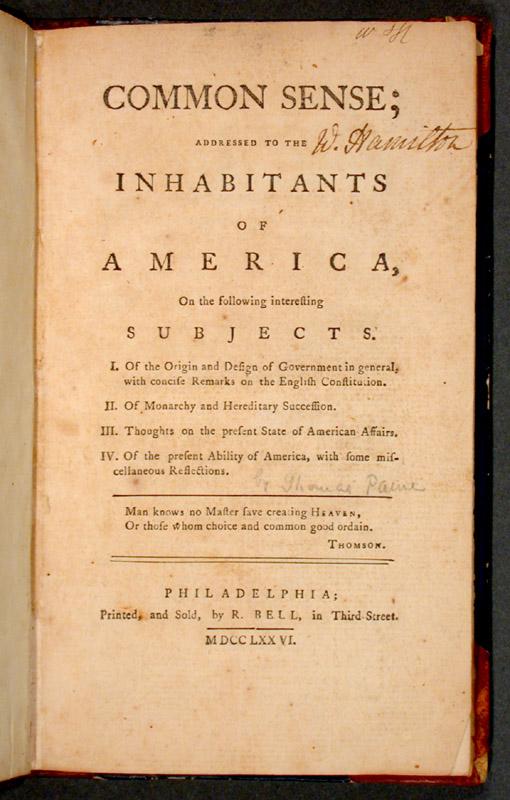
There are a lot of surprises in this book. For example, Thomas Paine’s Common Sense, the bestseller for 1776, is preceded by Lord Chesterfield’s Letters to His Son in 1775 and followed by Milton’s Paradise Lost (originally published in 1667) in 1777. In the early 1820s, people were buying a lot of Walter Scott and James Fenimore Cooper. They avidly read Washington Irving’s Tales of a Traveler and Sarah Josepha Hale’s Sketches of American Character; but not Timothy Dwight’s Travels in New England and New York. They did read George Bancroft’s History of the United States, but not as much as the delved into Jared Sparks’ Life of Washington or Daniel P. Thompson’s The Green Mountain Boys, published in the 1830s.

Possibly the most interesting thing about Mott’s list of American bestsellers is that nearly all of them are available “full-view” on Google Books (and now on Google ebooks). I think this is a game-changer for people interested in the past. We no longer have to depend on the judgment of previous scholars, who might have preferred Timothy Dwight over Sarah Hale, even though Hale was widely read in her time (and was the author of the nursery rhyme “Mary Had a Little Lamb”). Not that Dwight’s work doesn’t contain valuable material, but we no longer have to assume it gives us the best view of what interested people at the time. Using guides like Mott’s along with resources like Google, the Internet Archive, and Project Gutenberg, we may be able to better understand what regular people thought and cared about. This might tell us why Bellamy’s Looking Backward (1888) and Harvey’s Coin’s Financial School (1894) were so much more widely read (and influential?) in their day than Marx’s Capital (1889).