Friday, July 30, 2010

June Issue of Historically Speaking On-line

Randall Stephens

The June issue of Historically Speaking is now up at Project Muse. (We couldn't be more pleased with the terrific work the Muse people are doing. Readers can finally consistently read HS on-line. Scanning back issues is now in the works.)

The June issue includes a lively forum on Charles Joyner's classic Down by the Riverside. It also contains interviews and the usual fare of insightful essays.

In "The Art of History" popular historian Ian Mortimer throws down the gauntlet. Academic historians, in his estimation, don't care all that much about writing, narrating, and dramatic story telling. "Most professional historians do not understand the art of history," he asserts. "Quite what constitutes the 'art' seems to be the problem. Is it originality of thought, a distinct literary voice, innovative writing, sensitivity to public perceptions and assumptions about the past, or clarity of expression? Or something else entirely? Whatever the answer, these suggestions by themselves indicate that some of the activities associated with the 'art' do not figure prominently in university departments. Literary skill is almost always downgraded by academics to a supplementary role—supporting an analytical process but always subordinate to it. Originality is surprisingly rarely valued in academic circles: when it is most clearly displayed, it often proves to be the catalyst for its protagonist to be declared a 'maverick.' No historical departments (as far as I know) encourage their members to be sensitive to public perceptions and assumptions. Few historians have actively explored what drama, suspense, and literary conceits can add to a narrative. Creative writing is never discussed in historical journals, even though it is implicit in the very act of writing something new. All in all, historians seem generally oblivious to the basic fact that when expressing ideas about the past, the way one writes is as important as what one writes."

I disagree with Mortimer about some of these assumptions. Seems too broad a generalization, I think. Still I find it an interesting, provocative take. See Donald A. Yerxa's interview with Mortimer in the June issue for more on the subject.

Historically Speaking (June 2010)

"Two Historians on Defeat in War and Its Causes"
Peter Paret

"U.S. Expansion and the Woman Question, 1870-1929"
Allison Sneider

"Ian Mortimer: Making History More Meaningful to Society"

"The Art of History"
Ian Mortimer

"In Search of New Narrative Frameworks: An Interview with Ian Mortimer"
Conducted by Donald A. Yerxa

"Creolization in and Beyond Charles Joyner’s Down by the Riverside: A South Carolina Slave Community A Panel Discussion"

"Introduction"
David Moltke-Hansen

"Learning from Charles Joyner"
David Hackett Fischer

"The Influence of Down by the Riverside"
Sylvia R. Frey

"Two Journeys: Honoring Charles Joyner"
James Peacock

"Creolization, Decreolization, and Being 'at Home' in the Diaspora"
Stephanie J. Shaw

"Response"
Charles Joyner

"Writing Historical Crime Novels: An Interview with Jenny White"
Conducted by Donald A. Yerxa

"Prince Henry of Portugal and the Sea Route to India"
Anthony Disney

"Faith and the Founding of Virginia"
Lorri Glover

"Letters"
Stanley Sandlar
Vivian R. Gruder

"In Grateful Memory of Max Palevsky, 1924-2010"

Wednesday, July 28, 2010

History Book Reviews Reviewed, July/August 2010 edition

Chris Beneke

What follows is the first installment of a semi-regular update on historical reviews in the London Review of Books, The New Republic, The New York Review of Books, and other places that we bothered to look.

Jeffrey Rosen, “Why Brandeis Matters: The Constitution and the Crash” (TNR, July 22) Review of Melvin I. Urofsky, Louis D. Brandeis: A Life (Pantheon)

Writing admiringly of both book and subject, Rosen says that Urofsky’s “definitive,” “masterful” biography of the great supreme court justice is timely given Elena Kagan’s nomination to Brandeis’s Supreme Court seat and the rediscovery by progressives of “the virtues of judicial restraint.” Rosen is confident that Brandeis “would have predicted the crash of 2008.” (The bearish justice would have no doubt still preferred bonds, as he did in the 1920s, rather than credit default swaps on mortgage backed securities.) Rosen details Brandeis’s long-standing critique of concentrated financial power (“the curse of bigness”), his commitment to judicial restraint on most matters but “judicial vigilance” on the especially urgent matter of civil liberties, and his support for Zionism as both a complement to nationalism and a source of intra-national cultural vitality. The 2008 financial crisis figures centrally in this piece and Rosen builds on a distinction of Paul Krugman’s, positing the existence of two historically-informed schools of thought on financial reform: “the Jeffersonian-Brandeisians, who want to break up the big banks and prevent them from engaging in risky behavior, and the Hamiltonian neo-New Dealers, who prefer top-down government regulation.” Rosen suggests that the Jeffersonian-Brandeisians (like Paul Volcker) have gotten it right, but the Hamiltonian-New Dealers (like Lawrence Summers and Timothy Geithner) have gotten the votes. Urofsky’s biography is itself quite big. Given its hefty 955 page count, you might want to read Rosen’s longish review before taking the plunge. Or maybe even wait for Rosen’s own forthcoming book on Brandeis.

Anthony Grafton, “A Jewel of a Thousand Facets” (NYRB, June 24) Review of Lynn Hunt, Margaret C. Jacob, and Wijnand Mijnhardt, The Book That Changed Europe: Picart and Bernard’s Religious Ceremonies of the World (Belknap/Harvard); and, Hunt, Jacob, and Mijnhardt, eds., Bernard Picart and the First Global Vision of Religion (Getty Research Institute)

The two books reviewed here might be a good complement to Stephen Prothero’s hot-selling God is Not One (not mentioned by Grafton). Prothero’s conclusion that the world’s religion’s do not much converge is today’s contrarian position. That wasn’t the case in Bernard and Picart’s time. Grafton observes that the emphasis on the similarity of the world’s faiths was a subversive stance in the late seventeenth and early eighteenth centuries. Also subversive in that period: dense, weighty compilations of global knowledge like Religious Ceremonies of the World, and chatty, “ironic” footnote commentary on “orthodox inanities.” By detailing (in both print and image) the nuances of religions across the globe and by comparing the common forces underlying their different practices, Bernard and Picart injected sociological and anthropological substance into enlightened appeals for toleration. Though wondering what contemporary readers thought of Bernard and Picart’s Religious Ceremonies, Grafton is impressed by the collaborative, interdisciplinary effort that went into this two-volume project. He concludes that the authors “have done justice to a great work of eighteenth-century humanistic learning. And they have shown us some of the directions in which humanistic scholarship should move in generations to come: not only away from older narratives of intellectual change, but toward new models in which books and digital media, grand accounts and detailed inquiries shed light on one another.”

Bee Wilson, “Stuck with Your Own Face” (LRB, July 8) Review of Geoffrey Jones, Beauty Imagined: A History of the Global Beauty Industry (Oxford)

Beauty trends may rise and fall, but the beauty industry only rises. In 1916, roughly “four fifths of Americans used neither toothpaste nor shampoo, never mind mosturiser or deodorant, lipstick or hair gel.” Today, “[c]onsumers around the world spend ‘$330 billion a year on fragrances, cosmetics and toiletries’.” Scent was the first sense to be addressed by the broadly conceived category of beauty products. Salvaging the body from early modern street odors was not an easy job. Perfume helped. By the mid-nineteenth century, this early beauty product was sold in mass, factory-produced quantities, along with “‘the first factory-made, non-toxic mascara’.” Over time, manufacturers moved away from beauty products that poisoned their users and toward products adapted to the visual revelations of electric light. They also went global with products, such as skin-lightening creams, that changed or reinforced prevailing conceptions of race and personal attractiveness. The greatest of the beauty industry’s innovations, according to Wilson, may have been lipstick. It’s legitimation “over just a few decades [in the twentieth century] must have brought about one of the biggest changes to the appearance of the Western female body in history.” Wilson is generally pleased with the data that Jones offers. She is less impressed with his grasp of the “artifice” that has gone into the sale of these high-margin products with often questionable claims to effectiveness.

Sunday, July 25, 2010

American Character?

Sarah E. Igo reviews Claude S. Fischer's book Made in America in American Prospect, July 15, 2010. "A half-century ago," says Igo, "writing in the crucible of the early Cold War, American historians were convinced that something ran deep among U.S. citizens linking them to one another--a national personality or fundamental essence that made Americans American. . . ."

Igo isn't quite convinced. "Concerned as it is with the contours of American character as well as culture, it is hard to read Fischer's book as other than an argument for consensus history." Still she finds quite a bit to praise in this sprawling book.

Friday, July 23, 2010

History for the Public, or, Does the Center Hold?

Randall Stephens

NYU professor of history Thomas Bender's engaging on-line essay, "Historians in Public," at the SSRC has been making the rounds. He notes the worries of historians and social scientists, who think "that academic intellect has turned inward, cutting itself off from a role in public life."

Says Bender: "In the 1980s and 1990s instead of talk about and inquiry into “the public,” there was talk of publics, alternative publics, counter-publics, a black public sphere, and more. The list got pretty long, but the public dissolved in this otherwise invaluable historiography of the 1980s and 1990s. There was no United States. History was all parts, no whole. Bookstores organized American history by these identity-driven markets, often with no place for general histories. The challenge not taken up was how to narrate a whole made up of diverse and unequal parts. . . . Historians must bring the state back into relation to society, and along the way they need to rediscover the public. It will be, however, very different from [w]hat the early AHA . . . had in mind. And historians must make themselves a part of that public."

Unlike earlier calls for a unified history, this doesn't sound like a canon shot on the battlefield of the culture war. Though Bender's recommendations do bare some resemblance to those the late Arthur Schlesinger made in his 1991/1998 The Disuniting of America: Reflections on a Multicultural Society. Schlesinger's polemic makes what Bender writes look almost tame, though. And, of course, Schlesinger was writing about the nature and function of American identity.

Here's Schlesinger: "[P]ressed too far, the cult of ethnicity has had bad consequences too. The new ethnic gospel rejects the unifying vision of individuals from all nations melted into a new race. Its underlying philosophy is that America is not a nation of individuals at all but a nation of groups, that ethnicity is the defining experience for Americans, that ethnic ties are permanent and indelible, and that division into ethnic communities establishes the basic structure of American society and the basic meaning of American history." (Disuniting of America, 20-21.)

Tuesday, July 20, 2010

Their D-I-V-O-R-C-E: Mad Men, Infidelity, and Life in the 1960s

Randall J. Stephens

Some of us go around the world three times, divorce, remarry, divorce again, part with our children, make and waste a fortune, and coming back to our beginnings we find the same faces at the same windows, buy our cigarettes and newspapers from the same old man, say good morning to the same elevator operator, good night to the same desk clerk, to all those who seem, as Johnson did, driven into life by misfortune like nails into a floor.

-John Cheever, The Wapshot Scandal (Harper & Row, 1964)

The suburbs of New York City in the 1950s were a homogenous and extended community held together by common interests: children, sports, adultery, and lots of social drinking

-Susan Cheever, Home Before Dark: A Personal Memoir of John Cheever by His Daughter (Houghton Mifflin, 1984)

Frank could not escape the impression that she was asking him to get a divorce. Meanwhile, our advisory capacity in Vietnam was beginning to stink and the market was frightened, frightened yet excited by the expanding war. Basically business was uneasy with Kennedy; there was something unconvincing about him.

-John Updike, Couples (Ballantine Books, 1968)

Our D-I-V-O-R-C-E; becomes final today Me and little J-O-E will be goin' away I love you both and it will be pure H-E double L for me Oh, I wish that we could stop this D-I-V-O-R-C-E.

D-I-V-O-R-C-E, recorded by Tammy Wynette (1968)

More heavy drinking, more chain smoking, more prefeminist barbarity, more impeccably dressed businessmen, and woman. Mad Men, season 4, is kicking off on Sunday night.

Benjamin Schwarz wrote an insightful, appropriately skeptical piece on the series in The Atlantic back in the fall. Among other things Schwarz wondered about some of the over-the-top boorishness on display, condescending social commentary, and the overall historical accuracy of this "megamovie."

Watching the program, which I'll admit I'm a big fan of, has amazed and perplexed me. (How did the production crew get the colors and the tone just right? Scenes often look like staged advertisements from LIFE or Look Magazine.) Mad Men's interiors--wood paneling, ab-ex paintings, and sleek modernist surfaces--is as nearly as cool as the set of a Jacques Tati flick. The "lush styling and art direction," wrote Schwarz, "which make the series eye candy for its (again) target audience, already in thrall to the so-called mid-century-modern aesthetic—-an appeal that’s now further fueled by the slimline suit/pencil skirt marketing tie-in with Banana Republic, that canny purveyor of upper-mass-market urbanity."

How about the behavior, attitudes, and values of the characters? How does America in the early 1960s compare to America in 2010? The latter seems to be one of the chief questions the program raises. (At least for me, as a nerdy historian.) See, for instance, this John McWhorter piece from The New Republic, "Mad Men In a Good Place: How Did People Sound in 1963?" September 1, 2009. (Did they sound different after 1964? I'm wondering if a Beatles episode might feature Fab Four music. Doubtful. Would cost a fortune.)

And what about the infidelity on parade? Lead ad man Don Draper is a whiskey-soaked, feral Don Juan. Couples on the show occasional make fools of themselves in drunken revelry. Many of the chief men and women have had shaky relationships, boozing it up and forgetting their vows. One agent sleeps in his office after his wife discovers his alcohol-fueled, one-night stand with a secretary. Nearly all of the main male characters are unfaithful. Divorce, though not easy to obtain, is an ever-present option.

So what did the divorce rate look like in the swinging sixties? Brown University historian James Patterson notes that a significant rise in divorce rates seriously affected American families from the mid-sixties on. "Divorce rates per 1,000 of population doubled--from 2.5 per 1,000 people in 1965 to a peak of between 5 and 5.3 per 1,000 between 1976 and 1985."[1] Indeed, the divorce rate rocketed up 100% from '63 to '75. The current rate is 3.5 per 1,000 population.

What about infidelity? Is that more difficult to measure? David Gudelunas observes that we can gauge some national opinions by looking at letters to advice columnists. "The most frequent complaint from women in the 1960s was their cheating husbands," notes Gudelunas.[2] Polls and social science research from the day could also reveal much.

All that is to say that the show has made me more and more curious about how even the recent past can look decidedly strange, remote through the eyes of the present. Fun stuff.

On Sunday night when episode one of season four airs, I'll have my trusty DVD recorder at the ready. (A device, by the way, of pure science fiction by the standards of 1964.)

[1] James T. Patterson, Restless Giant: The United States from Watergate to Bush v. Gore (Oxford University Press, 2005), 50.

[2] David Gudelunas, Confidential to America: Newspaper Advice Columns and Sexual Education (Transaction, 2008), 112.

Sunday, July 18, 2010

Cincinnati Daguerreotype Time Machine, 1848

Randall Stephens

What if we could see, in vivid detail, the world of a mid-19th century American city? We can. Sort of.

On a sunny Sunday in September 1848, two clever daguerreotypists, Charles Fontayne and William S. Porter,
placed their camera on a rooftop next to the Ohio River. From Newport, Kentucky, they captured a sweeping panoramic view of Cincinnati. The massive, detailed image that resulted reveals a bustling western city. The original ranks as one of the Cincinnati Public Library's greatest treasures.

The huge picture contains amazing detail. (See the zoom-in from the YouTube clip embedded here.) Visible in the picture are open windows, a distant clock tower, merchants, free blacks, a railroad station, steamboats, factories, shops, and more. Combine all that visual evidence with the 1850-51 Cincinnati Directory, detail from local papers, booster works of the day, statistical reports, and a full picture emerges.

Wired magazine features the 1848 waterfront daguerreotype in its August 2010 issue. "The panorama could be blown up to 170 by 20 feet without losing clarity," writes Julie Rehmeyer. To reach that level of precision a digital camera version would have to record a staggering 140,000 megapixels per shot. The total stitched-together panorama contains nearly 9-billion pixels. Rehmeyer describes the restoration and stabilization of the plates through the latest technology. Her explanation of the daguerreotype (the latest technology of that day) gives a good sense of how this all worked.

The Cincinnati Library intends to make a zoomable version available on-line next year. Until then, see The University of Rochester and George Eastman House, which has a 180mb version of one part of the Cincinnati Waterfront image on-line. (Warning: That's a massive file.)

I wonder if the zoomable version will be available by the next time I teach my course on American history from 1783-1865. I can see pairing this image up with primary and secondary source materials. Students might answer questions about how the panorama confirms or challenges the reading. What can we learn from the visual record that we can't learn from print? What does the look, design, layout of an America city tell us about this age?

As far as a selection from a primary source . . . any of these would work: James Handasyd Perkins, Annals of the West: Embracing a Concise Account of Principal Events . . . (1852), Charles Cist, The Cincinnati Miscellany (1846), or Eliza R. Steele, A Summer Journey in the West (1841). On the secondary source side: Daniel Walker Howe, What Hath God Wrought: The Transformation of America, 1815-1848 (Oxford, 2007), Leo Damrosch, Tocqueville's Discovery of America (Farrar, Straus and Giroux, 2010), or David S. Reynolds, Waking Giant: America in the Age of Jackson (Harper Perennial, 2009).

Thursday, July 15, 2010

Dog History Days of Summer

Randall Stephens

Dogs are our link to paradise. They don't know evil or jealousy or discontent. To sit with a dog on a hillside on a glorious afternoon is to be back in Eden, where doing nothing was not boring--it was peace. -Milan Kundera

The dog was created specially for children. He is the god of frolic. -Henry Ward Beecher

To his dog, every man is Napoleon; hence the constant popularity of dogs. -Aldous Huxley

The more I see of man, the more I like dogs. -Mme. de Staël

Lately I've been on some history walking tours of Boston, accompanied by my dog, Beatrice. She's a border collie. Very smart.

Where to take a brainy dog in Boston? Recently I learned that dogs are welcome at the Boston Athenæum, "one of the oldest and most distinguished independent libraries and cultural institutions in the United States." That stately, some would say wicked stuffy, institution is trying to recruit younger members. (By young, I think they mean anything south of 70).

Young and old love dogs. I suppose the dog friendliness at the Athenæum dates back to the 19th-century Beacon Hill brahmin dog enthusiast, who wanted to bring his Borzoi to the library. Here's the official policy: "Members are allowed to bring a well behaved dog on a leash into the Athenæum. Pets are NOT permitted, however, in the Norma Jean Calderwood Galleries or the Recent Acquisitions Gallery at any time."

Kelly Baker lists some summer reading over at Religion in American History. Here are some good dog history and behavior books well worth checking out. Beach reading for the dog days of summer.

Marion Schwartz, A History of Dogs in the Early Americas (Yale, 1997).

Stanley Coren, The Pawprints of History: Dogs and the Course of Human Events (Free Press, 2003).

Michael G. Lemish, War Dogs: A History of Loyalty and Heroism (Potomac Books, 1999).

Bruce Thomas Boehrer, Animal Characters: Nonhuman Beings in Early Modern Literature (UPenn, 2010).

Katharine M. Rogers, First Friend: A History of Dogs and Humans (St. Martin's, 2005).

Katherine C. Grier, Pets in America: A History (North Carolina, 2006).

Temple Grandin and Catherine Johnson, Animals in Translation: Using the Mysteries of Autism to Decode Animal Behavior (Simon and Schuster, 2005).

Virginia DeJohn Anderson, Creatures of Empire: How Domestic Animals Transformed Early America (Oxford, 2006).

Douglas J. Brewer, et al., Dogs in Antiquity: Anubis to Cerbrus the Origins of the Domestic Dog (Aris & Phillips, 2002).

Tuesday, July 13, 2010

On Editing a History Blog

John Fea

I am glad that Randall Stephens asked me to write something about my short blogging career. With the exception of a presentation I gave recently to a few faculty and staff at Messiah College, I have never thought systematically about what I do at
The Way of Improvement Leads Home. I am grateful for the opportunity to post some of the ideas about blogging that have been swishing around in my head during the last couple of years.

I wrote my first comment on a blog in July 2007. It was posted at Paul Harvey's brand new
Religion in American History. Within a week or so I was his first "Contributing Editor." I owe much of my blogging career to Paul. His vision for a blog that would combine opinion, news from the profession, historical reflection on current events, and new research seemed to be a wonderful outlet for my rather eclectic interests in American history, religious history, and academic life. I wrote a lot of posts for Religion in American History during that year when RiAH picked up a Best New Blog award from HNN. I found that blogging satisfied my itch for engaging new ideas in the context of religion and American history.


In June of 2008 I decided to start my own blog. My first book, The Way of Improvement Leads Home, appeared a few months earlier and a publicity editor at Penn Press suggested that a blog might be a useful way to promote it. After having blogged with Paul for a year, I was now feeling pretty comfortable with the genre and format and thought that a blog, named after the title of my book, might help me branch out a bit beyond American religious history.


If you go back and look at some of the early posts at The Way of Improvement Leads Home you will notice that I tended to focus almost exclusively on the book and the life of its subject, the virtually unknown eighteenth-century diarist Philip Vickers Fithian. Eventually I began adding posts on other dimensions of early American history, Christianity and religious history, academic life, politics, and the occasional post about Springsteen, writing sheds, and speaking engagements.


I guess you could say that the turning point of my experience was a post I wrote about two hours after Sarah Palin was chosen as John McCain's running mate in the summer of 2008. “Does Sarah Palin Speak in Tongues" drew over 1000 hits in a six or seven hour period. I think I may have been the first person in the blogosphere to write something—anything—about Palin's Pentecostal background. I cross-posted the entry over at Religion in American History and I think it still may be the most visited post on that blog.

After the Palin incident, my readership stabilized a bit, but from that point forward it has remained pretty steady. On a good day I get several hundred visits. While this is a far cry from the Daily Dish or the Huffington Post or Religion in American History, I think it is still pretty good for a blog that engages the kinds of things that interest me as a historian and a Christian. At the end of 2009 I began blogging daily—a task that requires me to take about an hour a day to read (or in some cases skim) a host of different Internet sites. I usually write my blog posts early in the morning and post them on the site throughout the day.

I am often asked about my target audience at The Way of Improvement Leads Home. To be honest, I am not sure that I have one. Some posts I write for my family and friends just to let them know what I am doing with my life. Others I write with fellow professors or academics in mind. Others I write with my students in mind. We recently celebrated our second anniversary at The Way of Improvement Leads Home and over those two years I have developed a very loyal readership that includes college students, graduate students, professors, clergy, and all kinds of everyday folk. Hard-core academics will probably find the blog a bit light, but I am not writing for hard-core academics. I target most of my posts with an average history teacher or college-educated reader in mind.

I seldom discuss my personal life on the blog, although I have no hard and fast rule about NOT discussing my personal life. (When I have discussed my personal life I get lots of encouraging e-mails and Facebook notes). I do, of course, occasionally offer my opinion on things, but I think that most of the time the topics and articles that I post and engage with say more about me than any random opinion I might offer. I guess you might call The Way of improvement Leads Home a blog that sits somewhere between the personal and the professional.

I think it is also worth mentioning that I started the blog after I got tenure. I just felt more comfortable doing it that way. I also benefit from the fact that I teach at a liberal-arts college that encourages me in my work as a blogger. I have added my blog to my c.v. and might even be willing to make an argument for having it count for tenure and promotion as a form of public scholarship or professional service.

I am always looking for good ideas for the blog, especially stuff for my "So What CAN You Do With a History Major" and my "Places" feature. If you are attending a conference related to some of the themes of the blog and want to serve as a correspondent, please let me know. I would love to have you contribute something. Guest posts are always welcome. I also hope that some of you might connect with the blog through Facebook or via Google.

I am not sure how long I will be blogging, but I don't see myself stopping anytime in the immediate future. It does take time and occasionally takes me away from other projects, but one of the things I like about blogging is that it provides a nice little break from my other work. Sometimes it only takes just 15 minutes or so to get a quick post "up" at The Way of Improvement Leads Home. This makes it easier to keep the blog active and keep my readers coming back.

If you are interested in blogging I would be more than happy to share whatever I have learned. Feel free to drop me a note.

Thursday, July 8, 2010

Publishing Mark Twain's Long-Awaited Autobiography

Randall Stephens

W. D. Howells wrote his long-time friend Mark Twain: "I wonder why we hate the past so?" Twain snapped back "It's so damned humiliating." Mark Twain had a few choice things to say about history.

"I said there was but one solitary thing about the past worth remembering, and that was the fact that it is past-can't be restored."*

Elsewhere he paraphrased Herdotus: "Very few things happen at the right time, and the rest do not happen at all. The conscientious historian will correct these defects."


Twain was a cynic. A very funny one at that. His views on religion were so volatile in his day--and he feared enough for his own reputation and for that of his immediate family--that he chose not to air them. Though a skeptic, he made observations like this: "All that is great and good in our particular civilization came straight from the hand of Jesus Christ." The bloody theology of Christianity along with its particularity, in his view, was repulsive. He confided to his notebook in 1896: "If Christ was God, He is in the attitude of One whose anger against Adam has grown so uncontrollable in the course of . . . If Christ was God, then the crucifixion is without dignity. It is merely ridiculous, for to endure several hours."

In the autobiography he worked on, Twain meditated on religion, writing, the West, his acquaintances, and more. (See the PBS Newshour segment on the autobio embedded here.)

The editors of the Mark Twain Project at Berkeley have their hands full. The projects website explains:

Housed in the midst of the archive is the Mark Twain Project, a major editorial and publishing program of The Bancroft Library. Its six resident editors are at work on a comprehensive scholarly edition of all of Mark Twain's private papers and published works. More than thirty of an estimated seventy volumes in The Works and Papers of Mark Twain are currently available, all published by the University of California Press.

Twain stipulated that the autobiography could be published one-hundred years after his death. "He used the autobiography as a chance to disburden himself of a lot of feeling," says Benjamin Griffin in the Newshour piece. "He left this out of the final version of the autobiography." For example, as a staunch anti-imperialist, Twain took aim at Teddy Roosevelt for his role in the massacre of Filipino guerrillas during the Spanish-American War.

"[Roosevelt] knew perfectly well that to pen 600 helpless and weaponless savages in a hole like rats in a trap and massacre them in detail during a stretch of a day-and-a-half from a safe position on the heights above was no brilliant feat of arms. He knew perfectly well that our uniformed assassins had not upheld the honor of the American flag."

I look forward to reading the completed version. (Or at least thumbing through it.) Not a light read, I'm sure.

Wednesday, July 7, 2010

Lowenthal, "The Past WAS a Foreign Country," HNN

Randall Stephens

Over at HNN David Lowenthal responds to my piece, "The Past Is No Foreign Country." He uses it as a launching point for a larger discussion about the ways presentism continues to plague our culture. (He also describes the revised version of his classic book.) Lowenthal points out, as John Fea did too, that "flagrant presentism is no right-wing monopoly." Right on. I put too fine a rhetorical point on that in my essay.

"The Past WAS a Foreign Country"
By David Lowenthal

David Lowenthal is Professor Emeritus of Geography at University College London

Randall Stephens [The Past Is No Foreign Country, HNN, June 28, 2010] commends my The Past Is a Foreign Country (Cambridge, 1985) for tracing post-Renaissance awareness of the past’s difference. He chides Glenn Beck and likeminded conservative ideologues "incapable of coming to terms with change over time" for ignoring that difference. But flagrant presentism is no right-wing monopoly; it now suffuses all popular culture, from evangelical biblical literalists and strict constitutional constructionists to bleeding-heart apologists for ancestral iniquities from slavery to sexism to class hierarchy. In appropriating the past, partisan heritage domesticates it by purging or bowdlerizing its unpalatable oddness. Discussing the Victorians in Virginia Woolf’s Between the Acts, old Mrs Swithin says, "I don’t believe that there ever were such people, only you and me and William dressed differently." Like Mrs. Swithin, we don’t believe in history.>>>

Tuesday, July 6, 2010

Archeology Roundup

Judy Siegel-Itzkovich, "Long time archaeological riddle solved," Jerusalem Post, July 2, 2010

The riddle of the identity of a 3,200-year-old round bronze tablet with a carved face of a woman has apparently been solved, 13 years after it was discovered at the El-ahwat excavation site between Katzir-Harish and Nahal Iron (Wadi Ara) by scientist Oren Cohen of the University of Haifa.

The small, broken-off piece of metal is probably part of a linchpin that held the wheel to a war chariot sent to battle by the Canaanite general Sisera against the Israelites, says Prof. Adam Zertal, who for 33 years has led weekly walks with university colleagues and volunteers over “every square meter” of Samaria and the Jordan Rift to search for archeological evidence from biblical times.>>>

"2000-year-old human skeleton found at Gloucestershire Roman villa dig," This Is Gloucestershire, July 5, 2010

A 2,000-YEAR-OLD human skeleton has been unearthed alongside Iron Age artefacts near Tewkesbury.

Archaeologists uncovered signs of the ancient Roman villa in a field on the edge of Bredon's Norton. It is thought the finds could be of national importance.

Metal detector hunts in recent years had led historians to suspect an ancient community might be found there.

That was confirmed when contractors who were laying a new water pipeline began digging.>>>

"Female 'gladiator' remains found in Herefordshire," BBC, July 1, 2010

Amongst the evidence of a Roman suburb in Credenhill, they have found the grave of a massive, muscular woman.

The archaeological Project Manager, Robin Jackson, said: "Maybe the warrior idea is one that you could pursue, I'll leave that to people's imaginations."

Her remains were found in a crouched position, in what could be a suburb of the nearby Roman town of Kenchester.>>>

Nicole Winfield, "Lasers uncover first icons of Sts. Peter and Paul" AP, June 22, 2010

ROME — Twenty-first century laser technology has opened a window into the early days of the Catholic Church, guiding researchers through the dank, musty catacombs beneath Rome to a startling find: the first known icons of the apostles Peter and Paul.

Vatican officials unveiled the paintings Tuesday, discovered along with the earliest known images of the apostles John and Andrew in an underground burial chamber beneath an office building on a busy street in a working-class Rome neighborhood.>>>

Dinesh Ramde, "Chilly waters preserve 1890s shipwreck well," San Francisco Chronicle, June 25, 2010

A great wooden steamship that sank more than a century ago in a violent Lake Michigan storm has been found off the Milwaukee-area shoreline, and divers say the intact vessel appears to have been perfectly preserved by the cold fresh waters.

Finding the 300-foot-long L.R. Doty was important because it was the largest wooden ship that remained unaccounted for, said Brendon Baillod, president of the Wisconsin Underwater Archaeology Association.>>>

Thursday, July 1, 2010

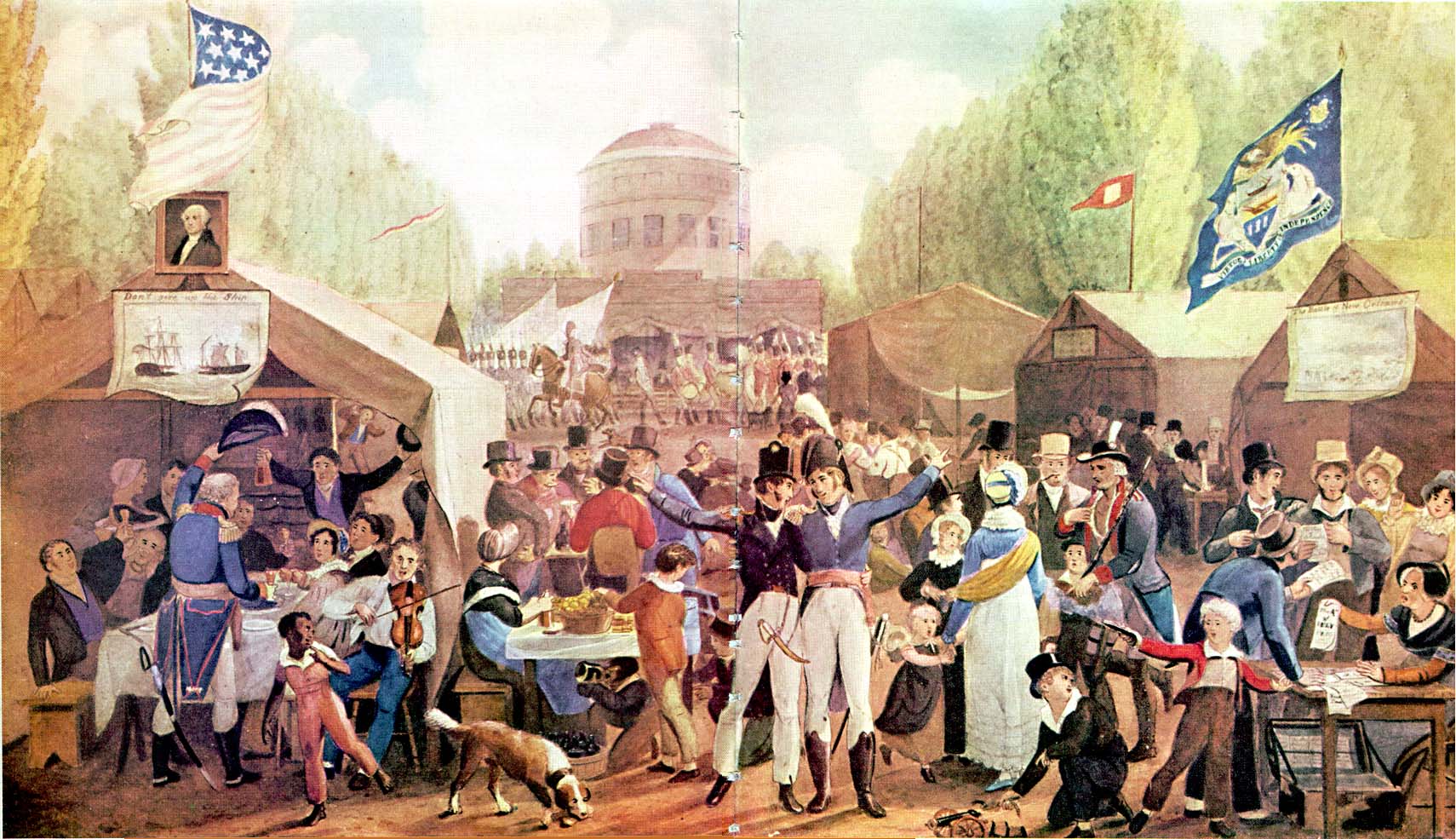
July 4, 1826

Randall Stephens

It was fifty years to the day after the 13 colonies declared independence from Great Britain.

President John Quincy Adams wrote in his diary about the festivities in Washington. "The volunteer companies assembled on the square," he observed, "fronting the house and paid the passing salute by marching through the yard."

Arriving at the door of the Capitol, I was there met by Mr. Anderson, the Comptroller, with whom we entered the hall of the House of Representatives. The Reverend Mr. Ryland made an introductory prayer.

Joseph Anderson, the Comptroller, read the Declaration of Independence; Walter Jones delivered an oration commemorative of the fiftieth anniversary; the Reverend Mr. Post, Chaplain of H. R. U. S., made a concluding prayer.


After which, Governor Barbour delivered an address to the citizens assembled, soliciting subscriptions for the relief of Mr. Jefferson. . .

News traveled slowly over bad roads. Members of congress knew of Jefferson's troubles, but the severity of his situation was unclear. Few could have guessed that Jefferson's one-time rival and on-again/off-again friend John Adams was also in his last throes. Thomas Jefferson and John Adams died on that hot July day.

Four days later John Quincy received a batch of letters. One brought bad news. A missive "from my brother, written on the morning of the 4th, announcing that, in the opinion of those who surrounded my father's couch, he was rapidly sinking; that they were sending an express for my son in Boston, who might perhaps arrive in time to receive his last breath. The third was from my brother's wife to her daughter Elizabeth to the same purport, and written in much distress." On his way north to Boston, while in Waterloo, MD, he heard that his father had died. It was July 9th. He was stricken with grief. "My father had nearly closed the ninety-first year of his life," he confided to his diary, "a life illustrious in the annals of his country and of the world."

He had served to great and useful purpose his nation, his age, and his God. He is gone, and may the blessing of Almighty Grace have attended him to his account! I say not, May my last end be like his!—it were presumptuous. The time, the manner, the coincidence with the decease of Jefferson, are visible and palpable marks of Divine favor, for which I would humble myself in grateful and silent adoration before the Ruler of the Universe. For myself, all that I dare to ask is, that I may live the remnant of my days in a manner worthy of him from whom I came, and, at the appointed hour of my Maker, die as my father has died, in peace with God and man, sped to the regions of futurity with the blessings of my fellow-men.

Plenty of Americans in 1826 had something to say about the death of two lions of the Revolution. Prone to view the world through the eyes of faith, and to read signs in the sky and on the ground, newspaper editors, clergy, and laypeople were astounded. On July 11 the Massachusetts Salem Gazette lamented "We know not in what language to express ourselves in announcing . . . another event which has transpired to render the late glorious anniversary, the national jubilee, in some respects the most memorable day in the history of our country." That was no hollow encomium. It rang true across the young nation. The New York Commercial Advertiser rhapsodized: "it seems as though Divine Providence had determined that the spirits of these great men, which were kindled at the same altar, and glowed with the same patriotic fervor . . . should be united in death, and travel into the unknown regions of eternity together!"

Some years back Margaret P. Battin wrote in Historically Speaking about the strange coincidence of Jefferson's and Adam's deaths on the same day. "Although the fact that Adams and Jefferson died the same day is taught to practically every schoolchild, asking why is not," Battin noted. "What could explain this? There are at least six principal avenues to explore, but all of them raise further issues." She then offered some of the explanations given over the ages for their demise on that same anniversary.

It makes me wonder about the comparison and contrast between our age and the beginning of the Jacksonian era. Do Americans now have similar ideas linking nation, patriotism, and providence? Do Americans esteem their leaders and the political giants of our day in any way like they did 184 years ago? How have citizens understood God and country from one era to the next?