Tuesday, March 30, 2010

A Search Engine a Historian Can Love

My friend Alan Bliss forwarded the following BBC tech story to me. (Alan, congrats on your dissertation defense at UF!)

"Search Engine Collects Historical Resources," BBC News, March 23, 2010.

A search engine is being created to help historians find useful sources. The Connected History project will link up currently separate databases of source materials.

Once complete, it will give academics or members of the public a single site that lets them search all the collections.


Once completed the search engine will index digitised books, newspapers, manuscripts, genealogical records, maps and images that date from 1500-1900.
>>>

Wednesday, March 24, 2010

Roundup: Maps through Time

Randall Stephens

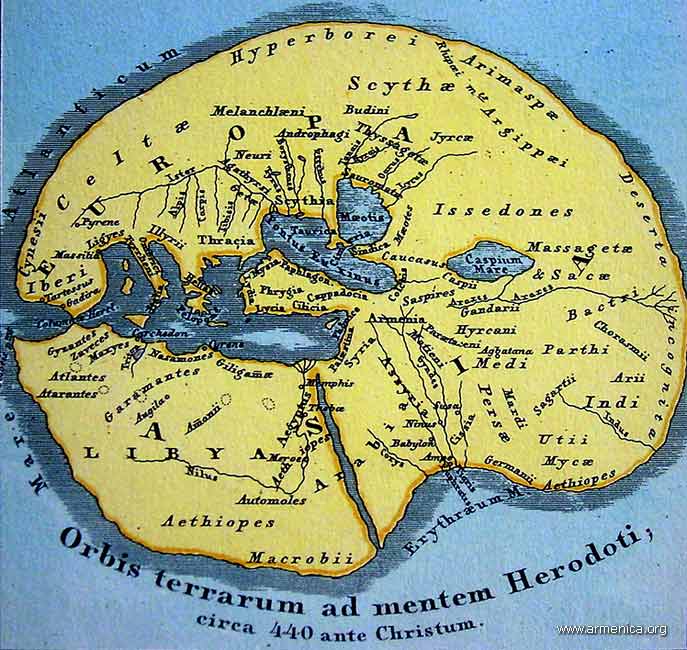
What better way to learn about the past, and what people once made of the world around them, than to study maps? A few days ago I read a fascinating passage in Herodotus: "If, therefore, I judge correctly of these things, the Ionians are mistaken with respect to Egypt; but if their opinion is correct, then I will show that neither the Greeks nor the Ionians themselves know how to reckon, when they say that the whole earth consists of three divisions, Europe, Asia, and Libya; for they ought to add a fourth, the Delta of Egypt, if it be not a part either of Asia or of Libya." A wonderful picture of the world.

I post here some wonderful recent on-line articles dealing with history, cartography, and cultural context. (One piece in particular got me thinking about an iPhone app I'd like to see. How about an interactive historical, walking map of 18th-century Boston? Strolling around the city, the iPhone-toting flaneur would notice that he would be under water were he at this or that place in 1770.)

Michael Church, "The Truth about Maps: How Cartographers Distort Reality," The Independent, March 20, 2010.

As a fascinating new exhibition shows, it's not always what they put in that matters – but what they leave out

What is a map? In effect, says Peter Barber, head of maps at the British Library, a map is a lie. "Unless you have a scale of one-to-one, every map is subjective, and always will be," he explains. "You have to select what you put on it." And selection involves rejection.

Throughout history, such lies have generally served purposes which have been political, religious or philosophical rather than scientific. >>>

Shirley Dent, "Literary London on your iPhone," Guardian Books Blog, March 23, 2010

A new iPhone application which brings the capital's literary heritage to life has made me a hazard on the streets of London. >>>

Cora Lewis,"Maps and Manuscripts Illustrate an Old Worldview," Yale Daily News, March 23, 2010

Napoleon Bonaparte famously had his men re-draw the world’s map to make France larger, but he wasn’t the only historic figure who tried to alter the public’s perceptions with cartography.

“Invented Bodies: Shapely Constructs of the Early Modern,” now on view at the Whitney Humanities Center, features maps and manuscripts from the 15th through 18th centuries, depicting Europeans’ interpretations of their world — from realistic renderings to fantastical imaginings. >>>

Steven Heller, "The World as Their Canvas," New York Times, March 5, 2010

There’s nothing like sitting by the fire with a good book, except maybe sitting by the fire with a good map—or better yet, a good book about maps. I’ve noticed an upsurge in cartographic interest these days, especially for maps’ value as conceptual artwork. >>>

Michael Elliott, "A World Map Under Eastern Eyes," Time, February 25, 2010

What does China really think of the U.S.? Spend some time in the Middle Kingdom, and you'll hear both protestations of admiration and plenty of disparaging comments about the West. Such attitudes have a long history. In 1602 the imperial Chinese court learned that the inhabitants of North America were "kindly and hospitable to strangers." >>>

Sunday, March 21, 2010

Some Historical Perspectives on National Healthcare

Randall Stephens

Teddy Roosevelt campaigned on health care in his 1912 Progressive Party bid for the presidency. Makes sense. He needed a little medical assistance after surviving a gunshot wound/assassination attempt in Milwaukee: "Friends, I shall ask you to be as quiet as possible. I don't know whether you fully understand that I have just been shot; but it takes more than that to kill a Bull Moose. . . . The bullet is in me now, so that I cannot make a very long speech, but I will try my best."

The Progressive Party platform of 1912 declared: "We favor the union of all the existing agencies of the Federal Government dealing with the public health into a single National health service without discrimination against or for any one set of therapeutic methods, school of medicine, or school of healing with such additional powers as may be necessary to enable it to perform efficiently such duties in the protection of the public from preventable diseases as may be properly undertaken by the Federal authorities . . ."

Two decades later FDR seemed to have thought a national health bill was one bill too many for his already ambitious alphabet soup initiatives.

It then fell to FDR's accidental successor to give it a go. "In my message to the Congress of September 6, 1945, there were enumerated in a proposed Economic Bill of Rights certain rights which ought to be assured to every American citizen." So began President Harry Truman's address to Congress on November 19, 1945.

One of them was: "The right to adequate medical care and the opportunity to achieve and enjoy good health." Another was the "right to adequate protection from the economic fears of . .. sickness ...."

Millions of our citizens do not now have a full measure of opportunity to achieve and enjoy good health. Millions do not now have protection or security against the economic effects of sickness. The time has arrived for action to help them attain that opportunity and that protection. . . .

Our programs for public health and related services should be enlarged and strengthened. The present Federal-State cooperative health programs deal with general public health work, tuberculosis and venereal disease control, maternal and child health services, and services for crippled children. >>>

Didn't work out. Some Republicans equated it with communism and the American Medical Association came out against it.

Indeed, longstanding opposition to federal involvement in health care squelched most efforts. The American Medical Association again stood firm against Lyndon Johnson's landmark 1965 health insurance program. The AMA's chief players backed Barry Goldwater's 1964 campaign, making their criticism loud and clear. The AMA fiercely opposed Medicare. And in the early 1960s, Ronald Reagan warned that after the passage of such a national program, "We will awake to find that we have socialism."

Calvin Woodward offers some useful historical context on the current battle in the Sunday LA Times.

To history, it is likely to be judged alongside the boldest acts of presidents and Congress in the pantheon of domestic affairs. Think of the guaranteed federal pensions of Social Security, socialized medicine for the old and poor, the civil rights remedies to inequality.

Change is coming, it now appears, but in steps, not overnight. . . .

In contrast, on June 30, 1966, after a titanic struggle capped by the bill signing a year earlier, President Lyndon Johnson launched government health insurance for the elderly with three simple words, as if flicking a switch: "Medicare begins tomorrow." >>>

See also: the Boston Globe's (Associated Press) rather interesting timeline of health care legislation; A PBS timeline from Healthcare Crisis; and Jonathan Chait, "Health Care Reform And History," TNR, March 19, 2010.

Monday, March 15, 2010

“I am almost coming to the conclusion that all histories are bad"

Randall Stephens

What's not to like a about collections of private letters? (Well lots, if you think they are boring, tedious, self-serving, etc.) I almost always enjoy reading the letters of novelists, historians, critics. Collections of letters, like memoirs, make for good reading. You can tell a great deal about an author’s opinions by reading his/her intimate thoughts on all manner of subjects. Often, the more unrestrained the letter writer is, the more interesting the letter.

I recently came across passages on history in the collected letters of two of the most famous authors of the 20th century. Flannery O’Connor makes a passing reference to C. Vann Woodward, while disparaging much of southern historical writing. High praise, indeed, to have O’Connor’s stamp of approval.

Flannery O’Connor to "A," May 25, 1963, Sally Fitzgerald, ed., The Habit of Being: Letters of Flannery O'Connor, pp. 521-22.

I have taken up with reading C. Vann Woodward. Have you ever read this gentleman—Burden of Southern History is what I have but I intend to order off after more. Southern history usually gives me pain, but this man knows how to write English.

C. S. Lewis is far more pessimistic about the history trade. A young fellow of Magdalen College, Oxford, Lewis, at least in this 1927 letter to his brother, has little patience for historians. Historians, he laments, typically fail to capture the truth of experience. Lewis’s meditation on “fact” sounds a little like E. H. Carr on the same. Though Lewis is here writing more than three decades before Carr.

Letters like this, though, often reflect the thoughts of a writer in the moment. They are like a snapshot, not a meticulously painted landscape.

C. S. Lewis to his brother, December 12, 1927, in Walter Hooper, ed., The Collected Letters of C. S. Lewis: Family Letters, 1905-1931, 741.

I am almost coming to the conclusion that all histories are bad. Whenever one turns from the historian to the writings of the people he deals with there is always such a difference. What is in my mind at present is (on the one hand) Beowulf and Alfred and the Sagas, and (on the other) Gibbon and Oman about 'the barbarians'. What common measure is there between 'Odoacer had alienated the sympathies of his Italian subjects by seizing a third of the land to reward his veterans' and 'Oft Scyld Scefing overthrew the mead benches of many a kindred. The dwellers round had to obey him across the whale's way. That was a good king . . . So shall a young hero do good and give lordly gifts, that his retainers may repay him when war comes.’ The implication (always present) in the first version that Odoacer oughtn't to have given the land to his men, or that any choice in the matter could have occurred to him, as against the perfectly untroubled sincerity with which the other describes the hero as 'doing good' in scattering the 'lordly gifts' (acquired no doubt at the cost of 'alienating the sympathy' of someone) makes one despair. Then 'his veterans’—memories of Chelsea Hospital! Of course one can see in some sense that the two passages refer to the same sort of fact. But what is left of the 'fact' if you take away both its two 'appearances'? And if you plump for one of them, is that historical truth?

See also these collections in full at Google Books:

Thursday, March 11, 2010

Abolitionism's Two Formulations

Donald A. Yerxa

Last night Andrew Delbanco gave the Alexis de Tocqueville Lecture on American Politics at Harvard’s Center for American Politics. His “Abolition and American Culture” was a provocative interdisciplinary assessment of antebellum abolitionists (‘the originals”) that also explored abolition as an enduring American cultural dynamic. Without detracting from the originals’ accomplishments, Delbanco believes that more measured approbation acknowledging the “limits of the abolitionist imagination” is needed. Their sacred rage, uncompromising fervor, and furious certitude, he noted, indeed broadened the horizons of the possible in American society—no small thing! But this needs to be considered in the light of the fact that it took the pragmatic Lincoln and a very bloody Civil War to end slavery.

One of the four scholars Harvard invited to respond to Delbanco was THS board member Wilfred McClay. In the interest of full disclosure, I should say that not only is Bill McClay a dear friend, in my opinion he is one of the finest historical essayists of his generation. And this was an ideal venue for his formidable skills. McClay observed that the Puritan-abolitionist style seems prone to a “strange combination of moral grandeur and nannying coerciveness.” In the main agreeing with Delbanco, McClay stressed the importance of the abolitionists’ millenarian religious fervor: “No religion. No abolitionism; it’s that simple.” And like Delbanco, McClay appreciates that abolitionism is amenable to two formulations. The prophetic moral clarity that single-mindedly has named evil as just that also exhibits overbearing and coercive tendencies that seemingly blind it to “the limits of human intentionality and the abyss of unknowable consequences.”

It was not hard to imagine Reinhold Niebuhr looking down on the proceedings last night at Harvard with a smile. And I was also reminded of David Brion Davis’s claim that history is a kind of moral philosophy, teaching by example. Single-minded devotion to noble ends stirs the moral imagination, but it also breeds a moral certitude that flirts with godlike mastery, which in some religious traditions is humanity’s besetting—even "original"?—sin. Much to ponder not only as we reflect on the 19th-century American experience, but also as we consider our present state of affairs.

Sunday, March 7, 2010

Rescuing Woodrow Wilson's Reputation

Former president of the Historical Society Eric Arnesen reviews John Milton Cooper's book on Woodrow Wilson in the Chicago Tribune. "Cooper’s strengths," Arnesen observes, "lie in his bringing his subject to life and portraying the world through his eyes. As a study of Wilson’s personal and political life, the meticulously researched 'Woodrow Wilson: A Biography' is unlikely to be surpassed any time soon."

Eric Arnesen's review of Woodrow Wilson: A Biography by John Milton Cooper Jr., Chicago Tribune, March 6, 2010.

Wilson President Woodrow Wilson, a confidant confided in his diary shortly after World War I, “will probably go down in history as the greatest figure of his time, and I hope, of all time.” As it turned out, such a prediction could hardly be farther off the mark. Even before the Armistice, Wilson’s political fortunes faltered. The 1918 elections delivered a severe blow, resulting in a Republican sweep. And American participation in his cherished League of Nations – his hope to prevent future wars through collaboration among nations – perished at the hands of Senatorial opponents. Wilsonian internationalism quickly gave way to an intense isolationism that viewed U.S. involvement in World War I as a grave mistake and sought to keep the nation out of the next European war. Wilson’s final years – in office and in retirement – were bitter ones for a man whose grandiose dreams had been utterly dashed.

John Milton Cooper, Jr., a presidential scholar and author of a monumental new biography of the 28th president, seeks to rescue Wilson’s reputation and restore him to his place as one of America’s finest leaders. Wilson was a bold, sophisticated idealist who could be “hardheaded” and pragmatic, he argues; his domestic record in office makes him “one of the greatest legislative leaders ever to occupy the White House.” A man who had given little thought to world affairs became a resolute wartime president whose shortening of the Great War meant that “hundreds of thousands, perhaps millions, of people owed their lives to him.” >>>

Friday, March 5, 2010

Ars Brevis, Vita Brevis?

From the Observer, Sunday, February 28, 2010:

Anushka Asthana and Rachel Williams, "Growing outcry at threat of cuts in humanities at universities: Academics offer stark warning over future of the arts in Britain in letter to the Observer."

An influential group of leading academics and cultural figures has issued a stark warning that they fear for the future of the arts and humanities in British universities.

A letter to the Observer, signed by the directors of major arts institutions and a number of university vice-chancellors, claims that funding cuts and a decision to focus on the sciences have left subjects such as philosophy, literature, history, languages and art facing "worrying times". . . .

Related articles:

Carolyn Foster Segal, "Chiseling Away at the Humanities," Chronicle Review, February 28, 2010.

At last we have the answer to the question that comes up at every one of my college's faculty meetings: Where have the liberal arts gone? China! It seems that China, concerned about creativity and critical thinking, will be handling them from now on—and in small classes, too, at least according to The Chronicle's own "Less Politics, More Poetry." . . .

Jennifer Howard, "Humanities Remain Popular Among Students Even as Tenure-Track Jobs Diminish," Chronicle Review, February 28, 2010.

The results of an important new cross-disciplinary survey of humanities departments make it clear that the humanities remain popular with students and central to the core mission of many institutions. They also confirm that the teaching of English, foreign languages, and other humanistic subjects has become more vulnerable at American colleges and universities. . . .

Wednesday, March 3, 2010

Lecture on Abolition and American Culture at Harvard

*
Abolition and American Culture
Alexis de Tocqueville Lecture on American Politics
Harvard University

March 10, 2010

by

Andrew Delbanco
Levi Profess or in the Humanities, Columbia University

Commentary by

John Stauffer
Professor of English and of
African American Studies
Harvard University

Manisha Sinha
Associate Professor of
Afro-American Studies
University of
Massachusetts, Amherst

Wilfred McClay
SunTrust Bank Chair of
Excellence in Humanities at the
University of Tennessee
at Chattanooga

Darryl Pinckney
Novelist, Essayist,
and Critic

Event Details
4:00pm–6:00pm Lecture
7:00-9:30pm Commentary and Rejoinder

Location
Tsai Auditorium (S-010)
Concourse Level 1737
Cambridge Street. Cambridge, MA 02138

Monday, March 1, 2010

Ye Very Olde English

Randall Stephens

Ammon Shea's enlightening piece on a comprehensive Old English Dictionary has been making the rounds from Humanities magazine, to Arts and Letters, to the Chronicle, and beyond. ("Violent but Charming: The Dictionary of Old English Explores the Brutality and Elegance of Our Ancestral Tongue," Humanities (Jan/Feb 2010.) Rightly so. Shea's essay is a fun romp through the twisty, turny (er, higgledy piggledy) story of Old English and its fastidious scholars. Why devote so much time and energy to a moribund tongue, some might ask. Is there an extensive dictionary of Nesili?

"The [Dictionary of Old English] corpus is comprehensive," observes Shea, "and contains about four million words, which makes it almost five times the size of the collected works of Shakespeare. It represents at least one copy of every piece of surviving Anglo-Saxon writing, although in some cases the corpus has more than a single copy of a work if it is in a different dialect or from a different date."

The essay made me further appreciate the importance of the evolution of language to history. Where's the Society for More Philological Studies in History when you need it? Trapped in the 1890s, maybe? Anyhow, historical and comparative linguistics, along with etymology, shed much light on the peoples and cultures of the past. Will it make the average history student fall asleep sitting upright? Not sure about that.

Take Shea's musings on the meaning and context of OE for example:

Browsing through a small section of the alphabet, I happened across gederednes, derian, gederian, gederod, deriendlic, deriendnes, derung, gedeþed, and gedigan, all of which are words that have to do with injuring, harming, or killing (with the exception of the last word, which means ‘to survive’). But lest you come away with the idea that
the speakers of this language were linguistically brutish, I would draw your attention to a word that appears shortly after all of these bruising terms: digollice.

Digollice is one of those words of which any language should be proud. It is elegant yet robust, clear yet multi-faceted—a description that perhaps sounds like that of an overpriced wine, but which is apt nonetheless. Among the meanings of this single word are the following: in a manner intended to avoid public attention, stealthily or furtively, in a manner that is unnoticed, with a lack of ostentation, in hiding, secluded in monastic life, spoken in a low or soft voice, spoken with circumspection or restraint, whispering slander, relating to secret thoughts of inward affliction, obscure or requiring interpretation, and a handful of others that I’ll let you find on your own.

Robert MacNeil's unsurpassed 9-part 1986 PBS series The Story of English is perfect for premodern and early modern history courses. (I've used it in my colonial America class to explore the divide between southern and northern accents, West Country vs. East Anglia. Watch selections from many of the episodes here.)